
Date published: 2026-7-10

1-800-457-3801

SCBT Portrait Logo
Seach Input

LSD1 CRISPR/Cas9 KO Plasmid (m): sc-430289

0.0(0)
Write a reviewAsk a question

Datasheets
  • Target species: mouse
  • 20 µg of transfection-ready, purified plasmid DNA; Suitable for up to 20 transfections
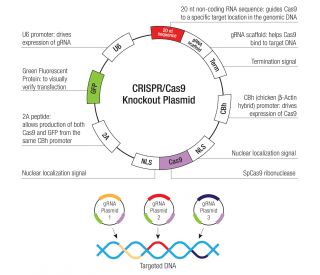
  • LSD1 CRISPR/Cas9 Knockout (KO) Plasmid (m) is a pool of plasmids, each encoding Cas9 nuclease and a target-specific 20 nt guide RNA (gRNA) designed for maximum knockout efficiency using sequences derived from the GeCKO v2 library
  • gRNA sequences direct Cas9 to induce site-specific double-strand breaks (DSBs) in the LSD1 genomic locus, resulting in gene knockout through non-homologous end joining (NHEJ)
  • LSD1 HDR Plasmid (m) (sc-430289-HDR) is recommended for co-transfection with LSD1 CRISPR/Cas9 KO Plasmid (m) to enable selection of successfully edited cells through HDR-mediated integration of a puromycin resistance cassette and RFP reporter gene
  • LSD1 HDR Plasmid (m) is a pool of plasmids, each containing a homology-directed repair (HDR) template corresponding to the gRNA target sites in the LSD1 CRISPR/Cas9 KO Plasmid (m)
  • Each HDR plasmid contains two ~800 bp homology arms flanking the puromycin resistance and RFP cassettes, designed to bind genomic DNA sequences surrounding the Cas9-induced double-strand break site and facilitate precise HDR-mediated integration
  • The puromycin resistance and RFP genes are flanked by LoxP sites, enabling removal of selection markers via Cre recombinase (Cre Vector: sc-418923) after establishing stable knockout cell lines
  • Following transfection, gene knockout efficiency can be assayed by WB, IF or IHC using antibody: LSD1 Antibody (B-9): sc-271720
    Gene Editing Promo Banner

    Ordering Information

    Product NameCatalog #UNITPriceQtyFAVORITES

    LSD1 CRISPR/Cas9 KO Plasmid (m)

    sc-430289
    20 µg
    $397.00

    LSD1 HDR Plasmid (m)

    sc-430289-HDR
    20 µg
    $445.00

    Overview

    Mouse Kdm1a encodes lysine-specific demethylase 1 (LSD1/KDM1A), a FAD-dependent histone demethylase that primarily removes H3K4me1/2 and H3K9me1/2 marks to modulate chromatin accessibility and transcriptional output. LSD1 functions within multi-protein corepressor and chromatin remodeling complexes, coupling epigenetic state to RNA polymerase II–dependent gene regulation during development, lineage commitment, and cell-cycle control. Through its roles in enhancer decommissioning, transcription factor programs, and maintenance of cellular identity, Kdm1a is frequently studied in models of aberrant differentiation and dysregulated proliferation. Altered LSD1 activity and expression patterns have been linked to epigenetic instability and oncogenic transcriptional networks, making it a key node in pathways governing stemness and tumor-associated gene expression.

    LSD1 CRISPR/Cas9 KO Plasmid (m) is a pool of plasmids designed for targeted disruption of the Kdm1a gene in mouse cell lines. Each plasmid in the pool co-expresses a unique sgRNA, targeting a distinct site within the Kdm1a locus, alongside the Streptococcus pyogenes Cas9 nuclease, and encodes GFP to enable fluorescent identification and enrichment of successfully transfected cells. This multi-guide strategy increases the likelihood of inducing frameshifts or deletions that produce a functional knockout, offering a more robust alternative to single-guide approaches. DSBs induced at multiple sites are resolved through non-homologous end joining (NHEJ) or, when used with the included HDR donor template, homology-directed repair (HDR) at a defined target site within the locus.

    When used in conjunction with the RFP-expressing HDR donor, GFP and RFP fluorescence can be used together to distinguish transfected from edited cell populations, streamlining flow cytometry-based sorting and clone selection workflows.

    Homology-Directed Repair (HDR) Donor — Puromycin Cassette with RFP Reporter

    For applications requiring confirmed, selectable knockout clones, LSD1 HDR Plasmid (m) includes an HDR donor construct containing a puromycin resistance cassette (PuroR) and a red fluorescent protein (RFP) reporter, flanked by homology arms specific to a defined Kdm1a target site.
    When co-transfected with LSD1 CRISPR/Cas9 KO Plasmid (m):

    • The PuroR-RFP cassette integrates at the Cas9 cut site via HDR, disrupting the Kdm1a open reading frame.
    • RFP fluorescence provides an immediate visual indicator of successful integration, enabling fluorescence-based identification or sorting of edited cells prior to or alongside puromycin selection.
    • Successfully edited cells are confirmed through puromycin resistance, substantially reducing clone screening burden.
    • This selection strategy is ideal for generating stable, clonal KO cell lines for downstream functional studies, drug screening, or model development.

    Cre-lox Cassette Removal System

    The HDR donor construct features loxP sites flanking the PuroR-RFP selection cassette to allow clean marker removal following clone confirmation. Transient expression of Cre recombinase via the included Cre Vector: sc-418923 excises the cassette, leaving a minimal residual loxP site within the Kdm1a locus and eliminating potential confounding effects on downstream assays.
    This two-step approach:

    • Minimizes disruption to local chromatin architecture and neighboring regulatory elements
    • Restores a near-native genomic context at the edited locus
    • Enables reuse of the puromycin selection strategy in the same cell line for additional edits

    Key Features

    • gRNA targeting Kdm1a exon(s) critical for LSD1 function
    • Co-expression of SpCas9 and sgRNA from a single plasmid for simplified delivery
    • HDR donor with puromycin resistance for positive clone selection
    • loxP-flanked PuroR cassette with Cre recombinase vector for seamless marker removal
    • Supplied ready to use for delivery by transfection

    For Research Use Only. Not Intended for Diagnostic or Therapeutic Use.
