
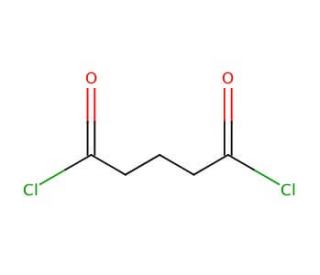

Glutaryl chloride (CAS 2873-74-7)
QUICK LINKS
Glutaryl chloride is primarily used in organic synthesis, where it acts as an acylating agent. This compound is pivotal for introducing glutaryl groups into various molecules, facilitating the production of glutaric acid derivatives. These derivatives are important for studies in polymer science and materials chemistry, where they are used to modify polymer structures and properties. In addition to its applications in synthesis, Glutaryl chloride is utilized in research focusing on reaction mechanisms involving acyl chlorides, helping to elucidate their behavior and reactivity under different chemical conditions. Moreover, Glutaryl chloride is instrumental in the development of new chemical processes that enhance the efficiency and selectivity of acylation reactions, contributing to advancements in chemical manufacturing technologies.
Glutaryl chloride (CAS 2873-74-7) References
- The structure-based design, synthesis and biological evaluation of DNA-binding bisintercalating bisanthrapyrazole anticancer compounds. | Hasinoff, BB., et al. 2008. Bioorg Med Chem. 16: 3959-68. PMID: 18258442
- Superparamagnetic bifunctional bisphosphonates nanoparticles: a potential MRI contrast agent for osteoporosis therapy and diagnostic. | Lalatonne, Y., et al. 2010. J Osteoporos. 2010: 747852. PMID: 20981332
- Diarylethene-modified nucleotides for switching optical properties in DNA. | Barrois, S. and Wagenknecht, HA. 2012. Beilstein J Org Chem. 8: 905-14. PMID: 23015841
- Effect of Linker Structure on Salicylic Acid-Derived Poly(anhydride-esters). | Prudencio, A., et al. 2005. Macromolecules. 38: 6895-6901. PMID: 23976793
- Understanding the effects of preorganization, rigidity, and steric interactions in synthetic barbiturate receptors. | McGrath, JM. and Pluth, MD. 2014. J Org Chem. 79: 711-9. PMID: 24377967
- An organic jelly made fractal logic gate with an infinite truth table. | Ghosh, S., et al. 2015. Sci Rep. 5: 11265. PMID: 26086417
- Small molecule antagonists of cell-surface heparan sulfate and heparin-protein interactions. | Weiss, RJ., et al. 2015. Chem Sci. 6: 5984-5993. PMID: 28133533
- Lipophilic Polycation Vehicles Display High Plasmid DNA Delivery to Multiple Cell Types. | Wu, Y., et al. 2017. Bioconjug Chem. 28: 2035-2040. PMID: 28731685
- Reversible Photo-Switching of Dual-Color Fluorescent Mn-Doped CdS-ZnS Quantum Dots Modulated by Diarylethene Molecules. | Yuan, Y., et al. 2019. Front Chem. 7: 145. PMID: 30949473
- Plasma-based fast-gelling biohybrid gels for biomedical applications. | Pal, A., et al. 2019. Sci Rep. 9: 10881. PMID: 31350449
- Synthesis, Properties, and Biodegradation of Sequential Poly(Ester Amide)s Containing γ-Aminobutyric Acid. | Nakayama, Y., et al. 2020. Int J Mol Sci. 21: PMID: 32456183
- Effect of N,N'-Dicyclohexyldicarboxamide Homologues on the Crystallization and Properties of Isotactic Polypropylene. | Horváth, F., et al. 2021. ACS Omega. 6: 9053-9065. PMID: 33842775
- Unprecedented Biodegradable Cellulose-Derived Polyesters with Pendant Citronellol Moieties: From Monomer Synthesis to Enzymatic Degradation. | Kayishaer, A., et al. 2021. Molecules. 26: PMID: 34946753
- The synthesis of some novel stilbene dimers incorporating diamide tethers: studies in single electron transfer oxidation (FeCl3). | Alehashem, MS., et al. 2018. RSC Adv. 8: 2506-2520. PMID: 35541461
- Synthesis and Enzymatic Degradation of Sustainable Levoglucosenone-Derived Copolyesters with Renewable Citronellol Side Chains. | Fadlallah, S., et al. 2022. Polymers (Basel). 14: PMID: 35631964
Ordering Information
| Product Name | Catalog # | UNIT | Price | Qty | FAVORITES | |
Glutaryl chloride, 25 g | sc-250057 | 25 g | $66.00 |