
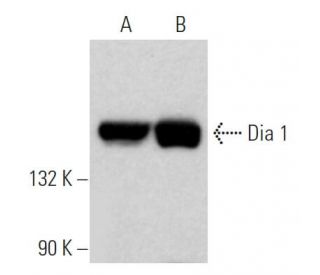
Not CRISPR data: the image illustrates antibody quality for visualizing CRISPR experiment results.
Not CRISPR data: the image illustrates antibody quality for visualizing CRISPR experiment results.
Dia 1 Double Nickase Plasmid (h): sc-401929-NIC
- Zielspezies: human
- 20 µg transfektionsfertige, aufgereinigte Plasmid DNA; geeignet für 20 Transfektionen
- Das Dia 1 Double Nickase Plasmid (h) wird als Plasmid-Paar geliefert. Die einzelnen Plasmide kodieren für eine D10A mutierte Cas9 Nuklease sowie für je eine unterschiedliche, zielspezifische 20nt guide RNA (gRNA) Sequenz. Dies erlaubt eine hohe Knockout-Effizienz bei gleichzeitig größerer Spezifität als das entsprechende CRISPR/Cas9 KO Plasmid
- gRNA Sequenzpaare liegen ca. 20 bp auseinander um ein spezifisches Cas9-vermitteltes "Double Nicking" der genomischen DNA zu erlauben und so im Resultat den Effekt eines Doppelstrangbruchs nachzuahmen.
- Ein Plasmid kodiert für ein Puromycin-Resistenzgen zur Selektion von stabilen Knockout-Zellen. Das andere Plasmid kodiert für ein GFP-Gen für den visuellen Nachweis der Transfektion
- Dia 1 Double-Nickase-Plasmid (h) und Dia 1 Double-Nickase-Plasmid (h2) kodieren unterschiedliche gepaarte gRNA-Designs, die auf DIAPH1 abzielen. Möglicherweise ist eines oder sind beide Designs verfügbar
- Nach der Transfektion kann die Effizienz des Gen-Knockouts per Western Blot oder histologisch mit folgendem Antikörper überprüft werden: Dia 1: sc-373807

Bestellinformation
| Produkt | Katalog # | EINHEIT | Preis | ANZAHL | Favoriten | |
Dia 1 Double Nickase Plasmid (h) | sc-401929-NIC | 20 µg | $410.00 | |||
Dia 1 Double Nickase Plasmid (h2) | sc-401929-NIC-2 | 20 µg | $410.00 |
DIAPH1 kodiert das Formin-Protein Dia1, einen Faktor für Aktin-Nukleation und -Elongation, der den zytoskelettalen Umbau nachgeschaltet an die RhoA-Signalübertragung koordiniert. Dia1 unterstützt den Aufbau linearer F-Aktin-Strukturen, die Bildung von Stressfasern und die Stabilisierung von Mikrotubuli und beeinflusst damit Zellpolarität, Adhäsion, Zytokinese und gerichtete Migration. Über seine Funktionen in der Zytoskelettdynamik und Mechanotransduktion trägt DIAPH1 zur Regulation von Prozessen wie Zellteilung und Gewebearchitektur bei. Eine veränderte DIAPH1-Aktivität wurde mit Krankheitsphänotypen beim Menschen in Verbindung gebracht, darunter sensorineuraler Hörverlust und Thrombozytopenie, und wird häufig in Kontexten untersucht, in denen aktinabhängige Motilität und Proliferation fehlreguliert sind.
Dia 1 Das Double-Nickase-Plasmid (h) besteht aus einem aufeinander abgestimmten Plasmidpaar, das für die hochspezifische Bearbeitung des DIAPH1-Lokus in human-Zelllinien entwickelt wurde. Jedes Plasmid exprimiert eine Cas9-D10A-Nickase und eine spezifische sgRNA, die auf entgegengesetzte DNA-Stränge innerhalb von DIAPH1 abzielt. Wenn sie auf benachbarte Stellen auf entgegengesetzten DNA-Strängen gerichtet sind, erzeugen die beiden Nickasen versetzte Einzelstrang-Schnitte, die zusammen einen versetzten Doppelstrangbruch erzeugen, was eine koordinierte On-Target-Aktivität beider Guides erfordert. Der resultierende DNA-Bruch wird durch endogene zelluläre Reparaturwege behoben, meist durch nicht-homologe Endverknüpfung (NHEJ), was zu Insertionen oder Deletionen führt, die die DIAPH1-Funktion stören. Durch die Notwendigkeit einer doppelten sgRNA-Bindung am Zielort erhöht der Doppel-Nick-Ansatz die Spezifität der Bearbeitung und bietet eine komplementäre CRISPR-Strategie für Anwendungen, bei denen eine zusätzliche Kontrolle über die Zielgenauigkeit gewünscht ist.
Um eine effiziente Identifizierung editierter Zellen zu unterstützen, kodiert ein Plasmid GFP zur fluoreszierenden Visualisierung transfizierter Populationen, während das Begleitplasmid ein Puromycin-Resistenzgen für die Antibiotika-Selektion trägt. Zusammen unterstützen diese Merkmale eine effiziente Anreicherung co-transfizierter Populationen und vereinfachen die Validierung von Klonen mit DIAPH1-Störung.
Nur für Forschungszwecke. Nicht für diagnostische oder therapeutische Zwecke bestimmt.