
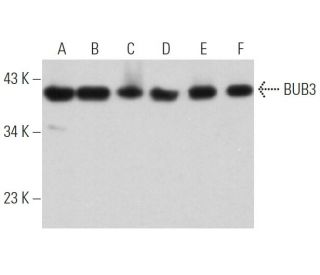
Not CRISPR data: the image illustrates antibody quality for visualizing CRISPR experiment results.
Not CRISPR data: the image illustrates antibody quality for visualizing CRISPR experiment results.
BUB3 CRISPR/Cas9 KO Plasmid (h): sc-402439
- Zielspezies: human
- 20 µg transfektionsfertige, aufgereinigte Plasmid DNA; geeignet für 20 Transfektionen
- BUB3 Das CRISPR/Cas9-Knockout (KO)-Plasmid (h) ist ein Pool von Plasmiden, von denen jedes für die Cas9-Nuklease und eine zielspezifische 20-nt-Guide-RNA (gRNA) kodiert, die für maximale Knockout-Effizienz unter Verwendung von Sequenzen aus der GeCKO v2-Bibliothek entwickelt wurde
- gRNA-Sequenzen lenken Cas9 so, dass es ortsspezifische Doppelstrangbrüche (DSBs) im BUB3-Genomlokus induziert, was zu einem Gen-Knockout durch nicht-homologe Endverknüpfung (NHEJ) führt
- BUB3 HDR-Plasmid (h) (sc-402439-HDR) wird für die Co-Transfektion mit dem BUB3 CRISPR/Cas9-KO-Plasmid (h) empfohlen, um die Selektion erfolgreich editierter Zellen durch HDR-vermittelte Integration einer Puromycin-Resistenzkassette und eines RFP-Reportergens zu ermöglichen
- Das BUB3 HDR-Plasmid (h) ist ein Pool von Plasmiden, von denen jedes eine HDR-Matrize (Homology-Directed Repair) enthält, die den gRNA-Zielstellen im BUB3 CRISPR/Cas9-KO-Plasmid (h) entspricht
- Jedes HDR-Plasmid enthält zwei ~800 bp lange Homologiearme, die die Puromycin-Resistenz- und RFP-Kassetten flankieren und so konzipiert sind, dass sie an genomische DNA-Sequenzen binden, die die durch Cas9 induzierte Doppelstrangbruchstelle umgeben, und eine präzise HDR-vermittelte Integration ermöglichen
- Die Puromycin-Resistenz- und RFP-Gene werden von LoxP-Stellen flankiert, was die Entfernung der Selektionsmarker mittels Cre-Rekombinase (Cre-Vektor: sc-418923) nach der Etablierung stabiler Knockout-Zelllinien ermöglicht
- Nach der Transfektion kann die Effizienz des Gen-Knockouts per Western Blot oder histologisch mit folgendem Antikörper überprüft werden: BUB3: sc-376506

Bestellinformation
| Produkt | Katalog # | EINHEIT | Preis | ANZAHL | Favoriten | |
BUB3 CRISPR/Cas9 KO Plasmid (h) | sc-402439 | 20 µg | $397.00 | |||
BUB3 HDR Plasmid (h) | sc-402439-HDR | 20 µg | $445.00 |
Übersicht
BUB3 kodiert ein konserviertes Protein des Spindelaufbau-Kontrollpunkts (SAC), das an BUB1 und BUBR1 (BUB1B) bindet, um die Bildung des mitotischen Checkpoint-Komplexes zu fördern und die Aktivität des APC/C zu hemmen, bis eine korrekte Anheftung der Kinetochoren an Mikrotubuli erreicht ist. Über diese SAC-Signalisierung trägt BUB3 zur Aufrechterhaltung der Chromosomen-Biorientierung und zur korrekten Segregation während der Mitose bei und begrenzt dadurch Aneuploidie und chromosomale Instabilität. Eine Störung der durch BUB3 regulierten Checkpoint-Kontrolle beeinträchtigt das mitotische Timing und kann die Genomintegrität gefährden – Prozesse, die häufig mit proliferativen Pathologien in Zusammenhang stehen. Humanes BUB3 wird daher breit in der Forschung zur Zellzyklusregulation, Kinetochor-Biologie und zu Stressantworten auf Spindelgifte untersucht.
BUB3 CRISPR/Cas9-KO-Plasmid (h) ist ein Pool von Plasmiden, die für die gezielte Disruption des BUB3-Gens in human-Zelllinien entwickelt wurden. Jedes Plasmid im Pool koexprimiert eine einzigartige sgRNA, die auf eine bestimmte Stelle innerhalb des BUB3-Lokus abzielt, zusammen mit der Streptococcus pyogenes Cas9-Nuklease, und kodiert für GFP, um die fluoreszente Identifizierung und Anreicherung erfolgreich transfizierter Zellen zu ermöglichen. Diese Multi-Guide-Strategie erhöht die Wahrscheinlichkeit, Frameshifts oder Deletionen zu induzieren, die zu einem funktionellen Knockout führen, und bietet damit eine robustere Alternative zu Single-Guide-Ansätzen. An mehreren Stellen induzierte DSBs werden durch nicht-homologe Endverknüpfung (NHEJ) oder, bei Verwendung mit der enthaltenen HDR-Donor-Matrize, durch homologe Reparatur (HDR) an einer definierten Zielstelle innerhalb des Lokus repariert.
Bei Verwendung in Verbindung mit dem RFP-exprimierenden HDR-Donor können GFP- und RFP-Fluoreszenz gemeinsam genutzt werden, um transfizierte von editierten Zellpopulationen zu unterscheiden, was die auf Durchflusszytometrie basierenden Sortier- und Klonauswahl-Workflows optimiert.
Homology-Directed Repair (HDR)-Donor — Puromycin-Kassette mit RFP-Reporter
Für Anwendungen, die bestätigte, selektierbare Knockout-Klone erfordern, enthält das BUB3 HDR-Plasmid (h) ein HDR-Donorkonstrukt mit einer Puromycin-Resistenzkassette (PuroR) und einem Reporter für rotes fluoreszierendes Protein (RFP), flankiert von Homologiearmen, die für eine definierte BUB3 Zielstelle spezifisch sind.
Bei Co-Transfektion mit dem BUB3 CRISPR/Cas9-KO-Plasmid (h):
- Die PuroR-RFP-Kassette integriert sich über HDR an der Cas9-Schnittstelle und unterbricht dabei das BUB3 offene Lesegerüst.
Die RFP-Fluoreszenz liefert einen unmittelbaren visuellen Hinweis auf eine erfolgreiche Integration und ermöglicht die fluoreszenzbasierte Identifizierung oder Sortierung editierter Zellen vor oder parallel zur Puromycin-Selektion.
Erfolgreich editierte Zellen werden durch Puromycin-Resistenz bestätigt, was den Aufwand für das Klon-Screening erheblich reduziert.
Diese Selektionsstrategie eignet sich ideal zur Erzeugung stabiler, klonaler KO-Zelllinien für nachgelagerte Funktionsstudien, Wirkstoffscreenings oder die Modellentwicklung.
Cre-lox-Kassetten-Entfernungssystem
Das HDR-Donorkonstrukt verfügt über loxP-Stellen, die die PuroR-RFP-Selektionskassette flankieren, um eine saubere Markerentfernung nach der Klonbestätigung zu ermöglichen. Die transiente Expression der Cre-Rekombinase über das enthaltene Cre-Vektor: sc-418923 schneidet die Kassette heraus, wobei eine minimale Rest-loxP-Stelle innerhalb des BUB3-Lokus verbleibt und potenzielle Störeffekte auf nachgeschaltete Assays eliminiert werden.
Dieser zweistufige Ansatz:
- Minimiert Störungen der lokalen Chromatinarchitektur und benachbarter regulatorischer Elemente
Stellt einen nahezu nativen genomischen Kontext am editierten Locus wieder her
Ermöglicht die Wiederverwendung der Puromycin-Selektionsstrategie in derselben Zelllinie für weitere Editierungen
Hauptmerkmale
- gRNA, die auf BUB3 Exon(e) abzielt, die für die BUB3 Funktion entscheidend sind
Koexpression von SpCas9 und sgRNA aus einem einzigen Plasmid für eine vereinfachte Verabreichung
HDR-Donor mit Puromycin-Resistenz für die positive Klonselektion
loxP-flankierte PuroR-Kassette mit Cre-Rekombinase-Vektor für die nahtlose Markerentfernung
Wird gebrauchsfertig für die Verabreichung durch Transfektion geliefert
Nur für Forschungszwecke. Nicht für diagnostische oder therapeutische Zwecke bestimmt.