
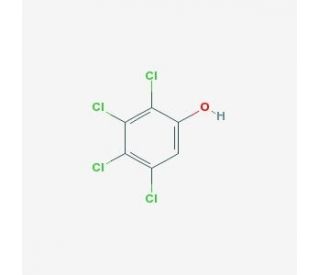

Molecular structure of 2,3,4,5-Tetrachlorophenol, CAS Number: 4901-51-3
2,3,4,5-Tetrachlorophenol (CAS 4901-51-3)
Alternate Names:
Tetrachlorophenol
CAS Number:
4901-51-3
Molecular Weight:
231.89
Molecular Formula:
C6H2Cl4O
Supplemental Information:
This is classified as a Dangerous Good for transport and may be subject to additional shipping charges.
For Research Use Only. Not Intended for Diagnostic or Therapeutic Use.
* Refer to Certificate of Analysis for lot specific data.
QUICK LINKS
Ordering Information
Description
Technical Information
Safety Information
SDS & Certificate of Analysis
2,3,4,5-Tetrachlorophenol is a chemical compound that belongs to the family of chlorophenols. It is derived from phenol by the substitution of four chlorine atoms on the aromatic ring. It is primarily used as a wood preservative and fungicide. Due to its toxic and persistent nature, it is regulated and restricted in many countries.
2,3,4,5-Tetrachlorophenol (CAS 4901-51-3) References
- Kinetic evidence for pentachlorophenol-dependent growth of a dehalogenating population in a pentachlorophenol- and acetate-fed methanogenic culture. | Stuart, SL. and Woods, SL. 1998. Biotechnol Bioeng. 57: 420-9. PMID: 10099218
- The effect of redox potential changes on reductive dechlorination of pentachlorophenol and the degradation of acetate by a mixed, methanogenic culture. | Stuart, SL., et al. 1999. Biotechnol Bioeng. 63: 69-78. PMID: 10099582
- The Ca(2+)-transport-ATPase of human erythrocytes as an in vitro toxicity test system--acute effects of some chlorinated compounds. | Janik, F. and Wolf, HU. 1992. J Appl Toxicol. 12: 351-8. PMID: 1447481
- Effects of sulfuroxy anions on degradation of pentachlorophenol by a methanogenic enrichment culture. | Madsen, T. and Aamand, J. 1991. Appl Environ Microbiol. 57: 2453-8. PMID: 16348548
- Reductive dechlorination of chlorophenols by a pentachlorophenol- acclimated methanogenic consortium. | Nicholson, DK., et al. 1992. Appl Environ Microbiol. 58: 2280-6. PMID: 1637165
- Sorption behaviour of some chlorophenols in lake aquatic humic matter. | Peuravuori, J., et al. 2002. Talanta. 56: 523-38. PMID: 18968525
- Infrared study of chlorophenols and products of their photodegradation. | Czaplicka, M. and Kaczmarczyk, B. 2006. Talanta. 70: 940-9. PMID: 18970864
- Metabolic studies on pentachlorophenol (PCP) in rats. | Renner, G. and Hopfer, C. 1990. Xenobiotica. 20: 573-82. PMID: 2219952
- Vibrational spectral analysis, computation of thermodynamic functions for various temperatures and NBO analysis of 2,3,4,5-tetrachlorophenol using ab initio HF and DFT calculations. | Balachandran, V., et al. 2013. Spectrochim Acta A Mol Biomol Spectrosc. 101: 356-69. PMID: 23123243
- The effects of different types of crop straw on the transformation of pentachlorophenol in flooded paddy soil. | Lin, J., et al. 2018. Environ Pollut. 233: 745-754. PMID: 29127932
- The cell-impermeable Ru(II) polypyridyl complex as a potent intracellular photosensitizer under visible light irradiation via ion-pairing with suitable lipophilic counter-anions. | Yan, ZY., et al. 2021. Free Radic Biol Med. 171: 69-79. PMID: 33957221
- Metabolites of 1,2,3,4-tetrachlorobenzene in monkey urine. | Schwartz, H., et al. 1985. J Toxicol Environ Health. 15: 603-7. PMID: 4046067
- Metabolism of tetrachlorophenols in the rat. | Ahlborg, UG. and Larsson, K. 1978. Arch Toxicol. 40: 63-74. PMID: 580377
- Activation of liver microsomes by 2,3,4,5-tetrachlorophenol. | Süssmuth, R., et al. 1980. Mutat Res. 77: 279-82. PMID: 6991923
- Comparison of the urinary metabolite profiles of hexachlorobenzene and pentachlorobenzene in the rat. | den Besten, C., et al. 1994. Chem Biol Interact. 90: 121-37. PMID: 8156603
Ordering Information
| Product Name | Catalog # | UNIT | Price | Qty | FAVORITES | |
2,3,4,5-Tetrachlorophenol, 100 mg | sc-256293 | 100 mg | $155.00 |