
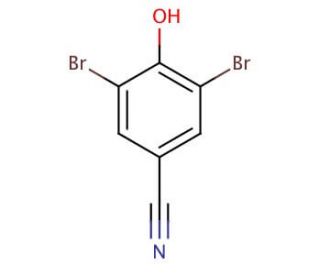

Bromoxynil (CAS 1689-84-5)
QUICK LINKS
Bromoxynil functions as a selective herbicide. Its mechanism of action involves inhibiting photosynthesis in plants by disrupting electron transport in photosystem II. This disruption ultimately leads to the accumulation of toxic free radicals within the plant cells, causing oxidative damage and cell death. Bromoxynil targets broadleaf weeds, making it effective for weed control in various agricultural and horticultural applications. Its mechanism of action at the molecular level involves binding to the D1 protein in photosystem II, preventing the transfer of electrons and disrupting the normal flow of energy during photosynthesis. This interference ultimately leads to the cessation of plant growth and the eventual death of the targeted weeds.
Bromoxynil (CAS 1689-84-5) References
- Exposure of ground-rig applicators to the herbicide bromoxynil applied as a 1:1 mixture of butyrate and octanoate. | Cessna, AJ. and Grover, R. 2002. Arch Environ Contam Toxicol. 42: 369-82. PMID: 11910467
- Degradation of ioxynil and bromoxynil as measured by a modified spectrophotometric method. | Hsu, JC. and Camper, ND. 1975. Can J Microbiol. 21: 2008-12. PMID: 1220864
- Factors associated with detection of bromoxynil in a sample of rural residents. | Semchuk, KM., et al. 2003. J Toxicol Environ Health A. 66: 103-32. PMID: 12653018
- Body mass index and bromoxynil exposure in a sample of rural residents during spring herbicide application. | Semchuk, K., et al. 2004. J Toxicol Environ Health A. 67: 1321-52. PMID: 15371235
- Antinuclear antibodies and bromoxynil exposure in a rural sample. | Semchuk, KM., et al. 2007. J Toxicol Environ Health A. 70: 638-57. PMID: 17365618
- Developmental toxicity of bromoxynil in mice and rats. | Rogers, JM., et al. 1991. Fundam Appl Toxicol. 17: 442-7. PMID: 1794648
- The degradation of the herbicide bromoxynil and its impact on bacterial diversity in a top soil. | Baxter, J. and Cummings, SP. 2008. J Appl Microbiol. 104: 1605-16. PMID: 18217937
- Bromoxynil residues and dissipation rates in maize crops and soil. | Chen, XX., et al. 2011. Ecotoxicol Environ Saf. 74: 1659-63. PMID: 21680020
- Synthesis and evaluation of heterocyclic analogues of bromoxynil. | Cutulle, MA., et al. 2014. J Agric Food Chem. 62: 329-36. PMID: 24354444
- 2-Methyl-4-chlorophenoxyacetic acid and bromoxynil herbicide death. | Berling, I., et al. 2015. Clin Toxicol (Phila). 53: 486-8. PMID: 25849311
- 2-Methyl-4-chlorophenoxyacetic acid (MCPA) and bromoxynil herbicide ingestion. | Chiew, AL., et al. 2018. Clin Toxicol (Phila). 56: 377-380. PMID: 28988498
- Bromoxynil and 2-methyl-4-chlorophenoxyacetic acid (MCPA) poisoning could be a bad combination. | Chan, BSH., et al. 2018. Clin Toxicol (Phila). 56: 861-863. PMID: 29382245
- Unraveling microbial turnover and non-extractable residues of bromoxynil in soil microcosms with 13C-isotope probing. | Nowak, KM., et al. 2018. Environ Pollut. 242: 769-777. PMID: 30031310
- Enzymic degradation of bromoxynil by cell-free extracts of Streptomyces felleus. | Neuzil, J., et al. 1988. Folia Microbiol (Praha). 33: 349-54. PMID: 3203927
- Zebrafish Oatp1d1 Acts as a Cellular Efflux Transporter of the Anionic Herbicide Bromoxynil. | Halbach, K., et al. 2022. Chem Res Toxicol. 35: 315-325. PMID: 34990119
Ordering Information
| Product Name | Catalog # | UNIT | Price | Qty | FAVORITES | |
Bromoxynil, 250 mg | sc-252523 | 250 mg | $28.00 |