
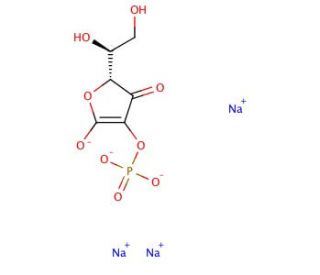

2-Phospho-L-ascorbic acid trisodium salt (CAS 66170-10-3)
QUICK LINKS
2-Phospho-L-ascorbic acid trisodium salt is a compound that functions as a reducing agent in various experimental applications. Its mechanism of action involves donating electrons to other molecules, thereby reducing them and undergoing oxidation itself. 2-Phospho-L-Ascorbic Acid Trisodium Salt is capable of scavenging free radicals and reactive oxygen species, thereby protecting sensitive compounds from oxidative damage. 2-Phospho-L-ascorbic acid trisodium salt can act as a cofactor for enzymes involved in collagen synthesis and other important cellular processes. Its ability to donate electrons also may be useful in the regeneration of other antioxidants, such as vitamin E, further contributing to its role in maintaining cellular redox balance. In experimental applications, 2-Phospho-L-ascorbic acid trisodium salt is used to study the effects of oxidative stress on biological systems and to investigate the mechanisms of antioxidant protection at the molecular and cellular levels.
2-Phospho-L-ascorbic acid trisodium salt (CAS 66170-10-3) References
- Transdermal delivery of three vitamin C derivatives by Er:YAG and carbon dioxide laser pretreatment. | Huang, CH., et al. 2013. Lasers Med Sci. 28: 807-14. PMID: 22825318
- A chronoamperometric screen printed carbon biosensor based on alkaline phosphatase inhibition for W(IV) determination in water, using 2-phospho-L-ascorbic acid trisodium salt as a substrate. | Alvarado-Gámez, AL., et al. 2015. Sensors (Basel). 15: 2232-43. PMID: 25621602
- Are We Economically Efficient Enough to Increase the Potential of in Vitro Proliferation of Osteoblasts by Means of Pharmacochemical Agents? | Isyar, M., et al. 2016. Open Orthop J. 10: 420-430. PMID: 27708738
- An enzyme-induced Au@Ag core-shell nanoStructure used for an ultrasensitive surface-enhanced Raman scattering immunoassay of cancer biomarkers. | Yang, L., et al. 2017. Nanoscale. 9: 2640-2645. PMID: 28155925
- Fluorescence turn-on detection of alkaline phosphatase activity based on controlled release of PEI-capped Cu nanoclusters from MnO2 nanosheets. | Zhang, Y., et al. 2017. Anal Bioanal Chem. 409: 4771-4778. PMID: 28616667
- A new photoelectrochemical biosensor for ultrasensitive determination of nucleic acids based on a three-stage cascade signal amplification strategy. | Xiong, E., et al. 2018. Analyst. 143: 2799-2806. PMID: 29862398
- Seed-Mediated Growth of Au Nanospheres into Hexagonal Stars and the Emergence of a Hexagonal Close-Packed Phase. | Huo, D., et al. 2019. Nano Lett. 19: 3115-3121. PMID: 30924662
- Single-Particle Enzyme Activity Assay with Spectral-Resolved Dark-Field Optical Microscopy. | Wang, F., et al. 2019. Anal Chem. 91: 6329-6339. PMID: 30978003
- Point-of-Care Assay of Alkaline Phosphatase Enzymatic Activity Using a Thermometer or Temperature Discoloration Sticker as Readout. | Liu, X., et al. 2019. Anal Chem. 91: 7943-7949. PMID: 31117415
- Enzyme Activity Triggered Blocking of Plasmon Resonance Energy Transfer for Highly Selective Detection of Acid Phosphatase. | Yan, X., et al. 2020. Anal Chem. 92: 2130-2135. PMID: 31850751
- DNA Nanofirecrackers Assembled through Hybridization Chain Reaction for Ultrasensitive SERS Immunoassay of Prostate Specific Antigen. | Wang, JR., et al. 2020. Anal Chem. 92: 4046-4052. PMID: 32048509
- Positive feedback between retinoic acid and 2-phospho-L-ascorbic acid trisodium salt during somatic cell reprogramming. | Zhang, M., et al. 2020. Cell Regen. 9: 17. PMID: 33000315
- Colorimetric determination of acid phosphatase activity and inhibitor screening based on in situ polymerization of aniline catalyzed by gold nanoparticles. | Liu, H., et al. 2021. Mikrochim Acta. 188: 155. PMID: 33822286
- A fluorescent and colorimetric dual-channel sensor based on acid phosphatase-triggered blocking of internal filtration effect. | Ran, F., et al. 2021. Mikrochim Acta. 188: 282. PMID: 34341880
- Hydrolysis and drug release from poly(ethylene glycol)-modified lactone polymers with open porosity | Sanja Asikainen a, Kaarlo Paakinaho b c, Anna-Kaisa Kyhkynen d, Markus Hannula e, Minna Malin a, Niina Ahola d, Minna Kellomäki d f, Jukka Seppälä a. 2019. European Polymer Journal. 113: 165-175.
Ordering Information
| Product Name | Catalog # | UNIT | Price | Qty | FAVORITES | |
2-Phospho-L-ascorbic acid trisodium salt, 10 g | sc-230644 | 10 g | $161.00 | |||
2-Phospho-L-ascorbic acid trisodium salt, 25 g | sc-230644A | 25 g | $344.00 |