
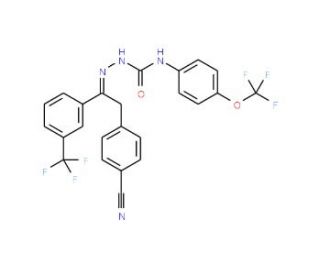

Metaflumizone (CAS 139968-49-3)
QUICK LINKS
Metaflumizone is a chemical compound that functions as a potent insecticide. Its mechanism of action involves targeting the nervous system of insects by binding to specific sites on the voltage-gated sodium channels. This binding disrupts the normal functioning of the channels, leading to prolonged and irreversible paralysis in the targeted insects. As a result, Metaflumizone effectively controls a wide range of insect pests, including lepidopteran, dipteran, and coleopteran species. Its mechanism of action at the molecular level involves blocking the sodium channels, preventing the influx of sodium ions and disrupting the generation and propagation of action potentials in the insect nervous system. This ultimately leads to the cessation of feeding and movement in the targeted pests, contributing to its efficacy as an insecticide in various experimental applications.
Metaflumizone (CAS 139968-49-3) References
- Determination of metaflumizone residues in cabbage and soil using ultra-performance liquid chromatography/ESI-MS/MS. | Dong, F., et al. 2009. J Sep Sci. 32: 3692-7. PMID: 19813227
- Baseline toxicity and field efficacy of metaflumizone on Colorado potato beetle (Coleoptera: Chrysomelidae). | Hitchner, EM., et al. 2012. J Econ Entomol. 105: 207-13. PMID: 22420273
- Degradation of metaflumizone in rice, water and soil under field conditions. | Li, C., et al. 2012. Ecotoxicol Environ Saf. 86: 73-8. PMID: 23079740
- Persistence of metaflumizone on cabbage (Brassica oleracea Linne) and soil, and its risk assessment. | Chatterjee, NS. and Gupta, S. 2013. Environ Monit Assess. 185: 6201-8. PMID: 23224645
- Baseline toxicity of metaflumizone and lack of cross resistance between indoxacarb and metaflumizone in diamondback moth (Lepidoptera: Plutellidae). | Khakame, SK., et al. 2013. J Econ Entomol. 106: 1423-9. PMID: 23865210
- Biochemical mechanisms for metaflumizone resistance in beet armyworm, Spodoptera exigua. | Tian, X., et al. 2014. Pestic Biochem Physiol. 113: 8-14. PMID: 25052521
- Fitness and inheritance of metaflumizone resistance in Plutella xylostella. | Shen, J., et al. 2017. Pestic Biochem Physiol. 139: 53-59. PMID: 28595922
- Metaflumizone inhibits the honeybee NaV 1 channel by targeting recovery from slow inactivation. | Gosselin-Badaroudine, P., et al. 2017. FEBS Lett. 591: 3842-3849. PMID: 29105054
- Resistance Risk Evaluated by Metaflumizone Selection and the Effects on Toxicities Over Other Insecticides in Spodoptera exigua (Lepidoptera: Noctuidae). | Sun, XX., et al. 2019. J Econ Entomol. 112: 2354-2361. PMID: 31219572
- Biochemical Mechanisms, Cross-resistance and Stability of Resistance to Metaflumizone in Plutella xylostella. | Shen, J., et al. 2020. Insects. 11: PMID: 32429053
- Method validation and residue analysis of methoxyfenozide and metaflumizone in Chinese broccoli under field conditions by liquid chromatography with tandem mass spectrometry. | Bi, Y., et al. 2021. J Sep Sci. 44: 3860-3869. PMID: 34384003
- Control efficacy and joint toxicity of metaflumizone mixed with chlorantraniliprole or indoxacarb against the fall armyworm, Spodoptera frugiperda. | Wu, YJ., et al. 2023. Pest Manag Sci. 79: 1094-1101. PMID: 36334007
- Dissipation pattern and safety assessment of fenazaquin and metaflumizone in butterbur (Petasites japonicus). | Sardar, SW., et al. 2023. J Environ Sci Health B. 58: 357-366. PMID: 37032589
Ordering Information
| Product Name | Catalog # | UNIT | Price | Qty | FAVORITES | |
Metaflumizone, 100 mg | sc-228461 | 100 mg | $194.00 |