

Periodic acid (CAS 10450-60-9)
See product citations (2)
QUICK LINKS
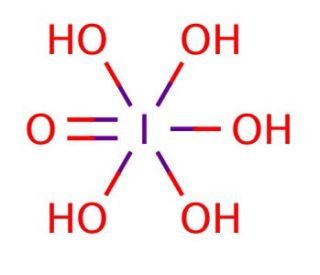
Periodic acid, with the CAS number 10450-60-9, is an inorganic compound notable for its strong oxidizing properties, typically existing in the form of colorless crystals. Chemically expressed as HIO4 or H5IO6 for its hydrated form, periodic acid is widely utilized in research primarily due to its ability to cleave vicinal diols into aldehydes or ketones. This reaction mechanism involves the oxidative cleavage of C-C bonds in 1,2-diols, a process that is invaluable in structural analysis of carbohydrates, facilitating the determination of their ring structures and linkage positions. The utility of periodic acid extends beyond simple structural elucidation; it is also employed in the synthesis of complex organic molecules where selective oxidation can be critical. In research environments, periodic acid is used to modify saccharides by oxidizing exposed diol groups, which can then be further manipulated or probed for various biochemical studies. Additionally, its application is crucial in the periodic acid-Schiff (PAS) stain, a technique used in histology to detect polysaccharides such as glycogen in tissues. The action of periodic acid in these contexts underscores its role as a versatile reagent that aids significantly in both analytical and synthetic chemistry disciplines, providing insights into molecular structure and composition.
Periodic acid (CAS 10450-60-9) References
- Chromium(VI) oxide catalyzed oxidation of sulfides to sulfones with periodic acid. | Xu, L., et al. 2003. J Org Chem. 68: 5388-91. PMID: 12816505
- Neuroendocrine differentiation of periodic-acid Schiff and Alcian blue-negative signet-ring cell-like cells and tubular adenocarcinoma cells within a gastric cancer. | Sugihara, A., et al. 2004. Scand J Gastroenterol. 39: 795-800. PMID: 15513370
- Bis(trimethylsilyl)chromate catalyzed oxidations of alcohols to aldehydes and ketones with periodic acid. | Asadolah, K., et al. 2007. Molecules. 12: 958-64. PMID: 17873831
- Demonstration of epithelial-mesenchymal transition in kidney. The contribution of a coupled histochemical and immunohistochemical staining with Periodic Acid-thionin Schiff. | Santos, MC., et al. 2008. Appl Immunohistochem Mol Morphol. 16: 191-5. PMID: 18227721
- Histological and histochemical uses of periodic acid. | McMANUS, JF. 1948. Stain Technol. 23: 99-108. PMID: 18867618
- STUDIES ON THE FLEXNER GROUP OF DYSENTERY BACILLI : VI. THE DETOXIFICATION OF SHIGELLA PARADYSENTERIAE BY MEANS OF PERIODIC ACID. | Goebel, WF. 1947. J Exp Med. 85: 499-514. PMID: 19871632
- The action of periodic acid on glucose phenylosazone. | CHARGAFF, E. and MAGASANIK, B. 1947. J Am Chem Soc. 69: 1459-61. PMID: 20249732
- On oxidative decarboxylations with periodic acid. | SPRINSON, DB. and CHARGAFF, E. 1946. J Biol Chem. 164: 433-49. PMID: 20989503
- Functionalization of pectin by periodate oxidation. | Gupta, B., et al. 2013. Carbohydr Polym. 98: 1160-5. PMID: 23987458
- The fate of rat palatal shelves cultivated in vitro in the presence of periodic acid. | Pourtois, M. 1971. Arch Oral Biol. 16: 503-8. PMID: 4103315
Ordering Information
| Product Name | Catalog # | UNIT | Price | Qty | FAVORITES | |
Periodic acid, 25 g | sc-215695 | 25 g | $86.00 | |||
Periodic acid, 100 g | sc-215695A | 100 g | $222.00 | |||
Periodic acid, 2.5 kg | sc-215695B | 2.5 kg | $1785.00 |