
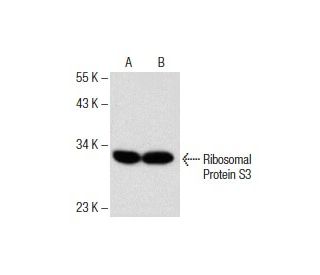
Not CRISPR data: the image illustrates antibody quality for visualizing CRISPR experiment results.
Not CRISPR data: the image illustrates antibody quality for visualizing CRISPR experiment results.
Ribosomal Protein S3 Plasmídeo duplo de Nickase (h): sc-402327-NIC
- alvos específicos: human
- 20 µg de plasmídeo de DNA pronto para transfecção; Suficiente para até 20 transfecções
- Ribosomal Protein S3O plasmídeo de dupla Nickase (h) consiste num par de plasmídeos cada um contem D10A com mutação na nuclease Cas9 nuclease e um alvo especifico de RNA guia com 20 na (gRNA), criado para nocautear a expressão genética com maior especificidade do que o seu correspondente CRISPR/Cas9 KO
- Sequencias pareadas de gRNA são de aproximadamente 20 bp para permitir que os cortes duplos no DNA genômico mediados pela Casp ocorram com especificidade , o que se assemelha ao corte pela DSB
- Cada plasmídeo pertencente ao par de plasmídeos contem um gene de resistência a puromicina para seleção; o outro plasmídeo do par contem um marcador de GFP para a visualização e confirmação da transfecção
- O Plasmídeo Double Nickase Ribosomal Protein S3 (h) e o Plasmídeo Double Nickase Ribosomal Protein S3 (h2) codificam designs distintos de pares de gRNA direcionados para RPS3. Um ou ambos os desenhos podem estar disponíveis
- Após a transfecção, a eficácia do processo de nocaute genético por ser testada WB, IF ou IHC usando o anticorpo:Ribosomal Protein S3 Anticorpo (C-7): sc-376008

Informacoes sobre ordens
| Nome do Produto | Numero de Catalogo | UNID | Preco | Qde | FAVORITOS | |
Ribosomal Protein S3 Plasmídeo duplo de Nickase (h) | sc-402327-NIC | 20 µg | $410.00 | |||
Ribosomal Protein S3 Plasmídeo duplo de Nickase (h2) | sc-402327-NIC-2 | 20 µg | $410.00 |
RPS3 codifica a Proteína Ribossômica S3 humana, um componente central da subunidade ribossômica pequena 40S, necessária para a iniciação precisa da tradução e a decodificação do mRNA. Além de seu papel estrutural na biogênese do ribossomo, a RPS3 tem sido associada a respostas ao estresse celular e à regulação de vias de sinalização que coordenam a síntese proteica com o crescimento e a vigilância de danos ao DNA. Alterações na homeostase de proteínas ribossômicas podem perturbar o controle traducional e a proteostase, processos frequentemente implicados na biologia tumoral e em outros distúrbios caracterizados por proliferação celular desregulada. Como resultado, a RPS3 é amplamente estudada no contexto da função ribossômica, de programas transcricionais adaptativos ao estresse e de mecanismos que conectam a tradução à integridade do genoma.
Ribosomal Protein S3 O Plasmídeo de Nickase Dupla (h) consiste num par de plasmídeos combinados, concebidos para a edição de alta especificidade do locus RPS3 em linhas celulares human. Cada plasmídeo expressa uma nickase Cas9 D10A e um sgRNA distinto que tem como alvo cadeias de ADN opostas dentro de RPS3. Quando direcionadas para locais adjacentes em cadeias de ADN opostas, as duas nickases geram cortes deslocados numa única cadeia que, em conjunto, produzem uma quebra escalonada de cadeia dupla, exigindo uma atividade coordenada no alvo por parte de ambas as guias. A quebra de ADN resultante é resolvida por vias de reparação celular endógenas, mais frequentemente através da junção de extremidades não homólogas (NHEJ), levando a inserções ou deleções que perturbam a função RPS3. Ao exigir o envolvimento de dois sgRNA no locus alvo, a abordagem de dupla nickase aumenta a especificidade da edição e fornece uma estratégia CRISPR complementar para aplicações em que se deseja um controlo adicional sobre a precisão do direcionamento.
Para apoiar a identificação eficiente das células editadas, um plasmídeo codifica GFP para visualização fluorescente das populações transfectadas, enquanto o plasmídeo complementar transporta um gene de resistência à puromicina para seleção antibiótica. Em conjunto, estas características apoiam o enriquecimento eficiente das populações co-transfectadas e simplificam a validação dos clones com RPS3 interrompido.
Apenas para uso em investigação. Não se destina a uso diagnóstico ou terapêutico.