
Date published: 2026-5-26

1-800-457-3801

SCBT Portrait Logo
Seach Input

PYGB/M Antibody (10H5): sc-51922

4.0(1)
Write a reviewAsk a question

Datasheets
  • PYGB/M Antibody (10H5) is a mouse monoclonal IgG2a provided at 100 µg/ml
  • raised against human brain glycogen phosphorylase
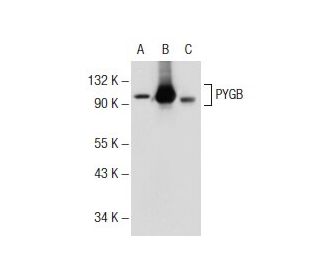
  • recommended for detection of PYGB and PYGM of human origin by WB and IP
  • At present, we have not yet completed the identification of the preferred secondary detection reagent(s) for PYGB/M Antibody (10H5). This work is in progress.
    Gene Editing Promo Banner

    QUICK LINKS

    SEE ALSO...

    PYGB/M Antibody (10H5) is a mouse monoclonal IgG2a antibody that detects PYGB/M of human origin by western blotting (WB) and immunoprecipitation (IP). Anti-PYGB/M antibody (10H5) specifically targets glycogen phosphorylase, an allosteric enzyme that plays a crucial role in carbohydrate metabolism by catalyzing the breakdown of glycogen into glucose-1-phosphate, which is then utilized for energy production. The regulation of glycogen phosphorylase is vital, as activity can be modulated through noncovalent binding of metabolites or through covalent modifications, such as phosphorylation. This regulation is particularly important in maintaining glucose homeostasis, especially during periods of fasting or intense physical activity. The enzyme exists in three isoforms, encoded by the genes PYGB, PYGL, and PYGM, which are expressed in the brain, liver, and muscle, respectively. Given its essential function in glycogen metabolism, glycogen phosphorylase has emerged as a significant target for the development of therapeutic agents aimed at treating conditions like type 2 diabetes mellitus, where impaired glucose regulation is a key concern.

    For Research Use Only. Not Intended for Diagnostic or Therapeutic Use.

    Alexa Fluor® is a trademark of Molecular Probes Inc., OR., USA

    LI-COR® and Odyssey® are registered trademarks of LI-COR Biosciences

    PYGB/M Antibody (10H5) References:

    1. PYGB siRNA inhibits the cell proliferation of human osteosarcoma cell lines.  |  Zhang, S., et al. 2018. Mol Med Rep. 18: 715-722. PMID: 29845265
    2. Bioinformatics-based discovery of PYGM and TNNC2 as potential biomarkers of head and neck squamous cell carcinoma.  |  Jin, Y. and Yang, Y. 2019. Biosci Rep. 39: PMID: 31324732
    3. PYGB facilitates cell proliferation and invasiveness in non-small cell lung cancer by activating the Wnt-β-catenin signaling pathway.  |  Xiao, L., et al. 2020. Biochem Cell Biol. 98: 565-574. PMID: 32191839
    4. TCR activation directly stimulates PYGB-dependent glycogenolysis to fuel the early recall response in CD8+ memory T cells.  |  Zhang, H., et al. 2022. Mol Cell. 82: 3077-3088.e6. PMID: 35738262
    5. A Novel 5-Chloro-N-phenyl-1H-indole-2-carboxamide Derivative as Brain-Type Glycogen Phosphorylase Inhibitor: Validation of Target PYGB.  |  Huang, Y., et al. 2023. Molecules. 28: PMID: 36838691
    6. METTL3-mediated m6A methylation of PYGB facilitates pancreatic ductal adenocarcinoma progression through the activation of NF-κB signaling.  |  Wang, G., et al. 2023. Pathol Res Pract. 248: 154645. PMID: 37422970
    7. Long-term potentiation-based screening identifies neuronal PYGM as a synaptic plasticity regulator participating in Alzheimer's disease.  |  Wang, T., et al. 2023. Zool Res. 44: 867-881. PMID: 37537141
    8. Brain-Type Glycogen Phosphorylase (PYGB) in the Pathologies of Diseases: A Systematic Review.  |  Yang, C., et al. 2024. Cells. 13: PMID: 38334681
    9. Hypoxia Stimulates PYGB Enzymatic Activity to Promote Glycogen Metabolism and Cholangiocarcinoma Progression.  |  Pan, Y., et al. 2024. Cancer Res. 84: 3803-3817. PMID: 39163511
    10. Liquid-liquid phase separation-related features of PYGB/ACTR3/CCNA2/ITGB1/ATP8A1/RAP1GAP2 predict the prognosis of pancreatic cancer.  |  Li, X., et al. 2024. J Gastrointest Oncol. 15: 1723-1745. PMID: 39279964

    Ordering Information

    Product NameCatalog #UNITPriceQtyFAVORITES

    PYGB/M Antibody (10H5)

    sc-51922
    100 µg/ml
    $322.00
