
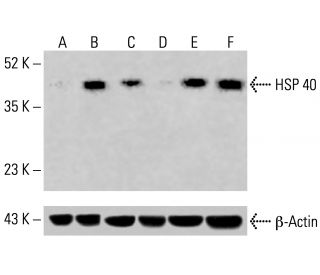
Datos CRISPR no: la imagen ilustra la calidad de los anticuerpos para visualizar los resultados de los experimentos CRISPR.
Datos CRISPR no: la imagen ilustra la calidad de los anticuerpos para visualizar los resultados de los experimentos CRISPR.
HSP 40 Plásmido CRISPR/Cas9 KO (h): sc-402810
- Especies Diana: human
- 20 µg de plásmido de ADN purificado listo para la trasfección; suficiente para 20 transfecciones máximo
- HSP 40 El plásmido CRISPR/Cas9 Knockout (KO) (h) es un conjunto de plásmidos, cada uno de los cuales codifica la nucleasa Cas9 y un ARN guía (gRNA) de 20 nt específico para el objetivo, diseñado para lograr la máxima eficiencia de knockout utilizando secuencias derivadas de la biblioteca GeCKO v2
- Las secuencias de gRNA dirigen a Cas9 para que induzca roturas de doble cadena (DSB) específicas en el locus genómico HSP 40, lo que da lugar a la inactivación del gen mediante unión de extremos no homólogos (NHEJ)
- Los genes de resistencia a la puromicina y RFP están flanqueados por sitios LoxP, lo que permite la eliminación de los marcadores de selección mediante la recombinasa Cre (Vector Cre: sc-418923) tras el establecimiento de líneas celulares knockout estables
- Tras la transfección, la eficacia del knockout puede comprobarse mediante WB, IF ó IHC utilzando el anticuerpo: HSP 40 Anticuerpo (B-3): sc-398766

Información sobre pedidos
| Nombre del producto | Número de catálogo | UNIDAD | Precio | CANTIDAD | Favoritos | |
HSP 40 Plásmido CRISPR/Cas9 KO (h) | sc-402810 | 20 µg | $397.00 |
Descripción general
DNAJB1 codifica la cocaperona humana HSP40 (homólogo de DnaJ, subfamilia B, miembro 1), un regulador clave de la proteostasis que estimula la actividad ATPasa de HSP70 para favorecer el plegamiento, el replegamiento y la selección/clasificación de proteínas cliente mal plegadas. Mediante su interacción con HSP70 dependiente del dominio J, HSP40 sostiene el control de calidad proteica citosólico, las respuestas al estrés y la coordinación de la degradación asistida por chaperonas a través del proteasoma y de vías vinculadas a la autofagia. La función de DNAJB1 es relevante para la resiliencia celular durante el choque térmico y otros estreses proteotóxicos, y las redes de chaperonas alteradas se implican con frecuencia en trastornos de agregación proteica y en la adaptación al estrés oncogénico. Un evento recurrente asociado a enfermedad que involucra a DNAJB1 es la fusión DNAJB1–PRKACA observada en el carcinoma fibrolamelar, lo que pone de relieve el valor de modelos centrados en DNAJB1 para estudiar la biología de las chaperonas en contextos genéticos definidos.
El plásmido CRISPR/Cas9 KO HSP 40 (h) es un conjunto de plásmidos diseñado para la interrupción dirigida del gen DNAJB1 en líneas celulares human. Cada plásmido coexpresa un ARN guía único (sgRNA) dirigido a un sitio distinto dentro del DNAJB1 junto con la nucleasa Cas9 de Streptococcus pyogenes. Los plásmidos también codifican GFP, lo que permite la identificación fluorescente y el enriquecimiento de las células transfectadas con éxito mediante microscopía de fluorescencia o citometría de flujo.
El diseño multiguía aumenta la probabilidad de generar inserciones o deleciones (indeles) que interrumpan el marco de lectura abierto de DNAJB1 tras la formación de roturas de doble cadena mediadas por Cas9. Las roturas de ADN introducidas por el sistema CRISPR/Cas9 se reparan a través de vías endógenas de unión de extremos no homólogos (NHEJ), lo que con frecuencia da lugar a mutaciones de desplazamiento del marco de lectura que anulan la expresión de la proteína HSP 40.
Este sistema de knockout CRISPR permite la generación eficiente de modelos celulares deficientes en DNAJB1 para la investigación de la señalización de HSP 40, estudios de genómica funcional, investigación en biología del cáncer y evaluación de respuestas terapéuticas en líneas celulares humanas.
Características principales
- sgRNA dirigidos a los exones de DNAJB1 críticos para la función de HSP 40
Coexpresión de SpCas9 y sgRNA a partir de un único plásmido para simplificar la administración
Reportero GFP para la identificación de células transfectadas
Conjunto de plásmidos dirigidos a múltiples sitios genómicos de DNAJB1 para mejorar la eficiencia del knockout
Compatible con la administración mediante transfección
Variantes de diseño
CRISPRs +/- HDRs
- Los gRNA codificados por el plásmido HSP 40 CRISPR/Cas9 KO (h) y el plásmido HSP 40 CRISPR/Cas9 KO (h2) se dirigen a sitios distintos dentro del locus DNAJB1. Puede estar disponible uno o ambos diseños de orientación. Consulte «Productos relacionados» para conocer la disponibilidad.
Las construcciones donantes HDR codificadas por el plásmido HDR HSP 40 (h) y el plásmido HDR HSP 40 (h2) contienen un casete de resistencia a la puromicina y un reportero RFP flanqueado por brazos de homología DNAJB1 para facilitar la reparación dirigida por homología en sitios diana DNAJB1 definidos que se corresponden con los diseños de KO de CRISPR/Cas9. La disponibilidad de los donantes HDR puede variar. Consulte «Productos relacionados» para conocer la disponibilidad.
Sólo para uso en investigación. No destinado a uso diagnóstico o terapéutico.