
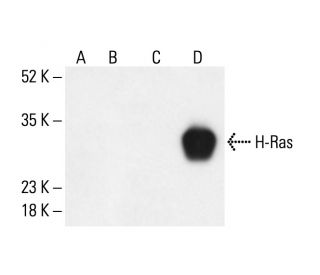
H-Ras Antibody (F235): sc-29
- H-Ras Antibody (F235) is a mouse monoclonal IgG1, cited in 180 publications, provided at 50 µg/0.5 ml
- raised against a recombinant protein
- recommended for detection of H-Ras p21 of mouse, rat and human origin by WB, IP, IF and IHC(P)
- See H-Ras (259): sc-35 for H-Ras antibody conjugates, including AC, HRP, FITC, PE, Alexa Fluor® 488, 594, 647, 680 and 790.
- m-IgG Fc BP-HRP and m-IgG1 BP-HRP are the preferred secondary detection reagents for H-Ras Antibody (F235) for WB and IHC(P) applications. These reagents are now offered in bundles with H-Ras Antibody (F235) (see ordering information below).

H-Ras Antibody (F235) is a mouse monoclonal IgG1 antibody raised against a recombinant protein, specifically designed to detect H-Ras p21 of mouse, rat, and human origin by western blotting (WB), immunoprecipitation (IP), immunofluorescence (IF), and immunohistochemistry with paraffin-embedded sections (IHCP). The H-Ras protein, also known as Harvey rat sarcoma viral oncogene homolog, is a member of the Ras gene family, which includes K-Ras and N-Ras. These small GTPase proteins are pivotal in regulating cell growth, differentiation, and signal transduction by cycling between inactive GDP-bound and active GTP-bound states. The structure of H-Ras is critical, comprising a conserved G-domain responsible for GTP/GDP binding and intrinsic GTPase activity, along with hypervariable regions that undergo post-translational modifications for membrane localization. Mutations in the G-domain can impair GTP hydrolysis, leading to constitutive activation of H-Ras, which results in uncontrolled cell proliferation and oncogenesis. The importance of understanding H-Ras structure lies in its role in oncogenic transformation, as aberrant activation can deregulate processes controlling both cell proliferation and apoptosis, making H-Ras a significant focus in cancer research. H-Ras (F235) monoclonal antibody is available in a non-conjugated form and serves as an essential tool for researchers investigating Ras-mediated signaling pathways and the molecular mechanisms underlying various cancers.
Alexa Fluor® is a trademark of Molecular Probes Inc., OR., USA
LI-COR® and Odyssey® are registered trademarks of LI-COR Biosciences
H-Ras Antibody (F235) References:
- The dark side of Ras: regulation of apoptosis. | Cox, AD. and Der, CJ. 2003. Oncogene. 22: 8999-9006. PMID: 14663478
- Ras signaling in prostate cancer progression. | Weber, MJ. and Gioeli, D. 2004. J Cell Biochem. 91: 13-25. PMID: 14689577
- Human RAS superfamily proteins and related GTPases. | Colicelli, J. 2004. Sci STKE. 2004: RE13. PMID: 15367757
- Oncogenic Ras in tumour progression and metastasis. | Giehl, K. 2005. Biol Chem. 386: 193-205. PMID: 15843165
- Ras plasma membrane signalling platforms. | Hancock, JF. and Parton, RG. 2005. Biochem J. 389: 1-11. PMID: 15954863
- Ras signaling on the Golgi. | Quatela, SE. and Philips, MR. 2006. Curr Opin Cell Biol. 18: 162-7. PMID: 16488589
- Compartmentalized Ras/MAPK signaling. | Mor, A. and Philips, MR. 2006. Annu Rev Immunol. 24: 771-800. PMID: 16551266
- Ras, PI(3)K and mTOR signalling controls tumour cell growth. | Shaw, RJ. and Cantley, LC. 2006. Nature. 441: 424-30. PMID: 16724053
- Three distinct genes in human DNA related to the transforming genes of mammalian sarcoma retroviruses. | Wong-Staal, F., et al. 1981. Science. 213: 226-8. PMID: 6264598
Ordering Information
| Product Name | Catalog # | UNIT | Price | Qty | FAVORITES | |
H-Ras Antibody (F235) | sc-29 | 50 µg/0.5 ml | $322.00 | |||
H-Ras Antibody (F235): m-IgG Fc BP-HRP Bundle | sc-538892 | 50 µg Ab; 10 µg BP | $361.00 | |||
H-Ras Antibody (F235): m-IgG1 BP-HRP Bundle | sc-541127 | 50 µg Ab; 20 µg BP | $361.00 |