
Date published: 2026-5-13

1-800-457-3801

SCBT Portrait Logo
Seach Input

EGFR Antibody (3H2094): sc-71033

5.0(3)
Write a reviewAsk a question

Datasheets
  • EGFR Antibody (3H2094) is a mouse monoclonal IgG1 κ, cited in 9 publications, provided at 200 µg/ml
  • raised against amino acids 985-996 of EGFR of human origin
  • recommended for detection of EGFR of mouse, rat and human origin by WB, IP, IF and IHC(P)
  • See EGFR (A-10): sc-373746 for EGFR antibody conjugates, including AC, HRP, FITC, PE, Alexa Fluor® 488, 594, 647, 680 and 790.
  • m-IgG Fc BP-HRP and m-IgG1 BP-HRP are the preferred secondary detection reagents for EGFR Antibody (3H2094) for WB and IHC(P) applications. These reagents are now offered in bundles with EGFR Antibody (3H2094) (see ordering information below).
Gene Editing Promo Banner

QUICK LINKS

SEE ALSO...

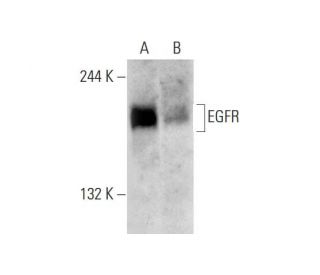
EGFR Antibody (3H2094) is a mouse monoclonal IgG1 antibody that detects amino acids 985-996 of EGFR of human origin in mouse, rat, and human samples through various applications including western blotting (WB), immunoprecipitation (IP), immunofluorescence (IF), and immunohistochemistry with paraffin-embedded sections (IHCP). EGFR, or epidermal growth factor receptor, is a critical receptor tyrosine kinase that plays a pivotal role in cell signaling pathways that regulate cell proliferation, survival, and differentiation. Located primarily on the cell membrane, EGFR is activated upon binding to its ligands, such as epidermal growth factor and transforming growth factor alpha, leading to receptor dimerization and subsequent activation of its intrinsic tyrosine kinase activity. This activation triggers a cascade of downstream signaling pathways, including the RAS-RAF-MAPK and PI3K-AKT pathways, which are essential for normal cellular functions and tissue homeostasis. EGFR undergoes several post-translational modifications that fine-tune its activity and interactions, most notably phosphorylation, where specific tyrosine residues such as Tyr 845, Tyr 1068, and Tyr 1173 are phosphorylated to recruit signaling proteins and propagate downstream signaling. Additionally, ubiquitination regulates EGFR degradation and trafficking, ensuring precise control over receptor turnover, while glycosylation affects receptor stability, ligand binding affinity, and membrane localization. These modifications not only enhance EGFR′s signaling capabilities but also contribute to its oncogenic potential by disrupting normal regulatory mechanisms. However, aberrant activation of EGFR is frequently associated with various cancers, as EGFR promotes uncontrolled cell division and tumor progression. Given its significant role in cancer biology, EGFR is a promising therapeutic target, and anti-EGFR antibody (3H2094) serves as a valuable tool for researchers investigating its function and implications in disease.

For Research Use Only. Not Intended for Diagnostic or Therapeutic Use.

Ordering Information

Product NameCatalog #UNITPriceQtyFAVORITES

EGFR Antibody (3H2094)

sc-71033
200 µg/ml
$322.00

EGFR Antibody (3H2094): m-IgG Fc BP-HRP Bundle

sc-539332
200 µg Ab; 10 µg BP
$361.00

EGFR Antibody (3H2094): m-IgG1 BP-HRP Bundle

sc-541415
200 µg Ab; 20 µg BP
$361.00

What blocking solution should I use with EGFR (3H2094): sc-71033 monoclonal antibody for Western blot?

Asked by: AbPolly
Thank you for your question. We recommend blocking with Blotto (either TBS Blotto A: sc-2333 or TBS Blotto B: sc-2335). Our Western blot protocol can be found here: https://www.scbt.com/scbt/resources/protocols/western-immuno-blotting
Answered by: Technical Support
Date published: 2017-04-13
  • y_2026, m_5, d_12, h_14CST
  • bvseo_bulk, prod_bvqa, vn_bulk_3.0.43
  • cp_1, bvpage1
  • co_hasquestionsanswers, tq_1
  • loc_en_US, sid_71033, prod, sort_[SortEntry(order=LAST_APPROVED_ANSWER_SUBMISSION_TIME, direction=DESCENDING)]
  • clientName_scbt
  • bvseo_sdk, java_sdk, bvseo-4.0.0
  • CLOUD, getContent, 106ms
  • QUESTIONS, PRODUCT
Rated 5 out of 5 by from Specific and SensitiveSpecifity to EGFR confirmed by cell lysate treatment with 17-AAG resulting in downregulation of EGFR expression - great choice.
Date published: 2017-02-02
Rated 5 out of 5 by from Good WB data with a little background inGood WB data with a little background in untreated and 17-AAG treated T98G whole cell lysates. - SCBT QC
Date published: 2015-03-05
Rated 5 out of 5 by from Works well on AWorks well on A-431 whole cell lysate by western blot. - SCBT QC
Date published: 2013-04-09
  • y_2026, m_5, d_12, h_14
  • bvseo_bulk, prod_bvrr, vn_bulk_3.0.43
  • cp_1, bvpage1
  • co_hasreviews, tv_0, tr_3
  • loc_en_US, sid_71033, prod, sort_[SortEntry(order=SUBMISSION_TIME, direction=DESCENDING)]
  • clientName_scbt
  • bvseo_sdk, java_sdk, bvseo-4.0.0
  • CLOUD, getReviews, 9ms
  • REVIEWS, PRODUCT
EGFR Antibody (3H2094) is rated 5.0 out of 5 by 3.
  • y_2026, m_5, d_12, h_14
  • bvseo_bulk, prod_bvrr, vn_bulk_3.0.43
  • cp_1, bvpage1
  • co_hasreviews, tv_0, tr_3
  • loc_en_US, sid_71033, prod, sort_[SortEntry(order=SUBMISSION_TIME, direction=DESCENDING)]
  • clientName_scbt
  • bvseo_sdk, java_sdk, bvseo-4.0.0
  • CLOUD, getAggregateRating, 105ms
  • REVIEWS, PRODUCT
