
Date published: 2026-5-18

1-800-457-3801

SCBT Portrait Logo
Seach Input

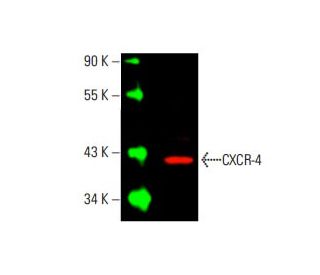
CXCR-4 Antibody (4G10): sc-53534

4.9(21)
Write a reviewAsk a question

Datasheets
  • CXCR-4 Antibody (4G10) is a mouse monoclonal IgG1 κ CXCR-4 antibody, cited in 90 publications, provided at 200 µg/ml
  • raised against the N-terminus amino acids of CXCR-4 of human origin
  • CXCR-4 Antibody (4G10) is recommended for detection of CXCR-4 of mouse, rat and human origin by WB, IP, IF, IHC(P) and FCM
  • Anti-CXCR-4 Antibody (4G10) is available conjugated to agarose for IP; HRP for WB, IHC(P) and ELISA; and to either phycoerythrin or FITC for IF, IHC(P) and FCM
  • also available conjugated to Alexa Fluor® 488, Alexa Fluor® 546, Alexa Fluor® 594 or Alexa Fluor® 647 for WB (RGB), IF, IHC(P) and FCM, and for use with RGB fluorescent imaging systems, such as iBright™ FL1000, FluorChem™, Typhoon, Azure and other comparable systems
  • also available conjugated to Alexa Fluor® 680 or Alexa Fluor® 790 for WB (NIR), IF and FCM; for use with Near-Infrared (NIR) detection systems, such as LI-COR®Odyssey®, iBright™ FL1000, FluorChem™, Typhoon, Azure and other comparable systems
  • m-IgG Fc BP-HRP and m-IgGκ BP-HRP are the preferred secondary detection reagents for CXCR-4 Antibody (4G10) for WB and IHC(P) applications. These reagents are now offered in bundles with CXCR-4 Antibody (4G10) (see ordering information below).
Gene Editing Promo Banner

QUICK LINKS

SEE ALSO...

CXCR-4 Antibody (4G10) is a mouse monoclonal IgG1 kappa light chain antibody raised against the N-terminus amino acids of CXCR-4 of human origin, reactive with mouse, rat, and human species, and validated for applications including western blotting (WB), immunoprecipitation (IP), immunofluorescence (IF), flow cytometry (FCM), and immunohistochemistry. CXCR-4, also known as CD184 or Fusin, is a seven-transmembrane G protein-coupled receptor that resides primarily on the cell surface. CXCR-4 is highly expressed in various tissues and plays a critical role in cellular signaling, particularly in immune and developmental processes. CXCR-4 interacts with stromal cell-derived factor-1 (SDF-1) to mediate chemotactic migration of immune cells such as T cells and monocytes. CXCR-4′s cell surface location enables efficient detection and response to extracellular signals, guiding cell movement during immune responses, tissue repair, and development. CXCR-4′s localization to the plasma membrane facilitates a role as a major co-receptor for T-tropic HIV-1, aiding in viral entry into host cells, while SDF-1 acts as an inhibitor of HIV-1 infection, highlighting significance in antiviral research. CXCR-4 is implicated in cancer progression, as dysregulated expression and signaling are associated with metastasis and tumor cell survival. Anti-CXCR-4 antibody (4G10) is available in non-conjugated form and as various conjugates, including agarose, horseradish peroxidase (HRP), phycoerythrin (PE), fluorescein isothiocyanate (FITC), and Alexa Fluor® options, offering researchers a versatile tool for exploring CXCR-4′s critical roles and cellular dynamics in health and disease.

For Research Use Only. Not Intended for Diagnostic or Therapeutic Use.

Alexa Fluor® is a trademark of Molecular Probes Inc., OR., USA

LI-COR® and Odyssey® are registered trademarks of LI-COR Biosciences

CXCR-4 Antibody (4G10) References:

  1. Pillars article: HIV-1 entry cofactor: functional cDNA cloning of a seven-transmembrane, G protein-coupled receptor. Science. 1996. 272: 872-877.  |  Feng, Y., et al. 2011. J Immunol. 186: 6076-81. PMID: 21597040
  2. CXC chemokines bind to unique sets of selectivity determinants that can function independently and are broadly distributed on multiple domains of human interleukin-8 receptor B. Determinants of high affinity binding and receptor activation are distinct.  |  Ahuja, SK., et al. 1996. J Biol Chem. 271: 225-32. PMID: 8550564
  3. Rapid mobilization of hematopoietic progenitor cells in rhesus monkeys by a single intravenous injection of interleukin-8.  |  Laterveer, L., et al. 1996. Blood. 87: 781-8. PMID: 8555503
  4. Identification of a major co-receptor for primary isolates of HIV-1.  |  Deng, H., et al. 1996. Nature. 381: 661-6. PMID: 8649511
  5. The lymphocyte chemoattractant SDF-1 is a ligand for LESTR/fusin and blocks HIV-1 entry.  |  Bleul, CC., et al. 1996. Nature. 382: 829-33. PMID: 8752280
  6. Homozygous defect in HIV-1 coreceptor accounts for resistance of some multiply-exposed individuals to HIV-1 infection.  |  Liu, R., et al. 1996. Cell. 86: 367-77. PMID: 8756719
  7. Defects of B-cell lymphopoiesis and bone-marrow myelopoiesis in mice lacking the CXC chemokine PBSF/SDF-1.  |  Nagasawa, T., et al. 1996. Nature. 382: 635-8. PMID: 8757135

Ordering Information

Product NameCatalog #UNITPriceQtyFAVORITES

CXCR-4 Antibody (4G10)

sc-53534
200 µg/ml
$322.00

CXCR-4 Antibody (4G10): m-IgG Fc BP-HRP Bundle

sc-528571
200 µg Ab; 10 µg BP
$361.00

CXCR-4 Antibody (4G10): m-IgGκ BP-HRP Bundle

sc-520982
200 µg Ab, 40 µg BP
$361.00

CXCR-4 Antibody (4G10) AC

sc-53534 AC
500 µg/ml, 25% agarose
$424.00

CXCR-4 Antibody (4G10) HRP

sc-53534 HRP
200 µg/ml
$322.00

CXCR-4 Antibody (4G10) FITC

sc-53534 FITC
200 µg/ml
$336.00

CXCR-4 Antibody (4G10) PE

sc-53534 PE
200 µg/ml
$349.00

CXCR-4 Antibody (4G10) Alexa Fluor® 488

sc-53534 AF488
200 µg/ml
$364.00

CXCR-4 Antibody (4G10) Alexa Fluor® 546

sc-53534 AF546
200 µg/ml
$364.00

CXCR-4 Antibody (4G10) Alexa Fluor® 594

sc-53534 AF594
200 µg/ml
$364.00

CXCR-4 Antibody (4G10) Alexa Fluor® 647

sc-53534 AF647
200 µg/ml
$364.00

CXCR-4 Antibody (4G10) Alexa Fluor® 680

sc-53534 AF680
200 µg/ml
$364.00

CXCR-4 Antibody (4G10) Alexa Fluor® 790

sc-53534 AF790
200 µg/ml
$364.00

SOURCE是什么?human?

Asked by: Andy
Thanks for your question. CXCR-4 Antibody (4G10):sc-53534 is a mouse monoclonal antibody. 谢谢您的问题。CXCR-4 Antibody (4G10):sc-53534是一种小鼠单克隆抗体。
Answered by: Yanru Tao
Date published: 2025-08-08

Do I need permeabilization for FCM?

Asked by: SAITO
Thank you for your question. It would be helpful if you could call us, allowing for a more interactive discussion of this and other related questions.
Answered by: Technical Support
Date published: 2021-07-23

I work with mouse samples. How can I stain the tissue with a mouse antibody and avoid non-specific staining?

Asked by: Cweed
We recommend staining with directly conjugated primary antibodies. SC-53534 is available conjugated to FITC, AF488, and AF647.
Answered by: TechService7
Date published: 2016-12-21

What secondary detection reagent do you recommend for this antibody?

Asked by: Cweed
We recommend using one our exclusive Mouse IgG Binding Proteins as a secondary detection reagent. A complete list of available binding proteins is available on our website here: https://www.scbt.com/scbt/browse/support-products-mouse-igg-binding-proteins/_/N-ecrety
Answered by: TechService7
Date published: 2016-12-21
  • y_2026, m_5, d_17, h_13CST
  • bvseo_bulk, prod_bvqa, vn_bulk_3.0.43
  • cp_1, bvpage1
  • co_hasquestionsanswers, tq_4
  • loc_en_US, sid_53534, prod, sort_[SortEntry(order=LAST_APPROVED_ANSWER_SUBMISSION_TIME, direction=DESCENDING)]
  • clientName_scbt
  • bvseo_sdk, java_sdk, bvseo-4.0.0
  • CLOUD, getContent, 100ms
  • QUESTIONS, PRODUCT
Rated 5 out of 5 by from good for IPA nice band when applied in IP sample of cells O.E. CXCR4 and human platelets
Date published: 2020-10-07
Rated 5 out of 5 by from Great compactibilityAs per the review, it sounds Great. The Staining is also really clear
Date published: 2019-03-01
Rated 5 out of 5 by from It's easy to dyeI applied this antibody to IHC (1:300) mice and we found that the CXCR-4 antibodies had a clear staining. It's very nice.
Date published: 2017-10-31
Rated 5 out of 5 by from Works great.Anti-CXCR4 staining in paraffin embeded sections worked very well. Good staining result with low background.
Date published: 2017-10-30
Rated 5 out of 5 by from works very wellI have used this antibody on 20 um spinal cord cryo-sections at a dilution of 1:500. It works very well and shows low background staining along with intense cytoplasm and nuclear staining of cells.
Date published: 2017-08-19
Rated 3 out of 5 by from goodAntibody sample, 1:200 dilution for immunostaining of paraffin-embedded sections from a xenograft model of oral cancer, which showing cytoplasmic staining of cells.
Date published: 2017-08-18
Rated 5 out of 5 by from western blot got strong bandUsed in western blot for CXCR-4 protein analysis,storng band and Low background was observed.Used with a dilution of 1:4000.
Date published: 2017-08-12
Rated 5 out of 5 by from Good control.The antibody works well in WB but over time with more use, I found a strong signal,Good control
Date published: 2017-06-06
  • y_2026, m_5, d_17, h_13
  • bvseo_bulk, prod_bvrr, vn_bulk_3.0.43
  • cp_1, bvpage1
  • co_hasreviews, tv_0, tr_21
  • loc_en_US, sid_53534, prod, sort_[SortEntry(order=SUBMISSION_TIME, direction=DESCENDING)]
  • clientName_scbt
  • bvseo_sdk, java_sdk, bvseo-4.0.0
  • CLOUD, getReviews, 8ms
  • REVIEWS, PRODUCT
CXCR-4 Antibody (4G10) is rated 4.9 out of 5 by 21.
  • y_2026, m_5, d_17, h_13
  • bvseo_bulk, prod_bvrr, vn_bulk_3.0.43
  • cp_1, bvpage1
  • co_hasreviews, tv_0, tr_21
  • loc_en_US, sid_53534, prod, sort_[SortEntry(order=SUBMISSION_TIME, direction=DESCENDING)]
  • clientName_scbt
  • bvseo_sdk, java_sdk, bvseo-4.0.0
  • CLOUD, getAggregateRating, 129ms
  • REVIEWS, PRODUCT
