
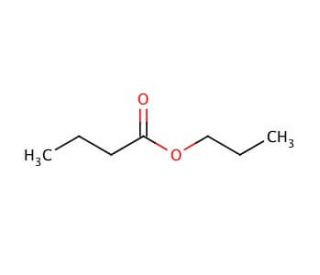

Propyl butyrate (CAS 105-66-8)
ENLACES RÁPIDOS
El butirato de propilo, identificado con el número CAS 105-66-8, es un compuesto orgánico categorizado como éster, derivado específicamente de la reacción entre el ácido butírico y el propanol. Conocido por su agradable aroma afrutado, que recuerda a la piña y el albaricoque, se utiliza ampliamente en las industrias de aromas y fragancias para impartir o realzar los olores y sabores deseados en los productos de consumo. Más allá de sus aplicaciones industriales, el butirato de propilo es un compuesto importante en la investigación química, sobre todo en el estudio de la síntesis de ésteres y los mecanismos de reacción orgánica. Este éster es fundamental para explorar los procesos de esterificación, donde ejemplifica cómo los ácidos carboxílicos reaccionan con alcoholes en condiciones catalíticas o ácidas para formar ésteres y agua, un tipo de reacción fundamental en química orgánica. En los laboratorios de investigación académica e industrial, el butirato de propilo se utiliza para investigar la cinética y la termodinámica de estas reacciones, lo que permite conocer la eficacia de las reacciones y la influencia de los distintos catalizadores. Además, su volatilidad lo convierte en un agente útil en estudios relacionados con la evaporación y difusión de compuestos orgánicos en ciencias atmosféricas. Los investigadores también emplean el butirato de propilo en química analítica para desarrollar mejores técnicas cromatográficas de detección y cuantificación de compuestos de éster en mezclas complejas, mejorando las metodologías analíticas de análisis alimentario, medioambiental y forense.
Propyl butyrate (CAS 105-66-8) Referencias
- Un nuevo atrayente potencial para Anastrepha obliqua a partir de los frutos de Spondias mombin. | Cruz-López, L., et al. 2006. J Chem Ecol. 32: 351-65. PMID: 16555133
- Identificación de sinergistas de feromonas para sistemas de trampeo de Rhynchophorus ferrugineus a partir de los volátiles de la palmera Phoenix canariensis. | Vacas, S., et al. 2014. J Agric Food Chem. 62: 6053-64. PMID: 24930773
- Plantas medicinales del género Acalypha (Euphorbiaceae): revisión de su etnofarmacología y fitoquímica. | Seebaluck, R., et al. 2015. J Ethnopharmacol. 159: 137-57. PMID: 25446604
- Diseño racional de células modulares eficientes. | Trinh, CT., et al. 2015. Metab Eng. 32: 220-231. PMID: 26497627
- Diferenciación entre restos descompuestos de origen humano y mamíferos mayores. | Rosier, E., et al. 2017. J Forensic Leg Med. 50: 28-35. PMID: 28686981
- Aplicación de la lipasa inmovilizada en un soporte hidrófobo para la síntesis de ésteres aromáticos. | Dos Santos, MMO., et al. 2021. Biotechnol Appl Biochem. 68: 538-546. PMID: 32438471
- Aislamiento e identificación de sustancias volátiles con efectos atrayentes sobre Wohlfahrtia magnifica de la vagina del camello bactriano. | Xue, J., et al. 2022. Vet Sci. 9: PMID: 36423086
- Efectos de las Variaciones de los Compuestos Volátiles del Sabor en el Aroma Variado de los Mangos 'Tainong' y 'Hongyu' durante el Almacenamiento. | Xie, H., et al. 2023. Molecules. 28: PMID: 37175103
- El pretratamiento con electroacupuntura alivia la espasticidad tras el ictus en ratas mediante la inducción de la vía de señalización NF-κB/NLRP3 y el eje intestino-cerebro. | Sun, X., et al. 2024. Brain Res. 1822: 148643. PMID: 37884180
- Evaluación de seguridad de ingredientes de fragancias RIFM, butirato de propilo, número de registro CAS 105-66-8. | Api, AM., et al. 2024. Food Chem Toxicol. 183 Suppl 1: 114273. PMID: 38040232
Información sobre pedidos
| Nombre del producto | Número de catálogo | UNIDAD | Precio | CANTIDAD | Favoritos | |
Propyl butyrate, 1 kg | sc-215753 | 1 kg | $69.00 | |||
Propyl butyrate, 4 kg | sc-215753A | 4 kg | $195.00 |