
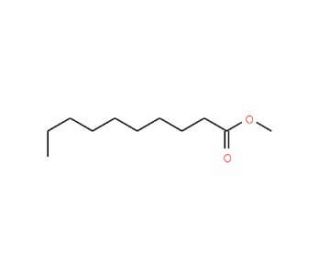

Methyl decanoate (CAS 110-42-9)
QUICK LINKS
Methyl decanoate, derived from decanoic acid, has garnered attention as a surrogate for single-component biodiesel. Another noteworthy component, Methyl Caprate, serves as an unsaturated biodiesel fuel surrogate and finds utility as an additive in flavors and fragrances. Exploration into the behavior of methyl decanoate under various conditions has yielded insights. In one study, its thermal decomposition was scrutinized within a jet-stirred reactor operating at temperatures spanning from 773K to 1123K. Furthermore, the oxidation of this compound was investigated within a similar reactor, covering a temperature range of 500K to 1100K. Methyl decanoate is identifiable in diverse sources such as parmesan cheese, sparkling wine, and banana. It stands as a substantial methyl ester, functioning as an effective surrogate for biodiesels. Also recognized as metholene 2095 or methyl caprate, methyl decanoate is categorized as a fatty acid methyl ester—a subgroup of organic compounds. These esters are characterized by the presence of a fatty acid bound to a methyl group. Their general structure is denoted as RC(=O)OR′, wherein R signifies a fatty aliphatic tail or organyl group and R′ represents a methyl group. Existing in liquid form, methyl decanoate exhibits practical insolubility in water and a relatively neutral nature. Notably detected in urine, it predominantly resides within cell membranes and the cytoplasm. Its presence spans across eukaryotic organisms, ranging from yeast to humans. The taste of methyl decanoate is described as floral, fruity, and oily. In essence, methyl decanoate qualifies as both a fatty acid methyl ester and a decanoate ester.
Methyl decanoate (CAS 110-42-9) References
- Oil-in-water nanoemulsions for pesticide formulations. | Wang, L., et al. 2007. J Colloid Interface Sci. 314: 230-5. PMID: 17612555
- Experimental and modeling study of the thermal decomposition of methyl decanoate. | Herbinet, O., et al. 2011. Combust Flame. 158: 1288-1300. PMID: 23710078
- Biguanide-functionalized mesoporous SBA-15 silica as an efficient solid catalyst for interesterification of vegetable oils. | Xie, W. and Hu, L. 2016. Food Chem. 197: 92-9. PMID: 26616928
- Mesoporous SBA-15 Silica-supported Diisopropylguanidine: an Efficient Solid Catalyst for Interesterification of Soybean Oil with Methyl Octanoate or Methyl Decanoate. | Xie, W. and Hu, L. 2016. J Oleo Sci. 65: 803-813. PMID: 27628732
- Effects of fuel components and combustion particle physicochemical properties on toxicological responses of lung cells. | Jaramillo, IC., et al. 2018. J Environ Sci Health A Tox Hazard Subst Environ Eng. 53: 295-309. PMID: 29227181
- Three classes of ligands each bind to distinct sites on the orphan G protein-coupled receptor GPR84. | Mahmud, ZA., et al. 2017. Sci Rep. 7: 17953. PMID: 29263400
- Effect of decanoic acid and 10-hydroxydecanoic acid on the biotransformation of methyl decanoate to sebacic acid. | Sugiharto, YEC., et al. 2018. AMB Express. 8: 75. PMID: 29730843
- Change in profiles of volatile compounds from two types of Fagopyrum esculentum (buckwheat) soksungjang during fermentation. | Park, MK., et al. 2017. Food Sci Biotechnol. 26: 871-882. PMID: 30263615
- Ester-Producing Mechanism of Ethanol O-acyltransferase EHT1 Gene in Pichia pastoris from Shanxi Aged Vinegar. | Chen, J., et al. 2019. Biomed Res Int. 2019: 4862647. PMID: 30719444
- RIFM fragrance ingredient safety assessment, methyl decanoate, CAS Registry Number 110-42-9. | Api, AM., et al. 2021. Food Chem Toxicol. 156 Suppl 1: 112462. PMID: 34363878
- Tile-Based Pairwise Analysis of GC × GC-TOFMS Data to Facilitate Analyte Discovery and Mass Spectrum Purification. | Cain, CN., et al. 2022. Anal Chem. 94: 5658-5666. PMID: 35347985
- Characterization and Discrimination of Apples by Flash GC E-Nose: Geographical Regions and Botanical Origins Studies in China. | Wu, X., et al. 2022. Foods. 11: PMID: 35681382
- The impact of indigenous Saccharomyces cerevisiae and Schizosaccharomyces japonicus on typicality of crystal grape (Niagara) wine. | Wang, C., et al. 2022. Food Res Int. 159: 111580. PMID: 35940784
Ordering Information
| Product Name | Catalog # | UNIT | Price | Qty | FAVORITES | |
Methyl decanoate, 2.5 g | sc-215344 | 2.5 g | $56.00 | |||
Methyl decanoate, 100 g | sc-215344A | 100 g | $82.00 |