
serum reponse factor /SRF Lentiviral Activation Particles (h): sc-400470-LAC
- Zielspezies: human
- 200 µl transduktionsfertige, hoch-titer CRISPR/dCas9 Lentivirale Aktivierungs-Partikel
- serum reponse factor /SRF Lentiviral Activation Particles (h) sind ein SAM-Komplex (Mediator-Komplex zur synergistischen Gen-Aktivierung) gesteuertes System zur Transkriptionsaktivierung eines gewünschten Zielgens, um wirkungsvoll die spezifische Genexpression mittels lentiviraler Transduktion der Zellen zu erhöhen
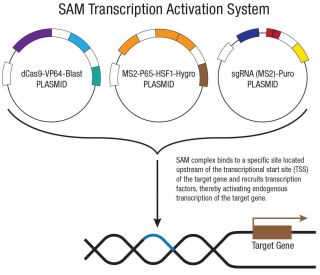
- serum reponse factor /SRF Lentiviral Activation Particles (h) enthalten die folgenden SAM Aktivierungselemente: deaktivierte Cas9 (dCas9) Nuklease (D10A und N863A) fusioniert an die Transaktivierungs-Domäne VP64, ein MS2-p65-HSF1 Fusionsprotein und eine zielspezifische 20nt gRNA. Des Weiteren enthalten sind die Resistenzgene für blasticidin, hygromycin und puromycin
- Der entstehende SAM-Komplex (Mediator-Komplex zur synergistischen Gen-Aktivierung) bindet eine sequenzspezifische Region 200-250 nt upstream (in 5'-Richtung) des Transkriptionsstartsignals und rekrutiert dort ständig Transkriptionsfaktoren für eine verstärkte Gen-Aktivierung und Gen-Expression.
- Die von serum reponse factor /SRF Lentiviral Activation Plasmid (h) und serum reponse factor /SRF Lentiviral Activation Plasmid (h2) kodierten gRNAs zielen auf unterschiedliche regulatorische Regionen des SRF-Promotors ab. Eines oder beide Designs sind möglicherweise verfügbar
- Nach der Transfektion kann die Effizienz der Genaktivierung per Western Blot oder histologisch mit folgendem Antikörper überprüft werden: serum reponse factor /SRF Antibody (A-11): sc-25290

Bestellinformation
| Produkt | Katalog # | EINHEIT | Preis | ANZAHL | Favoriten | |
serum reponse factor /SRF Lentiviral Activation Particles (h) | sc-400470-LAC | 200 µl | $455.00 |
Humanes SRF (Serum Response Factor) ist ein MADS-Box-Transkriptionsfaktor, der an CArG-Box-Motive bindet, um die Expression von Immediate-Early-Genen sowie zytoskelettale Genprogramme zu steuern. Es integriert Signale aus dem MAPK/ERK-Weg über Ternärkomplexfaktoren und aus der RhoA–Aktin-Dynamik über Myokardin-assoziierte Transkriptionsfaktoren und koordiniert dadurch Proliferation, Differenzierung, Motilität und Stressantworten. Die durch SRF regulierte Transkription ist zentral für Gen-Netzwerke der glatten und der Herzmuskulatur sowie für Aktin-Remodelling‑Signalwege, die Zelladhäsion und Migration prägen. Eine Fehlregulation der SRF-Aktivität und der vorgeschalteten Signalwege wurde mit abnormem Wachstum und invasiven Phänotypen in der Krebsbiologie sowie mit pathologischem Remodelling in kardiovaskulären und fibroseassoziierten Krankheitskontexten in Verbindung gebracht.
serum reponse factor /SRF Lentivirale Aktivierungspartikel (h) erfüllen diesen Bedarf, indem sie das vollständige Transkriptionsaktivierungssystem des Synergistic Activation Mediator (SAM) in transduktionsbereite, hoch-titrige lentivirale Partikel verpacken und so eine effiziente SRF-Hochregulation über ein breiteres Spektrum menschlicher Zelltypen ermöglichen.
serum reponse factor /SRF Lentivirale Aktivierungspartikel (h) liefern alle funktionellen Komponenten des Synergistic Activation Mediator (SAM)-Systems über lentivirale Transduktion. Das System umfasst drei Partikelpräparate, die gemeinsam in Zielzellen transduziert werden: eines, das für katalytisch inaktives dCas9 (Mutationen D10A und N863A) kodiert, das mit der VP64-Transaktivierungsdomäne und einem Blasticidin-Resistenzgen fusioniert ist; eines, das für das MS2-p65-HSF1-Fusionsprotein mit einem Hygromycin-Resistenzgen kodiert; und eines, das für eine zielspezifische 20-nt-sgRNA kodiert, die an zwei MS2-RNA-Aptamere mit einem Puromycin-Resistenzgen fusioniert ist. Nach der lentiviralen Transduktion und der genomischen Integration der Expressionskassetten werden die SAM-Komponenten stabil exprimiert und lagern sich am Zielort innerhalb der proximalen Promotorregion stromaufwärts der SRF-Transkriptionsstartstelle an, wo VP64, p65 und HSF1 kooperativ wirken, um endogene Transkriptionsmaschinerie zu rekrutieren und eine anhaltende Hochregulation der endogenen serum reponse factor /SRF-Expression zu bewirken. Die Verwendung von nuklease-inaktivem dCas9 verhindert die Einführung von Doppelstrangbrüchen in der DNA und bewahrt den nativen SRF-Genomlokus sowie die regulatorische Architektur.
Das lentivirale Format bietet mehrere praktische Vorteile: Die stabile genomische Integration unterstützt eine vererbbare Aktivierung über Zellteilungen hinweg; Partikelpräparate mit hohem Titer machen eine eigene Virusproduktion überflüssig; und die Kompatibilität mit primären, sich nicht teilenden und transfektionsresistenten Zelltypen erweitert die experimentellen Möglichkeiten. Eine erfolgreiche Transduktion kann durch eine dreifache Antibiotika-Selektion mit Puromycin, Hygromycin und Blasticidin bestätigt und verstärkt werden.
Nur für Forschungszwecke. Nicht für diagnostische oder therapeutische Zwecke bestimmt.