
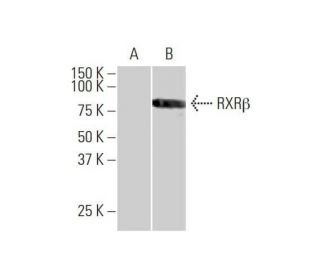


RXRβ Antibody (3C8): sc-293432
- RXRβ Antibody (3C8) is a mouse monoclonal IgG2b κ, cited in 1 publications, provided at 100 µg/ml
- raised against amino acids 161-260 representing partial length RXRβ of human origin
- recommended for detection of RXRβ of mouse, rat and human origin by WB, IP and ELISA
- See RXRα/β/γ (F-1): sc-46659 for RXRβ antibody conjugates, including AC, HRP, FITC, PE, Alexa Fluor® 488, 594, 647, 680 and 790.
- At present, we have not yet completed the identification of the preferred secondary detection reagent(s) for RXRβ Antibody (3C8). This work is in progress.

QUICK LINKS
RXRβ Antibody (3C8) is a mouse monoclonal IgG2b antibody that detects RXRβ in mouse, rat, and human samples through applications such as western blotting (WB), immunoprecipitation (IP), and enzyme-linked immunosorbent assay (ELISA). RXRβ, a member of the retinoid X receptor family, plays a crucial role in mediating the effects of retinoic acid, a vital signaling molecule involved in various biological processes, including cell differentiation, growth, and apoptosis. RXRβ is primarily located in the nucleus, where RXRβ functions as a transcription factor that regulates gene expression in response to retinoic acid binding. This nuclear localization is essential for RXRβ′s role in modulating the transcription of target genes, which are involved in critical pathways such as development and metabolism. Additionally, RXRβ can form heterodimers with other nuclear receptors, such as retinoic acid receptors (RARs) and thyroid hormone receptors, enhancing the complexity of regulatory functions and allowing for fine-tuned control of gene expression in response to various hormonal signals. Anti-RXRβ antibody (3C8) serves as an invaluable tool for researchers studying the intricate mechanisms of retinoid signaling and its implications in health and disease.
Alexa Fluor® is a trademark of Molecular Probes Inc., OR., USA
LI-COR® and Odyssey® are registered trademarks of LI-COR Biosciences
RXRβ Antibody (3C8) References:
- Photoaffinity labeling of human retinoid X receptor beta (RXRbeta) with 9-cis-retinoic acid: identification of phytanic acid, docosahexaenoic acid, and lithocholic acid as ligands for RXRbeta. | Radominska-Pandya, A. and Chen, G. 2002. Biochemistry. 41: 4883-90. PMID: 11939783
- Growth inhibitory retinoid effects after recruitment of retinoid X receptor beta to the retinoic acid receptor beta promoter. | Cheung, B., et al. 2003. Int J Cancer. 105: 856-67. PMID: 12767074
- Retinoid X receptor beta (RXRB) expression in Sertoli cells controls cholesterol homeostasis and spermiation. | Vernet, N., et al. 2008. Reproduction. 136: 619-26. PMID: 18713813
- Retinoid X receptor beta polymorphisms do not explain functional differences in vitamins D and A response in Antineutrophil cytoplasmic antibody associated vasculitis patients. | Kälsch, AI., et al. 2009. Autoimmunity. 42: 467-74. PMID: 19811264
- Honokiol increases ABCA1 expression level by activating retinoid X receptor beta. | Jung, CG., et al. 2010. Biol Pharm Bull. 33: 1105-11. PMID: 20606297
- Expression of retinoid X receptor β is induced in astrocytes during corpus callosum demyelination. | König, R., et al. 2012. J Chem Neuroanat. 43: 120-32. PMID: 22306550
- Tumor-specific macrophage targeting through recognition of retinoid X receptor beta. | Tang, T., et al. 2019. J Control Release. 301: 42-53. PMID: 30871996
- Overexpression of retinoid X receptor beta provides protection against oxidized low-density lipoprotein-induced inflammation via regulating PGC1α-dependent mitochondrial homeostasis in endothelial cells. | Zeng, Y., et al. 2021. Biochem Pharmacol. 188: 114559. PMID: 33872571
- Dominant negative retinoid X receptor beta inhibits retinoic acid-responsive gene regulation in embryonal carcinoma cells. | Minucci, S., et al. 1994. Mol Cell Biol. 14: 360-72. PMID: 8264603
- Retinoic acid induction of major histocompatibility complex class I genes in NTera-2 embryonal carcinoma cells involves induction of NF-kappa B (p50-p65) and retinoic acid receptor beta-retinoid X receptor beta heterodimers. | Segars, JH., et al. 1993. Mol Cell Biol. 13: 6157-69. PMID: 8413217
Ordering Information
| Product Name | Catalog # | UNIT | Price | Qty | FAVORITES | |
RXRβ Antibody (3C8) | sc-293432 | 100 µg/ml | $322.00 |