
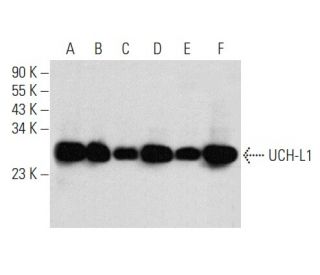
Anticorpo UCH-L1 (31A3): sc-58595
- UCH-L1 Antibody 31A3 è un monoclonale di topo IgG1 κ, citato in 2 pubblicazioni, fornito in 200 µg/ml
- sensibilizzato contro il UCH-L1 nativo di origine human
- raccomandato per il rilevamento di UCH-L1 on neuronal cell bodies and axons in the CNS and periphery, small nerve fibers in peripheral tissues, neuroendocrine cells in the pituitary, thyroid, pancreas and tumors of the DNES di origine mouse, rat e human in WB, IP, IF e IHC(P); anche reattivo con ulteriori specie, incluse e bovine and porcine
- m-IgG Fc BP-HRP e m-IgG1 BP-HRP sono i reagenti secondari preferiti per l'anticorpo UCH-L1 (31A3) for WB and IHC(P) applications. Questi reagenti sono ora offerti in bundle con l'anticorpo UCH-L1 (31A3)(vedere le informazioni per l'ordine sotto).

UCH-L1 (ubiquitina idrolasi C-terminale) è un membro di una famiglia di geni i cui prodotti idrolizzano piccoli addotti C-terminali dell'ubiquitina per generare il monomero ubiquitina. L'espressione di UCH-L1 è altamente specifica per i neuroni e per le cellule del sistema neuroendocrino diffuso e dei loro tumori. UCH-L1 è espresso nei neuroni del cervello. L'esame di regioni cerebrali specifiche rivela l'espressione in tutte le aree analizzate, in particolare nella substantia nigra. UCH-L1 rappresenta l'1-2% delle proteine cerebrali solubili totali. La sua presenza nei corpi di Lewy e la sua funzione nella via del proteasoma lo rendono un gene candidato interessante nella malattia di Parkinson. Il gene che codifica UCH-L1 mappa sul cromosoma umano 4p13. La proteina umana UCH-L3, di 230 aminoacidi, è identica al 54% a quella di UCH-L1. UCH-L3 è la proteasi tiolica predominante e possiede siti di legame ad alta affinità per l'ubiquitina.
Alexa Fluor® è un marchio registrato di Molecular Probes Inc., OR., USA
LI-COR® e Odyssey® sono marchi registrati di LI-COR Biosciences
Anticorpo UCH-L1 (31A3) Riferimenti:
- UCH-L1 induce l'ipertrofia dei podociti nella nefropatia membranosa mediante l'accumulo di proteine. | Lohmann, F., et al. 2014. Biochim Biophys Acta. 1842: 945-58. PMID: 24583340
- L'inibizione di UCH-L1 diminuisce la funzione di legame al microtubulo della proteina Tau. | Xie, M., et al. 2016. J Alzheimers Dis. 49: 353-63. PMID: 26444754
- Gli esosomi contenenti UCH-L1 mediano il trasferimento della resistenza ai chemioterapici nel cancro al seno. | Ning, K., et al. 2017. J Surg Oncol. 115: 932-940. PMID: 28334432
- L'inibizione di UCH-L1 sopprime la formazione di aggresomi di tau durante la compromissione proteasomica. | Yu, Q., et al. 2018. Mol Neurobiol. 55: 3812-3821. PMID: 28540657
- L'UCH-L1 promuove l'invasione delle cellule del cancro al seno attraverso l'attivazione della via di segnalazione Akt. | Luo, Y., et al. 2018. J Cell Biochem. 119: 691-700. PMID: 28636190
- L'inibizione di UCH-L1 aggrava lo sprouting delle fibre muscolari nel modello di kindling con pentilenetetrazolo. | Wen, Y., et al. 2018. Biochem Biophys Res Commun. 503: 2312-2318. PMID: 29964011
- UCH-L1 è un povero biomarcatore sierico della lesione cerebrale traumatica murina dopo il politrauma. | Morris, MC., et al. 2019. J Surg Res. 244: 63-68. PMID: 31279265
- Associazione dei livelli sierici di Ubiquitina C-Terminale Idrolasi-L1 (Uch-L1) con la cognizione e il metabolismo energetico del cervello. | Zhang, M., et al. 2022. Eur Rev Med Pharmacol Sci. 26: 3656-3663. PMID: 35647847
- Associazioni dei livelli di UCH-L1 e NfL nel sangue con la disfunzione cognitiva nei pazienti con malattia di Parkinson. | Dong, L., et al. 2023. Neurosci Lett. 804: 137219. PMID: 37023526
- Il livello plasmatico di ubiquitina idrolasi C-terminale-L1 (UCH-L1) come biomarcatore ematico del danno neurologico dopo il trapianto di cellule ematopoietiche allogeniche. | Okada, Y., et al. 2023. Int J Hematol. 118: 340-346. PMID: 37480445
Informazioni ordini
| Nome del prodotto | Codice del prodotto | UNITÀ | Prezzo | Quantità | Preferiti | |
UCH-L1 Anticorpo (31A3) | sc-58595 | 200 µg/ml | $322.00 | |||
UCH-L1 (31A3): m-IgG Fc BP-HRP Bundle | sc-539087 | 200 µg Ab; 10 µg BP | $361.00 | |||
UCH-L1 (31A3): m-IgG1 BP-HRP Bundle | sc-541250 | 200 µg Ab; 20 µg BP | $361.00 |