
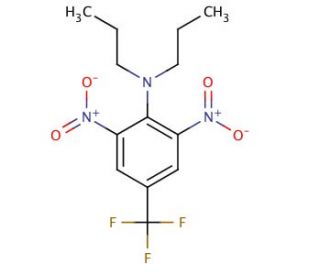

Trifluralin (CAS 1582-09-8)
QUICK LINKS
Trifluralin is a pre-emergence herbicide that functions by inhibiting the growth of roots in germinating weed seeds. It disrupts the formation of microtubules in the cells of the roots, preventing the normal growth and development of the plant. This interference with the microtubule assembly leads to the inhibition of cell division and elongation, ultimately causing the death of the weed seedlings. Trifluralin′s mechanism of action involves its selective binding to a specific protein target in the plant cells, interfering with the normal cellular processes required for root development. This disruption of the microtubule network within the plant cells effectively prevents the establishment and growth of unwanted weeds in agricultural and horticultural applications.
Trifluralin (CAS 1582-09-8) References
- Trifluralin toxicity in a Chagas disease mouse model. | Zaidenberg, A., et al. 2007. Basic Clin Pharmacol Toxicol. 101: 90-5. PMID: 17651308
- Trifluralin liposomal formulations active against Leishmania donovani infections. | Carvalheiro, M., et al. 2009. Eur J Pharm Biopharm. 71: 292-6. PMID: 18761404
- Investigation of the fate of trifluralin in shrimp. | Chan, D., et al. 2013. J Agric Food Chem. 61: 2371-7. PMID: 23339341
- Leachability and potential ecotoxic impact of trifluralin-impregnated mulch. | Bisceglia, KJ., et al. 2018. Environ Sci Pollut Res Int. 25: 2972-2980. PMID: 29147986
- Enhanced Trifluralin Metabolism Can Confer Resistance in Lolium rigidum. | Chen, J., et al. 2018. J Agric Food Chem. 66: 7589-7596. PMID: 29965748
- Do trifluralin and tebuthiuron impair isolated rat liver mitochondria? | de Oliveira, B., et al. 2020. Pestic Biochem Physiol. 163: 175-184. PMID: 31973855
- Loss of trifluralin metabolic resistance in Lolium rigidum plants exposed to prosulfocarb recurrent selection. | Busi, R., et al. 2020. Pest Manag Sci. 76: 3926-3934. PMID: 32638493
- Trifluralin residues in soils from main cotton fields of China and associated ecological risk. | Li, Y., et al. 2021. Chemosphere. 284: 131300. PMID: 34225126
- Trifluralin recognition using touch-based fingertip: Application of wearable glove-based sensor toward environmental pollution and human health control. | Farshchi, F., et al. 2021. J Mol Recognit. 34: e2927. PMID: 34288170
- Understanding Resistance Mechanisms to Trifluralin in an Arkansas Palmer Amaranth Population. | González-Torralva, F. and Norsworthy, JK. 2021. Genes (Basel). 12: PMID: 34440399
- Target-site resistance to trifluralin is more prevalent in annual ryegrass populations from Western Australia. | Chen, J., et al. 2022. Pest Manag Sci. 78: 1206-1212. PMID: 34837476
- Designing, Optimization and Characterization of Trifluralin Transfersomal Gel to Passively Target Cutaneous Leishmaniasis. | Khan, AU., et al. 2022. J Pharm Sci. 111: 1798-1811. PMID: 35081406
- Bioremediation of a trifluralin contaminated soil using bioaugmentation with novel isolated bacterial strains and cyclodextrin. | Lara-Moreno, A., et al. 2022. Sci Total Environ. 840: 156695. PMID: 35709999
Ordering Information
| Product Name | Catalog # | UNIT | Price | Qty | FAVORITES | |
Trifluralin, 250 mg | sc-258299 | 250 mg | $58.00 |