
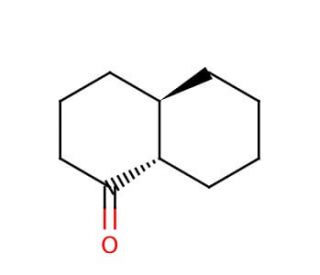

trans-1-Decalone 의 분자 구조, CAS 번호: 21370-71-8
trans-1-Decalone (CAS 21370-71-8)
대체 이름:
trans-Decahydro-1-naphthalenone
CAS 등록번호:
21370-71-8
분자량:
152.23
분자식:
C10H16O
연구용으로만 사용가능합니다. 진단이나 치료용으로 사용불가합니다.
* Refer to Certificate of Analysis for lot specific data.
빠른 링크
주문정보
설명
기술정보
안전정보
SDS 및 분석 증명서
Trans-1-Decalone(트랜스-1-D)은 합성 시클로펜타논 유도체로 실험실 실험 및 과학 연구에서 상당한 잠재력을 가지고 있다. 케톤류 화합물의 일원으로서, 다양한 과학적 연구에 광범위한 응용을 제공한다. 특히, 트랜스-1-Decalone은 친염증성 사이토카인의 생성을 억제함으로써 항염증제로서의 가능성이 검토되었다. 항종양제로서의 효과도 암세포 증식을 저해하는 능력으로 인해 연구되었다. 더욱이, 트랜스-1-Decalone은 뇌의 도파민 수준을 감소시킴으로써 신경 질환의 잠재적 치료제로서의 가능성을 보여주었다. 트랜스-1-Decalone과 관련된 작용 기전은 다양하다. 이는 친염증성 사이토카인의 생성을 담당하는 시클로옥시게나제-2(COX-2) 효소의 억제제로서 기능하는 것으로 여겨진다. 또한, 트랜스-1-Decalone은 염증 반응에 관여하는 류코트리엔의 생성에 기여하는 효소 5-리폭시게나제(5-LOX)의 활성을 억제하는 능력을 입증하였다. 나아가, 아세틸콜린 분해를 담당하는 효소인 아세틸콜린에스테라제의 활성을 조절하여 신경 전달 물질 수준에 영향을 미친다. 요약하면, 트랜스-1-Decalone은 항염증성 및 항종양성으로부터 다양한 작용 기전을 통한 신경 질환에 대한 영향에 이르기까지 응용 분야가 다양한 과학 연구에서 다재다능한 화합물로서의 가능성을 보여준다.
trans-1-Decalone (CAS 21370-71-8) 참고자료
- 광학 회전 분산 연구. XLI.1 α- 할로케톤 (파트 9).2 광학 활성 시스-1- 데칼론의 브롬화. 회전 분산에 의한 형태 이동성 시연3 | Carl Djerassi and J. Staunton. 1961,. J. Am. Chem. Soc. 83, 3,: 736–743.
- 시스-데칼린과 트랜스-데칼린의 광감작 산화에 대한 메커니즘 연구 | https://www.sciencedirect.com/science/article/abs/pii/101060309087114Q. 15 July 1990,. Journal of Photochemistry and Photobiology A: Chemistry. Volume 53, Issue 1,: Pages 69-75.
주문정보
| 제품명 | 카탈로그 번호 | 단위 | 가격 | 수량 | 관심품목 | |
trans-1-Decalone, 1 g | sc-237137 | 1 g | $175.00 |