
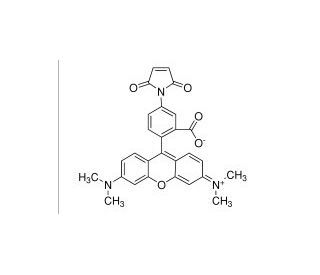

Tetramethylrhodamine-5-maleimide (CAS 174568-67-3)
QUICK LINKS
Tetramethylrhodamine-5-maleimide is a chemical compound widely used in biological and biochemical research due to its fluorescent properties and reactivity with thiol groups. It belongs to the rhodamine family of dyes and serves as a versatile tool for labeling and detection purposes. The primary characteristic of Tetramethylrhodamine-5-maleimide is its strong fluorescence emission in the red-orange spectrum, making it easily detectable and distinguishable in various experimental applications. It is employed in fluorescence microscopy, flow cytometry, and other imaging techniques to visualize and track specific molecules or structures of interest. Tetramethylrhodamine-5-maleimide is especially valued for its ability to react with thiol groups, which are present in cysteine residues of proteins or peptides. Through a thiol-maleimide reaction, the compound covalently attaches to thiol-containing biomolecules, forming a stable linkage. This property enables the specific labeling of proteins, peptides, and other molecules that possess thiol groups, facilitating their detection and analysis. Furthermore, Tetramethylrhodamine-5-maleimide exhibits good photostability, enabling prolonged observation without significant fading or photobleaching. Its fluorescence properties remain relatively unchanged even under continuous illumination, allowing for reliable and consistent imaging results. In summary, Tetramethylrhodamine-5-maleimide is a valuable fluorescent compound widely used in biological and biochemical research. Its intense red-orange fluorescence and reactivity with thiol groups make it a versatile tool for labeling and visualization of specific biomolecules, facilitating various applications in cellular and molecular studies.
Tetramethylrhodamine-5-maleimide (CAS 174568-67-3) References
- Membrane topology of loop 13-14 of the Na+/glucose cotransporter (SGLT1): a SCAM and fluorescent labelling study. | Gagnon, DG., et al. 2005. Biochim Biophys Acta. 1712: 173-84. PMID: 15904891
- 4-aminopyridine prevents the conformational changes associated with p/c-type inactivation in shaker channels. | Claydon, TW., et al. 2007. J Pharmacol Exp Ther. 320: 162-72. PMID: 17015639
- Molecular biosensing system based on intrinsically disordered proteins. | Cissell, KA., et al. 2008. Anal Bioanal Chem. 391: 1721-9. PMID: 18193204
- Osmium carbonyl clusters containing labile ligands hyperstabilize microtubules. | Kong, KV., et al. 2009. Chem Res Toxicol. 22: 1116-22. PMID: 19441774
- Easy route to functionalize iron oxide nanoparticles via long-term stable thiol groups. | Maurizi, L., et al. 2009. Langmuir. 25: 8857-9. PMID: 19572525
- Fluorescence Detection of Heavy Atom Labeling (FD-HAL): a rapid method for identifying covalently modified cysteine residues by phasing atoms. | Chaptal, V., et al. 2010. J Struct Biol. 171: 82-7. PMID: 20152903
- Fluorescence-tracking of activation gating in human ERG channels reveals rapid S4 movement and slow pore opening. | Es-Salah-Lamoureux, Z., et al. 2010. PLoS One. 5: e10876. PMID: 20526358
- Identification of protein-protein and protein-ribosome interacting regions of the C-terminal tail of human mitochondrial inner membrane protein Oxa1L. | Haque, ME., et al. 2010. J Biol Chem. 285: 34991-8. PMID: 20739282
- Site-directed alkylation studies with LacY provide evidence for the alternating access model of transport. | Jiang, X., et al. 2011. Biochemistry. 50: 1634-40. PMID: 21254783
- Functional characterization of the LQT2-causing mutation R582C and the associated voltage-dependent fluorescence signal. | Fougere, RR., et al. 2011. Heart Rhythm. 8: 1273-80. PMID: 21376840
- Effects of arginine and other solution additives on the self-association of different surfactants: an investigation at single-molecule resolution. | Haldar, S. and Chattopadhyay, K. 2011. Langmuir. 27: 5842-9. PMID: 21488688
- Fluorescent labeling and tracking of nanoclay. | Diaz, CA., et al. 2013. Nanoscale. 5: 164-8. PMID: 23174756
- Peptide-based fluorescence biosensors for detection/measurement of nanoparticles. | Akinloye, O., et al. 2017. Anal Bioanal Chem. 409: 903-915. PMID: 27904938
- The role of Tat peptide self-aggregation in membrane pore stabilization: insights from a computational study. | Jan Akhunzada, M., et al. 2017. Phys Chem Chem Phys. 19: 27603-27610. PMID: 28980686
- Biophysical characterization of full-length TAR DNA-binding protein (TDP-43) phase separation. | Staderini, T., et al. 2022. Protein Sci. 31: e4509. PMID: 36371546
Ordering Information
| Product Name | Catalog # | UNIT | Price | Qty | FAVORITES | |
Tetramethylrhodamine-5-maleimide, 1 mg | sc-215961 | 1 mg | $137.00 | |||
Tetramethylrhodamine-5-maleimide, 5 mg | sc-215961A | 5 mg | $265.00 | |||
Tetramethylrhodamine-5-maleimide, 25 mg | sc-215961B | 25 mg | $1044.00 |