
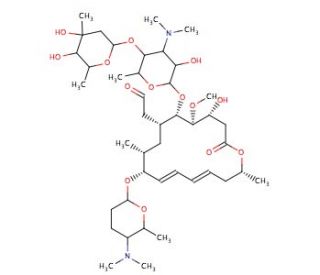

Spiramycin I (CAS 24916-50-5)
LINKS RÁPIDOS
A espiramicina I, um membro proeminente dos antibióticos macrolídeos, distingue-se por sua grande estrutura de anel de lactona macrocíclica, que é intrincadamente decorada com açúcares. Essa arquitetura molecular é fundamental em seu mecanismo de ação, visando principalmente os ribossomos bacterianos para inibir a síntese de proteínas. Ao se ligar à subunidade 50S do ribossomo, a espiramicina I bloqueia efetivamente a etapa de se transloca do alongamento da proteína, interrompendo assim o crescimento bacteriano. Esse modo de ação é particularmente valioso em ambientes de pesquisa, onde a espiramicina I serve como uma ferramenta para investigar os meandros da síntese de proteínas bacterianas e a função do ribossomo. Sua utilidade vai além das meras aplicações antibacterianas, fornecendo informações sobre a estrutura e a função ribossômica, que são cruciais para a compreensão dos processos fundamentais da vida e para o desenvolvimento de novos antibióticos.
Spiramycin I (CAS 24916-50-5) Referencias
- Análise da espiramicina por eletroforese capilar. | González-Hernández, R., et al. 1999. Electrophoresis. 20: 2407-11. PMID: 10499332
- Determinação simultânea de metronidazol e espiramicina I em plasma humano, saliva e fluido crevicular gengival por LC-MS/MS. | Sagan, C., et al. 2005. J Pharm Biomed Anal. 38: 298-306. PMID: 15925222
- [Deleção do gene da espiramicina 3-O-aciltransferase de Streptomyces spiramyceticus F21 resultando na produção de espiramicina I como componente principal]. | Wu, LZ., et al. 2007. Sheng Wu Gong Cheng Xue Bao. 23: 612-7. PMID: 17849607
- Hidroxilação e hidrólise: duas vias metabólicas principais da espiramicina I na digestão anaeróbia. | Zhu, P., et al. 2014. Bioresour Technol. 153: 95-100. PMID: 24345568
- Biodegradação anaeróbia da espiramicina I e caraterização dos seus novos metabolitos. | Yao, J., et al. 2017. Biosci Biotechnol Biochem. 81: 1051-1054. PMID: 28095730
- Efeitos Estimuladores da Metil-β-ciclodextrina na Produção de Espiramicina e Caracterização Físico-Química de Complexos Não-Hospedeiro@Guia. | Calcagnile, M., et al. 2018. ACS Omega. 3: 2470-2478. PMID: 30221219
- Relações estrutura-atividade das espiramicinas. | Omura, S., et al. 1985. J Antimicrob Chemother. 16 Suppl A: 1-11. PMID: 3902764
- Modificação química das espiramicinas. V. Síntese e atividade antibacteriana da 3'- ou 4''-de-N-metilspiramicina I e dos seus derivados N-substituídos. | Sano, H., et al. 1985. J Antibiot (Tokyo). 38: 186-96. PMID: 3997666
- Modificação química das espiramicinas. VI. Síntese e actividades antibacterianas de derivados 3,3''-di-O-acil-4''-O-sulfonil e 3,3''-di-O-acil-4''-O-alquil da espiramicina I. | Sano, M., et al. 1985. J Antibiot (Tokyo). 38: 1350-8. PMID: 4066488
- Modificação química das espiramicinas. III. Síntese e actividades antibacterianas de 4''-sulfonatos e 4''-alquiléteres da espiramicina I. | Sano, H., et al. 1984. J Antibiot (Tokyo). 37: 750-9. PMID: 6469869
- Modificação química das espiramicinas. IV. Síntese e actividades in vitro e in vivo de 3'',4''-diacilatos e 3,3'',4''-triacilatos de espiramicina I. | Sano, H., et al. 1984. J Antibiot (Tokyo). 37: 760-72. PMID: 6469870
- Modificação química das espiramicinas. I. Síntese dos derivados acetais da neospiramicina I. | Sano, H., et al. 1983. J Antibiot (Tokyo). 36: 1336-44. PMID: 6643282
- Biossíntese e destino metabólico da espiramicina I marcada com carbono-14. | Inoue, A., et al. 1983. J Antibiot (Tokyo). 36: 442-4. PMID: 6853373
Informacoes sobre ordens
| Nome do Produto | Numero de Catalogo | UNID | Preco | Qde | FAVORITOS | |
Spiramycin I, 2.5 g | sc-220129 | 2.5 g | $331.00 |