
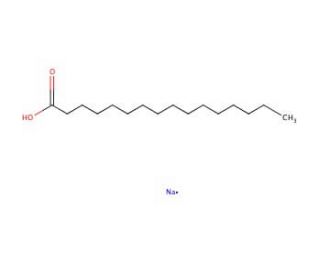

Sodium palmitate (CAS 408-35-5)
See product citations (6)
QUICK LINKS
Sodium palmitate, with the chemical formula C_16H_31NaO_2, is primarily recognized for its amphiphilic nature due to a long hydrophobic hydrocarbon chain and a hydrophilic carboxylate group neutralized by sodium. This structure endows it with surfactant properties, leading to extensive research into its ability to form micelles and bilayers in aqueous solutions. Such studies are pivotal in understanding the mechanisms of surfactant behavior, particularly in reducing surface and interfacial tension, and in exploring self-assembly processes which are in mimicking biological membranes. Additionally, sodium palmitate is instrumental in materials science for investigating crystallization and liquid crystal formation, offering insights into phase transitions and thermodynamics of self-assembled systems. Its role as a reference compound in analytical chemistry further underscores its importance, aiding in the development of new techniques for studying complex organic compounds and fatty acid salts. Thus, sodium palmitate not only provides a deeper understanding of surfactant chemistry and molecular interactions but also plays a significant role in advancing research in materials science and analytical methodologies.
Sodium palmitate (CAS 408-35-5) References
- Sodium palmitate induces partial mitochondrial uncoupling and reactive oxygen species in rat pancreatic islets in vitro. | Carlsson, C., et al. 1999. Endocrinology. 140: 3422-8. PMID: 10433196
- Preparation and characterization of a new lipid nano-emulsion containing two cosurfactants, sodium palmitate for droplet size reduction and sucrose palmitate for stability enhancement. | Takegami, S., et al. 2008. Chem Pharm Bull (Tokyo). 56: 1097-102. PMID: 18670109
- Effect of amylopectin on the rheological properties of aqueous dispersions of starch-sodium palmitate complexes. | Byars, JA., et al. 2013. Carbohydr Polym. 95: 171-6. PMID: 23618255
- Saturated free fatty acid sodium palmitate-induced lipoapoptosis by targeting glycogen synthase kinase-3β activation in human liver cells. | Cao, J., et al. 2014. Dig Dis Sci. 59: 346-57. PMID: 24132507
- Bcl-2 maintains the mitochondrial membrane potential, but fails to affect production of reactive oxygen species and endoplasmic reticulum stress, in sodium palmitate-induced β-cell death. | Wang, X. and Welsh, N. 2014. Ups J Med Sci. 119: 306-15. PMID: 25266628
- EndoC-βH1 cells display increased sensitivity to sodium palmitate when cultured in DMEM/F12 medium. | Krizhanovskii, C., et al. 2017. Islets. 9: e1296995. PMID: 28277987
- LXRɑ participates in the mTOR/S6K1/SREBP-1c signaling pathway during sodium palmitate-induced lipogenesis in HepG2 cells. | Zhou, Y., et al. 2018. Nutr Metab (Lond). 15: 31. PMID: 29743930
- Is palmitate truly proinflammatory? Experimental confounders and context-specificity. | Ono-Moore, KD., et al. 2018. Am J Physiol Endocrinol Metab. 315: E780-E794. PMID: 30016150
- κ-Opioid receptor stimulation reduces palmitate-induced apoptosis via Akt/eNOS signaling pathway. | Cui, Y., et al. 2019. Lipids Health Dis. 18: 52. PMID: 30764838
- Berberine attenuates sodium palmitate-induced lipid accumulation, oxidative stress and apoptosis in grass carp(Ctenopharyngodon idella)hepatocyte in vitro. | Yang, SS., et al. 2019. Fish Shellfish Immunol. 88: 518-527. PMID: 30880233
- Amylopectin-Sodium Palmitate Complexes as Sustainable Nanohydrogels with Tunable Size and Fractal Dimensions. | Zhang, H., et al. 2020. J Agric Food Chem. 68: 3796-3805. PMID: 32069053
- miR-375 induces adipogenesis through targeting Erk1 in pancreatic duct cells under the influence of sodium palmitate. | Gezginci-Oktayoglu, S., et al. 2021. J Cell Physiol. 236: 3881-3895. PMID: 33107061
- Activation of κ-opioid receptor inhibits inflammatory response induced by sodium palmitate in human umbilical vein endothelial cells. | Zhang, S., et al. 2021. Cytokine. 146: 155659. PMID: 34332276
- Deoxycholic Acid Promotes Pyroptosis in Free Fatty Acid-Induced Steatotic Hepatocytes by Inhibiting PINK1-Mediated Mitophagy. | Gao, X., et al. 2022. Inflammation. 45: 639-650. PMID: 34674097
- High-fat diet promotes colorectal carcinogenesis through SERCA2 mediated serine phosphorylation of Annexin A2. | Fan, L., et al. 2022. Int J Biochem Cell Biol. 145: 106192. PMID: 35257889
Ordering Information
| Product Name | Catalog # | UNIT | Price | Qty | FAVORITES | |
Sodium palmitate, 5 g | sc-215881 | 5 g | $107.00 | |||
Sodium palmitate, 10 g | sc-215881A | 10 g | $199.00 | |||
Sodium palmitate, 25 g | sc-215881B | 25 g | $265.00 | |||
Sodium palmitate, 500 g | sc-215881C | 500 g | $2142.00 |