
Date published: 2026-1-9

1-800-457-3801

SCBT Portrait Logo
Seach Input

Sm D1 Antibody (A-9): sc-166650

5.0(2)
Write a reviewAsk a question

Datasheets
  • Sm D1 Antibody (A-9) is a mouse monoclonal IgG3 κ Sm D1 antibody, cited in 3 publications, provided at 200 µg/ml
  • specific for an epitope mapping between amino acids 84-98 near the C-terminus of Sm D1 of human origin
  • recommended for detection of Sm D1 of mouse, rat, human and origin by WB, IP, IF, IHC(P) and ELISA; also reactive with additional species, including and equine, canine, bovine, porcine and avian
  • available conjugated to agarose for IP; HRP for WB, IHC(P) and ELISA; phycoerythrin, FITC, Alexa Fluor® 488 or Alexa Fluor® 647 for IF, IHC(P) and FCM
  • m-IgG3 BP-HRP and m-IgGκ BP-HRP are the preferred secondary detection reagents for Sm D1 Antibody (A-9) for WB and IHC(P) applications. These reagents are now offered in bundles with Sm D1 Antibody (A-9) (see ordering information below).

QUICK LINKS

SEE ALSO...

Sm D1 Antibody (A-9) is a mouse monoclonal IgG3 kappa light chain antibody that detects the Sm D1 protein of mouse, rat, and human origin by western blotting (WB), immunoprecipitation (IP), immunofluorescence (IF), immunohistochemistry, and enzyme-linked immunosorbent assay (ELISA). anti-Sm D1 antibody (A-9) is available in both non-conjugated and various conjugated forms, including agarose, horseradish peroxidase (HRP), phycoerythrin (PE), fluorescein isothiocyanate (FITC), and multiple Alexa Fluor® conjugates. Sm D1, also called Small nuclear ribonucleoprotein Sm D1, snRNP core protein D1, and SNRPD1, plays a crucial role in the assembly of small nuclear ribonucleoproteins (snRNPs), which are essential components of the spliceosome, a complex responsible for the splicing of pre-mRNA in eukaryotic cells. By facilitating the binding of snRNPs to the conserved Sm site on U snRNA, Sm D1 helps form a stable snRNP core complex, which is vital for the accurate processing of mRNA. The presence of Sm D1, along with other Sm proteins, ensures the proper functioning of the spliceosome, thereby influencing gene expression and cellular function. Notably, autoantibodies against Sm D1 are commonly found in patients with systemic lupus erythematosus, highlighting Sm D1′s significance in autoimmune responses. The major linear epitope recognized by these autoantibodies includes the C-terminal RG dipeptide repeats present in Sm D1, underscoring Sm D1′s importance in both health and disease.

For Research Use Only. Not Intended for Diagnostic or Therapeutic Use.

Alexa Fluor® is a trademark of Molecular Probes Inc., OR., USA

LI-COR® and Odyssey® are registered trademarks of LI-COR Biosciences

Sm D1 Antibody (A-9) References:

  1. The C-terminal RG dipeptide repeats of the spliceosomal Sm proteins D1 and D3 contain symmetrical dimethylarginines, which form a major B-cell epitope for anti-Sm autoantibodies.  |  Brahms, H., et al. 2000. J Biol Chem. 275: 17122-9. PMID: 10747894
  2. Purified U7 snRNPs lack the Sm proteins D1 and D2 but contain Lsm10, a new 14 kDa Sm D1-like protein.  |  Pillai, RS., et al. 2001. EMBO J. 20: 5470-9. PMID: 11574479
  3. Hepatitis C virus nonstructural protein NS3 binds to Sm-D1, a small nuclear ribonucleoprotein associated with autoimmune disease.  |  Iwai, A., et al. 2003. Microbiol Immunol. 47: 601-11. PMID: 14524621
  4. Evidence for three distinct D proteins, which react differentially with anti-Sm autoantibodies, in the cores of the major snRNPs U1, U2, U4/U6 and U5.  |  Lehmeier, T., et al. 1990. Nucleic Acids Res. 18: 6475-84. PMID: 1701240
  5. SNRPD1 confers diagnostic and therapeutic values on breast cancers through cell cycle regulation.  |  Dai, X., et al. 2021. Cancer Cell Int. 21: 229. PMID: 33879154
  6. The diagnostic and prognostic significance of small nuclear ribonucleoprotein Sm D1 aberrantly high expression in hepatocellular carcinoma.  |  Wang, H., et al. 2022. J Cancer. 13: 184-201. PMID: 34976182
  7. SNRPD1/E/F/G Serve as Potential Prognostic Biomarkers in Lung Adenocarcinoma.  |  Liu, G., et al. 2022. Front Genet. 13: 813285. PMID: 35356432
  8. SNRPD1 conveys prognostic value on breast cancer survival and is required for anthracycline sensitivity.  |  Dai, X., et al. 2023. BMC Cancer. 23: 376. PMID: 37098488
  9. SNRPD1 inhibition suppresses the proliferation of hepatocellular carcinoma and promotes autophagy through the PI3K/AKT/mTOR/4EBP1 pathway.  |  Wang, H., et al. 2023. Arch Biochem Biophys. 743: 109661. PMID: 37268273
  10. The Potential Role of SNRPD1 Stabilized by IGF2BP2 in the Progression of Triple-Negative Breast Cancer.  |  Liu, S., et al. 2024. Breast Cancer (Dove Med Press). 16: 679-688. PMID: 39411513
  11. U2 RNA shares a structural domain with U1, U4, and U5 RNAs.  |  Branlant, C., et al. 1982. EMBO J. 1: 1259-65. PMID: 6202507
  12. The snRNP core assembly pathway: identification of stable core protein heteromeric complexes and an snRNP subcore particle in vitro.  |  Raker, VA., et al. 1996. EMBO J. 15: 2256-69. PMID: 8641291

Ordering Information

Product NameCatalog #UNITPriceQtyFAVORITES

Sm D1 Antibody (A-9)

sc-166650
200 µg/ml
$322.00

Sm D1 Antibody (A-9): m-IgGκ BP-HRP Bundle

sc-521692
200 µg Ab, 40 µg BP
$361.00

Sm D1 Antibody (A-9): m-IgG3 BP-HRP Bundle

sc-550336
200 µg Ab; 40 µg BP
$361.00

Sm D1 Antibody (A-9) AC

sc-166650 AC
500 µg/ml, 25% agarose
$424.00

Sm D1 Antibody (A-9) Alexa Fluor® 488

sc-166650 AF488
200 µg/ml
$364.00

Sm D1 Antibody (A-9) Alexa Fluor® 647

sc-166650 AF647
200 µg/ml
$364.00

Sm D1 Antibody (A-9) FITC

sc-166650 FITC
200 µg/ml
$336.00

Sm D1 Antibody (A-9) HRP

sc-166650 HRP
200 µg/ml
$322.00

Sm D1 (A-9) Neutralizing Peptide

sc-166650 P
100 µg/0.5 ml
$69.00

Sm D1 Antibody (A-9) PE

sc-166650 PE
200 µg/ml
$349.00

What application is the blocking peptide sc-166650 P appropriate for?

Asked by: TinTin
Thank you for your question. The blocking peptide is intended for use as a negative control, by pre-adsorbing the mouse monoclonal antibody against the antigen. For full protocol details, please contact our Technical Services Department or view our online protocol here: https://www.scbt.com/scbt/resources/protocols/peptide-neutralization
Answered by: Technical Support
Date published: 2017-02-24
  • y_2025, m_12, d_31, h_9CST
  • bvseo_bulk, prod_bvqa, vn_bulk_3.0.42
  • cp_1, bvpage1
  • co_hasquestionsanswers, tq_1
  • loc_en_US, sid_166650, prod, sort_[SortEntry(order=LAST_APPROVED_ANSWER_SUBMISSION_TIME, direction=DESCENDING)]
  • clientName_scbt
  • bvseo_sdk, java_sdk, bvseo-4.0.0
  • CLOUD, getContent, 109ms
  • QUESTIONS, PRODUCT
Rated 5 out of 5 by from it is a very useful antibodylast week, we used this antibody to detect the SNRPD1 expression in breast cancer cell line MDAMB231, the results showed that the band is very bright.
Date published: 2017-03-28
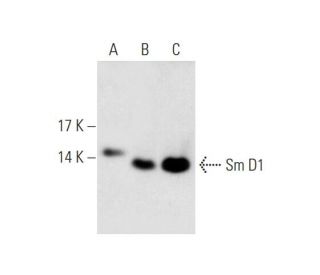
Rated 5 out of 5 by from Produced nice Western blot data of Sm D1Produced nice Western blot data of Sm D1 expression in K-562 whole cell lysate and HeLa and Ramos nuclear extracts. -SCBT QC
Date published: 2014-12-15
  • y_2025, m_12, d_31, h_9
  • bvseo_bulk, prod_bvrr, vn_bulk_3.0.42
  • cp_1, bvpage1
  • co_hasreviews, tv_0, tr_2
  • loc_en_US, sid_166650, prod, sort_[SortEntry(order=SUBMISSION_TIME, direction=DESCENDING)]
  • clientName_scbt
  • bvseo_sdk, java_sdk, bvseo-4.0.0
  • CLOUD, getReviews, 8ms
  • REVIEWS, PRODUCT
Sm D1 Antibody (A-9) is rated 5.0 out of 5 by 2.
  • y_2025, m_12, d_31, h_9
  • bvseo_bulk, prod_bvrr, vn_bulk_3.0.42
  • cp_1, bvpage1
  • co_hasreviews, tv_0, tr_2
  • loc_en_US, sid_166650, prod, sort_[SortEntry(order=SUBMISSION_TIME, direction=DESCENDING)]
  • clientName_scbt
  • bvseo_sdk, java_sdk, bvseo-4.0.0
  • CLOUD, getAggregateRating, 118ms
  • REVIEWS, PRODUCT
