
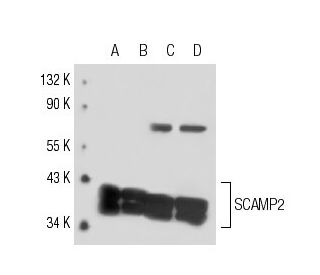
SCAMP2 Antibody (8C10): sc-58286
- SCAMP2 Antibody (8C10) is a mouse monoclonal IgM κ SCAMP2 antibody, cited in 1 publications, provided at 200 µg/ml
- raised against purified insulin-responsive glucose transporter vesicles of human origin
- recommended for detection of SCAMP2 of mouse, rat and human origin by WB, IP and IF
- At present, we have not yet completed the identification of the preferred secondary detection reagent(s) for SCAMP2 Antibody (8C10). This work is in progress.

QUICK LINKS
SCAMP2 Antibody (8C10) is a mouse monoclonal IgM antibody that detects SCAMP2 protein of mouse, rat, and human origin by western blotting (WB), immunoprecipitation (IP), and immunofluorescence (IF). Anti-SCAMP2 antibody (8C10) is available as the non-conjugated format. Secretory carrier membrane proteins (SCAMPs) play a crucial role in cellular processes such as endocytosis, vesicle recycling, and membrane trafficking, which are essential for maintaining cellular homeostasis and communication. SCAMP2 is characterized by unique structural features, including multiple N-terminal NPF repeats and four highly conserved transmembrane regions, which are vital for function. These NPF repeats facilitate interactions with EH domain proteins, promoting the budding of transport vesicles from the plasma membrane and the Golgi complex. This interaction is particularly important for the efficient transport of proteins and lipids within the cell, ensuring that cellular signaling and metabolic processes occur smoothly. SCAMPs, including SCAMP2, are distinct yet related proteins, with SCAMP1, SCAMP2, and SCAMP3 sharing similar functions but differing in expression patterns and regulatory mechanisms. Notably, the phosphorylation of SCAMP1 and SCAMP3 by the epidermal growth factor receptor indicates that SCAMPs are subject to post-translational modifications that can influence activity and interactions. While SCAMPs are expressed in various tissues, SCAMPs are found in particularly high concentrations in neural tissue, where SCAMPs are associated with synaptic vesicles, underscoring their importance in neurotransmission and synaptic plasticity.
Alexa Fluor® is a trademark of Molecular Probes Inc., OR., USA
LI-COR® and Odyssey® are registered trademarks of LI-COR Biosciences
SCAMP2 Antibody (8C10) References:
- SCAMP1 function in endocytosis. | Fernández-Chacón, R., et al. 2000. J Biol Chem. 275: 12752-6. PMID: 10777571
- Novel SCAMPs lacking NPF repeats: ubiquitous and synaptic vesicle-specific forms implicate SCAMPs in multiple membrane-trafficking functions. | Fernández-Chacón, R. and Südhof, TC. 2000. J Neurosci. 20: 7941-50. PMID: 11050114
- Secretory carrier membrane proteins 31-35 define a common protein composition among secretory carrier membranes. | Brand, SH., et al. 1991. J Biol Chem. 266: 18949-57. PMID: 1717458
- The glucose transporter GluT4 and secretory carrier membrane proteins (SCAMPs) colocalize in rat adipocytes and partially segregate during insulin stimulation. | Laurie, SM., et al. 1993. J Biol Chem. 268: 19110-7. PMID: 8360193
- SCAMP 37, a new marker within the general cell surface recycling system. | Brand, SH. and Castle, JD. 1993. EMBO J. 12: 3753-61. PMID: 8404846
- Evidence for colocalization and interaction between 37 and 39 kDa isoforms of secretory carrier membrane proteins (SCAMPs). | Wu, TT. and Castle, JD. 1997. J Cell Sci. 110 (Pt 13): 1533-41. PMID: 9224770
- Tyrosine phosphorylation of selected secretory carrier membrane proteins, SCAMP1 and SCAMP3, and association with the EGF receptor. | Wu, TT. and Castle, JD. 1998. Mol Biol Cell. 9: 1661-74. PMID: 9658162
- Structure and Asn-Pro-Phe binding pocket of the Eps15 homology domain. | de Beer, T., et al. 1998. Science. 281: 1357-60. PMID: 9721102
- Recognition specificity of individual EH domains of mammals and yeast. | Paoluzi, S., et al. 1998. EMBO J. 17: 6541-50. PMID: 9822599
Ordering Information
| Product Name | Catalog # | UNIT | Price | Qty | FAVORITES | |
SCAMP2 Antibody (8C10) | sc-58286 | 200 µg/ml | $322.00 |