
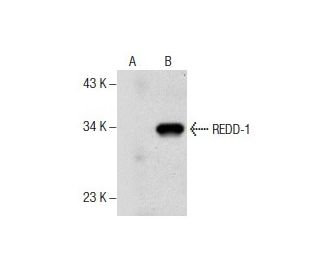


REDD-1 (h): 293 Lysate: sc-111360
- human REDD-1 transfected 293 lysate
- 100 µg protein in 200 µl SDS-PAGE buffer; suitable as Western Blotting control for REDD-1 antibodies
- Suitable control antibody: REDD-1 Antibody (B-3): sc-376671 is recommended as control antibody for monitoring of REDD-1 expression knockdown by Western blotting or immunofluorescence
- should be stored at -20° C and repeated freezing and thawing should be minimized
- sample vial should be boiled once prior to use
- non-transfected control 293 lysate (sc-110760)

QUICK LINKS
REDD-1 (h): 293 Lysate is derived from the human embryonic kidney 293 cell line, engineered to express the human Regulated in Development and DNA Damage Response 1 (REDD-1) protein. REDD-1 is a stress-responsive protein involved in the regulation of cellular responses to hypoxia and oxidative stress. It functions primarily by inhibiting the mammalian target of rapamycin (mTOR) signaling pathway, a crucial regulator of cell growth and metabolism. In research, REDD-1 (h): 293 Lysate is employed to study the mechanisms by which cells adapt to stress conditions. REDD-1 expression is induced under hypoxic conditions, leading to the inhibition of mTORC1 activity through the activation of TSC1/TSC2 complex, which in turn suppresses protein synthesis and cell growth. This lysate is instrumental in biochemical assays such as Western blotting and immunoprecipitation to analyze the expression levels and interaction partners of REDD-1. Additionally, it is used in functional studies to investigate the role of REDD-1 in autophagy and its interaction with other stress-related pathways. Researchers utilize this lysate to gain insights into the cellular adaptation mechanisms to environmental stresses, contributing to a deeper understanding of the molecular processes governing stress response and homeostasis.
Ordering Information
| Product Name | Catalog # | UNIT | Price | Qty | FAVORITES | |
REDD-1 (h): 293 Lysate | sc-111360 | 100 µg/200 µl | $236.00 |