
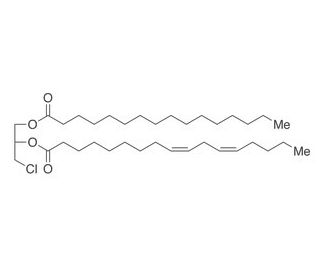

rac-1-Palmitoyl-2-linoleoyl-3-chloropropanediol (CAS 1246833-87-3)
QUICK LINKS
Rac-1-Palmitoyl-2-linoleoyl-3-chloropropanediol is a compound that functions as a surfactant in experimental applications. It acts by reducing the surface tension between two substances, allowing them to mix more easily. At the molecular level, rac-1-Palmitoyl-2-linoleoyl-3-chloropropanediol interacts with the interfaces between different phases, such as oil and water, to facilitate emulsification and dispersion. This surfactant′s mode of action involves its hydrophobic and hydrophilic properties, which enable it to stabilize emulsions and prevent the separation of different components. By lowering the interfacial tension, it promotes the formation of stable mixtures and enhances the solubility of substances that are typically immiscible. In experimental applications, rac-1-Palmitoyl-2-linoleoyl-3-chloropropanediol may play a functional role in facilitating the creation of stable emulsions and improving the dispersion of substances.
rac-1-Palmitoyl-2-linoleoyl-3-chloropropanediol (CAS 1246833-87-3) References
- High-throughput and sensitive analysis of 3-monochloropropane-1,2-diol fatty acid esters in edible oils by supercritical fluid chromatography/tandem mass spectrometry. | Hori, K., et al. 2012. J Chromatogr A. 1250: 99-104. PMID: 22749582
- Direct determination of fatty acid esters of 3-chloro-1, 2-propanediol in edible vegetable oils by isotope dilution - ultra high performance liquid chromatography - triple quadrupole mass spectrometry. | Li, H., et al. 2015. J Chromatogr A. 1410: 99-109. PMID: 26239698
- Insights into the formation mechanism of chloropropanol fatty acid esters under laboratory-scale deodorization conditions. | Hori, K., et al. 2016. J Biosci Bioeng. 122: 246-51. PMID: 26822095
- Benefits of ion mobility for analysing monochloropropane-diol esters. | Grössl, M. and Nagy, K. 2017. Food Addit Contam Part A Chem Anal Control Expo Risk Assess. 34: 1131-1139. PMID: 28513334
- Direct determination of 3-chloropropanol esters in edible vegetable oils using high resolution mass spectrometry (HRMS-Orbitrap). | Graziani, G., et al. 2017. Food Addit Contam Part A Chem Anal Control Expo Risk Assess. 34: 1893-1903. PMID: 28820048
- Development of a partitioned liquid-liquid extraction- dispersive solid phase extraction procedure followed by liquid chromatography-tandem mass spectrometry for analysis of 3-monochloropropane-1,2-diol diesters in edible oils. | Custodio-Mendoza, JA., et al. 2018. J Chromatogr A. 1548: 19-26. PMID: 29555360
- Occurrence and exposure of 3-monochloropropanediol diesters in edible oils and oil-based foodstuffs from the Spanish market. | Custodio-Mendoza, JA., et al. 2019. Food Chem. 270: 214-222. PMID: 30174037
- Ultrasound-assisted enzymatic indirect determination of total 3-monochloropropane-1,2-diol esters in canned fish oil fraction. | Custodio-Mendoza, JA., et al. 2023. Food Chem. 403: 134423. PMID: 36183472
- Simultaneous determination of 3-MCPD fatty acid esters and glycidol fatty acid esters in edible oils using liquid chromatography time-of-flight mass spectrometry | Hori, K., Koriyama, N., Omori, H., Kuriyama, M., Arishima, T., & Tsumura, K. 2012. LWT-Food Science and Technology. 48(2): 204-208.
Ordering Information
| Product Name | Catalog # | UNIT | Price | Qty | FAVORITES | |
rac-1-Palmitoyl-2-linoleoyl-3-chloropropanediol, 25 mg | sc-478031 | 25 mg | $388.00 |