
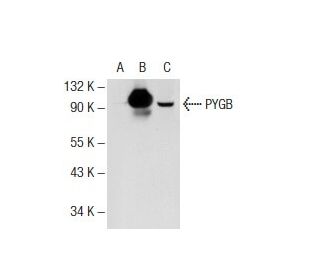
PYGB/M Anticuerpo (6F1): sc-51926
- PYGB/M Anticuerpo 6F1 es un monoclonal de ratón IgG1 proporcionado como 100 µg/ml
- planteado contra human glicógeno fosforilasa cerebral
- recomendado para detectar PYGB and PYGM de human origen, mediante WB y IP
- Actualmente, aún no hemos completado la identificación de los reactivos de detección secundaria preferidos para PYGB/M Anticuerpo (6F1). Este trabajo está en progreso.

ENLACES RÁPIDOS
VER TAMBIÉN ....
El anticuerpo PYGB/M (6F1) es un anticuerpo monoclonal de ratón IgG1 que detecta la proteína PYGB/M de origen humano mediante WB e IP. La glicólisis es una serie evolutivamente conservada de diez reacciones químicas que utiliza once enzimas para generar simultáneamente piruvato y ATP a partir de glucosa. La fosfo-fructo quinasa-2/fructosa 2,6-bifosfatasa (PFK-2) estimula la síntesis y degradación de fructosa 2,6-bifosfato. La glucógeno fosforilasa (también conocida como GP) es una enzima alostérica importante en el metabolismo de carbohidratos. Su actividad está regulada ya sea a través de la unión no covalente de metabolitos o por modificación covalente. La glucógeno fosforilasa cataliza la fosforilación del glucógeno a Glc-1-P. Hay tres genes que codifican las formas cerebral, hepática y muscular de la glucógeno fosforilasa, PYGB, PYGL y PYGM. Debido a su papel fundamental en el metabolismo del glucógeno, la glucógeno fosforilasa ha sido un objetivo para el diseño de compuestos inhibidores, que podrían ser valiosos en el tratamiento terapéutico de la diabetes mellitus tipo 2.
Alexa Fluor® es una marca registrada de Molecular Probes Inc., OR., USA
REIVEW LI-COR® y Odyssey® son marcas registradas de LI-COR Biosciences.
PYGB/M Anticuerpo (6F1) Referencias:
- Expresión de isoformas de glucógeno fosforilasa en músculo cultivado de pacientes con enfermedad de McArdle portadores de la mutación p.R771PfsX33 PYGM. | Nogales-Gadea, G., et al. 2010. PLoS One. 5: PMID: 20957198
- El aumento de la sensibilidad a la inanición de glucosa se correlaciona con la regulación a la baja de la isoforma PYGB de la glucógeno fosforilasa en líneas celulares tumorales resistentes a la 2-deoxi-D-glucosa. | Philips, KB., et al. 2014. Cancer Chemother Pharmacol. 73: 349-61. PMID: 24292700
- Nueva variante en el gen PYGM que causa miopatía de cinturas de extremidades de aparición tardía, ptosis y camptocormia. | Chéraud, C., et al. 2018. Muscle Nerve. 57: 157-160. PMID: 28120463
- El silenciamiento de PYGB suprime el crecimiento y promueve la apoptosis de las células de cáncer de próstata a través de la vía de señalización NF-κB/Nrf2. | Wang, Z., et al. 2018. Mol Med Rep. 18: 3800-3808. PMID: 30106110
- El análisis proteómico diferencial del líquido endometrial sugiere un aumento de la inflamación y una alteración del metabolismo de la glucosa en los ciclos de FIV no implantatorios y señala a la PYGB como un posible marcador de implantación. | Azkargorta, M., et al. 2018. Hum Reprod. 33: 1898-1906. PMID: 30169642
- Una nueva enfermedad de almacenamiento de glucógeno causada por una mutación dominante de PYGM. | Echaniz-Laguna, A., et al. 2020. Ann Neurol. 88: 274-282. PMID: 32386344
- PYGB promovió la progresión tumoral mediante la regulación de Wnt/β-Catenin Pathway en el cáncer gástrico. | Xia, B., et al. 2020. Technol Cancer Res Treat. 19: 1533033820926592. PMID: 32462986
- La secuenciación del exoma completo detecta variantes PYGM en dos adultos con enfermedad de McArdle. | Thomas-Wilson, A., et al. 2022. Cold Spring Harb Mol Case Stud. 8: PMID: 35022222
- El análisis de aprendizaje automático basado en la proteómica revela que el PYGB es un biomarcador inmunohistoquímico novedoso para distinguir el papiloma urotelial invertido del carcinoma papilar urotelial de bajo grado con crecimiento invertido. | Jung, M., et al. 2022. Front Oncol. 12: 841398. PMID: 35402263
- Desarrollo y Validación de un Método UHPLC-MS/MS para la Cuantificación de un Nuevo Inhibidor PYGB en Plasma: Aplicación a estudios farmacocinéticos. | Xu, S., et al. 2023. Molecules. 28: PMID: 37836837
Información sobre pedidos
| Nombre del producto | Número de catálogo | UNIDAD | Precio | CANTIDAD | Favoritos | |
PYGB/M Anticuerpo (6F1) | sc-51926 | 100 µg/ml | $322.00 |