
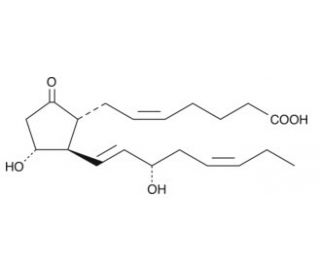

Prostaglandin E3 (CAS 802-31-3)
QUICK LINKS
Prostaglandin E3 (PGE3) stands as a vital lipid mediator that occurs naturally. As a member of the prostaglandin family, Prostaglandin E3 belongs to a group of unsaturated fatty acid derivatives synthesized from arachidonic acid. Furthermore, Prostaglandin E3 finds extensive utility in scientific research, particularly in the realms of cell culture and tissue engineering. In cell culture studies, Prostaglandin E3 has been employed to induce the differentiation of stem cells into specific cell types and to enhance the proliferation of particular cell populations. In the realm of tissue engineering, Prostaglandin E3 has demonstrated its efficacy in promoting tissue growth and improving the survival rate of transplanted tissues. Prostaglandin E3 exerts its influence on cells through an array of receptors, including EP2, EP4, and IP receptors. The EP2 and EP4 receptors belong to the class of G-protein coupled receptors, while the IP receptor functions as a ligand-gated ion channel. Upon binding to these receptors, Prostaglandin E3 initiates a cascade of intracellular signaling pathways, triggering alterations in gene expression.
Prostaglandin E,[object Object], (CAS 802-31-3) References
- Biological activity of prostaglandin E3 with regard to oedema formation in mice. | Hawkes, JS., et al. 1992. Agents Actions. 35: 85-7. PMID: 1509981
- Emerging importance of omega-3 fatty acids in the innate immune response: molecular mechanisms and lipidomic strategies for their analysis. | Maskrey, BH., et al. 2013. Mol Nutr Food Res. 57: 1390-400. PMID: 23417926
- Effect of eicosapentaenoic acid-derived prostaglandin E3 on intestinal epithelial barrier function. | Rodríguez-Lagunas, MJ., et al. 2013. Prostaglandins Leukot Essent Fatty Acids. 88: 339-45. PMID: 23453388
- Prostaglandin E3 metabolism and cancer. | Yang, P., et al. 2014. Cancer Lett. 348: 1-11. PMID: 24657656
- Prostaglandin E2 induces apoptosis in cultured rat microglia. | Nagano, T., et al. 2014. Brain Res. 1568: 1-9. PMID: 24845544
- Effects of prostaglandin E3 and eicosapentaenoic acid on rat bone in organ culture. | Raisz, LG., et al. 1989. Prostaglandins. 37: 615-25. PMID: 2544927
- Prostaglandin transporter (OATP2A1/SLCO2A1) contributes to local disposition of eicosapentaenoic acid-derived PGE3. | Gose, T., et al. 2016. Prostaglandins Other Lipid Mediat. 122: 10-7. PMID: 26692285
- The urinary excretion of prostaglandins E and their corresponding tetranor metabolites by rats fed a diet rich in eicosapentaenoate. | Kivits, GA. and Nugteren, DH. 1988. Biochim Biophys Acta. 958: 289-99. PMID: 2827784
- Comparative effects of prostaglandin E2 and prostaglandin E3 on water flow and cyclic AMP in the urinary bladder of the frog, Rana pipiens. | Herman, CA., et al. 1985. Prostaglandins. 29: 629-42. PMID: 2988024
- Occurrence of prostaglandin E3 in human urine as a result of marine oil ingestion: gas chromatographic-mass spectrometric evidence. | Ferretti, A., et al. 1988. Biochim Biophys Acta. 959: 262-8. PMID: 3162687
- Gestational long-term hypoxia induces metabolomic reprogramming and phenotypic transformations in fetal sheep pulmonary arteries. | Leslie, E., et al. 2021. Am J Physiol Lung Cell Mol Physiol. 320: L770-L784. PMID: 33624555
- Prostaglandin E3 attenuates macrophage-associated inflammation and prostate tumour growth by modulating polarization. | Cui, J., et al. 2021. J Cell Mol Med. 25: 5586-5601. PMID: 33982835
- Isolation of two novel E prostaglandins in human seminal fluid. | Oliw, EH., et al. 1986. J Biol Chem. 261: 2675-83. PMID: 3949743
- Identification and quantification of prostaglandin E3 in renal medullary tissue of three strains of rats fed fish oil. | Ferretti, A., et al. 1981. Lipids. 16: 800-4. PMID: 7311739
Ordering Information
| Product Name | Catalog # | UNIT | Price | Qty | FAVORITES | |
Prostaglandin E3, 50 µg | sc-205454 | 50 µg | $180.00 | |||
Prostaglandin E3, 100 µg | sc-205454A | 100 µg | $281.00 | |||
Prostaglandin E3, 500 µg | sc-205454B | 500 µg | $1436.00 | |||
Prostaglandin E3, 1 mg | sc-205454C | 1 mg | $2569.00 |