
POT1 Lentiviral Activation Particles (h): sc-403275-LAC
- Zielspezies: human
- 200 µl transduktionsfertige, hoch-titer CRISPR/dCas9 Lentivirale Aktivierungs-Partikel
- POT1 Lentiviral Activation Particles (h) sind ein SAM-Komplex (Mediator-Komplex zur synergistischen Gen-Aktivierung) gesteuertes System zur Transkriptionsaktivierung eines gewünschten Zielgens, um wirkungsvoll die spezifische Genexpression mittels lentiviraler Transduktion der Zellen zu erhöhen
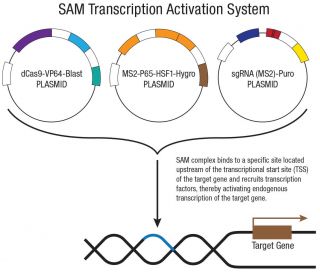
- POT1 Lentiviral Activation Particles (h) enthalten die folgenden SAM Aktivierungselemente: deaktivierte Cas9 (dCas9) Nuklease (D10A und N863A) fusioniert an die Transaktivierungs-Domäne VP64, ein MS2-p65-HSF1 Fusionsprotein und eine zielspezifische 20nt gRNA. Des Weiteren enthalten sind die Resistenzgene für blasticidin, hygromycin und puromycin
- Der entstehende SAM-Komplex (Mediator-Komplex zur synergistischen Gen-Aktivierung) bindet eine sequenzspezifische Region 200-250 nt upstream (in 5'-Richtung) des Transkriptionsstartsignals und rekrutiert dort ständig Transkriptionsfaktoren für eine verstärkte Gen-Aktivierung und Gen-Expression.
- Die von POT1 Lentiviral Activation Plasmid (h) und POT1 Lentiviral Activation Plasmid (h2) kodierten gRNAs zielen auf unterschiedliche regulatorische Regionen des POT1-Promotors ab. Eines oder beide Designs sind möglicherweise verfügbar
- Nach der Transfektion kann die Effizienz der Genaktivierung per Western Blot oder histologisch mit folgendem Antikörper überprüft werden: POT1 Antibody (M1-P1H5): sc-81711

Bestellinformation
| Produkt | Katalog # | EINHEIT | Preis | ANZAHL | Favoriten | |
POT1 Lentiviral Activation Particles (h) | sc-403275-LAC | 200 µl | $455.00 |
Humanes POT1 (Protection of Telomeres 1) kodiert eine zentrale Komponente des Shelterin-Komplexes, die an den einzelsträngigen 3′-telomerischen Überhang bindet, aberrantes, ATR-abhängiges DNA-Schadenssignalieren begrenzt und den Zugang der Telomerase reguliert. Durch die Koordination von Telomerkappung, Endprozessierung und Replikationsgabel-Fortschritt durch telomerische Wiederholungssequenzen trägt POT1 zur Erhaltung der Integrität der Chromosomenenden und zur Genomstabilität bei. Eine Störung der POT1-Funktion ist mit Telomer-Dysfunktion, veränderter Homöostase der Telomerlänge und erhöhter chromosomaler Instabilität verbunden – Prozesse, die für Studien zur Tumorprädisposition sowie zur Biologie hämatologischer und kutaner, malignitätsassoziierter Erkrankungen relevant sind. POT1 wird daher häufig als zentraler Ansatzpunkt genutzt, um Signalwege der DNA-Schadensantwort, Replikationsstress an repetitiver DNA und Mechanismen der Telomererhaltung zu untersuchen.
POT1 Lentivirale Aktivierungspartikel (h) erfüllen diesen Bedarf, indem sie das vollständige Transkriptionsaktivierungssystem des Synergistic Activation Mediator (SAM) in transduktionsbereite, hoch-titrige lentivirale Partikel verpacken und so eine effiziente POT1-Hochregulation über ein breiteres Spektrum menschlicher Zelltypen ermöglichen.
POT1 Lentivirale Aktivierungspartikel (h) liefern alle funktionellen Komponenten des Synergistic Activation Mediator (SAM)-Systems über lentivirale Transduktion. Das System umfasst drei Partikelpräparate, die gemeinsam in Zielzellen transduziert werden: eines, das für katalytisch inaktives dCas9 (Mutationen D10A und N863A) kodiert, das mit der VP64-Transaktivierungsdomäne und einem Blasticidin-Resistenzgen fusioniert ist; eines, das für das MS2-p65-HSF1-Fusionsprotein mit einem Hygromycin-Resistenzgen kodiert; und eines, das für eine zielspezifische 20-nt-sgRNA kodiert, die an zwei MS2-RNA-Aptamere mit einem Puromycin-Resistenzgen fusioniert ist. Nach der lentiviralen Transduktion und der genomischen Integration der Expressionskassetten werden die SAM-Komponenten stabil exprimiert und lagern sich am Zielort innerhalb der proximalen Promotorregion stromaufwärts der POT1-Transkriptionsstartstelle an, wo VP64, p65 und HSF1 kooperativ wirken, um endogene Transkriptionsmaschinerie zu rekrutieren und eine anhaltende Hochregulation der endogenen POT1-Expression zu bewirken. Die Verwendung von nuklease-inaktivem dCas9 verhindert die Einführung von Doppelstrangbrüchen in der DNA und bewahrt den nativen POT1-Genomlokus sowie die regulatorische Architektur.
Das lentivirale Format bietet mehrere praktische Vorteile: Die stabile genomische Integration unterstützt eine vererbbare Aktivierung über Zellteilungen hinweg; Partikelpräparate mit hohem Titer machen eine eigene Virusproduktion überflüssig; und die Kompatibilität mit primären, sich nicht teilenden und transfektionsresistenten Zelltypen erweitert die experimentellen Möglichkeiten. Eine erfolgreiche Transduktion kann durch eine dreifache Antibiotika-Selektion mit Puromycin, Hygromycin und Blasticidin bestätigt und verstärkt werden.
Nur für Forschungszwecke. Nicht für diagnostische oder therapeutische Zwecke bestimmt.