
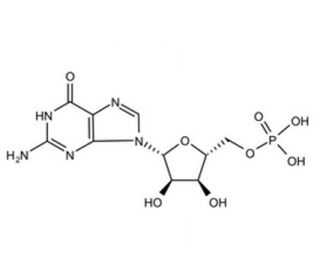

Polyguanylic acid potassium salt (CAS 54684-83-2)
ACCÈS RAPIDE AUX LIENS
Le sel de potassium de l'acide polyguanylique est une molécule cible pour les études physicochimiques de la guanosine. L'acide polyguanylique présente une conformation hélicoïdale à quatre brins et est produit artificiellement chez Thermus thermophilus par l'action catalytique de l'enzyme polynucléotide phosphorylase, en utilisant la guanosine diphosphate (GDP) comme précurseur. Il est utile pour étudier les effets des rayonnements ionisants sur la formation et la stabilité des structures G-quadruplex et sert de molécule cible pour les études physicochimiques de l'excitation électronique de la guanosine (spectres vibrationnels). En outre, le sel de potassium de l'acide polyguanylique a été utilisé à diverses fins, notamment pour des études d'internalisation impliquant la neuropiline-1 de surface (NRP1) comme ligand, des études d'intercalation avec des dérivés phényliques liés à des triazoles trisubstitués et disubstitués (CL41, CL42 et CL2r50) à l'aide de techniques de voltampérométrie, et comme polynucléotide synthétique pour l'analyse par électrophorèse sur gel d'agarose.
Polyguanylic acid potassium salt (CAS 54684-83-2) Références
- Détection électrochimique de la séquence de l'ADNr 16S d'E. coli à l'aide d'électrodes sérigraphiées imprégnées de fullerène et activées par plasma d'air. | Shiraishi, H., et al. 2007. Bioelectrochemistry. 70: 481-7. PMID: 16962387
- Réseau de micropuits voltampérométriques pour la guanosine oxydée dans l'ADN ds intact. | Song, B., et al. 2013. Anal Chem. 85: 11061-7. PMID: 24164630
- Système de livraison de gènes sûr et efficace, composé d'ADN plasmidique recouvert d'un polynucléotide. | Kodama, Y., et al. 2015. J Drug Target. 23: 43-51. PMID: 25148610
- Application des biocapteurs d'ADN et de la calorimétrie différentielle à balayage à l'étude de l'agent liant l'ADN, le Berenil. | De Abreu, FC., et al. 2008. Sensors (Basel). 8: 1519-1538. PMID: 27879778
- Oxydation électrocatalytique des alcools, de la tripropylamine et de l'ADN avec des nanoclusters d'or sans ligand sur du carbone nitruré. | Yao, H., et al. 2016. ChemElectroChem. 3: 2100-2109. PMID: 28497012
- Le polyG atténue la fibrose pulmonaire induite par la silice en inhibant la nucléoline et en régulant la voie de réparation des dommages à l'ADN. | Zhou, Q., et al. 2020. Biomed Pharmacother. 125: 109953. PMID: 32036217
- Mécanisme d'oxydoréduction de l'azathioprine et son interaction avec l'ADN. | Bunea, MC., et al. 2021. Int J Mol Sci. 22: PMID: 34202734
- Évaluation électrochimique in situ de l'interaction de l'ADNdb avec le médicament anticancéreux inhibiteur du protéasome, le bortézomib. | Bunea, MC., et al. 2023. Molecules. 28: PMID: 37050039
- La liaison des 7,8-diol-9,10-époxydes de benzo[a]pyrène à l'ADN, à l'ARN et aux protéines de la peau de souris se produit avec une stéréosélectivité élevée. | Koreeda, M., et al. 1978. Science. 199: 778-81. PMID: 622566
- Essai de reconnaissance de l'ADN par échange de ligands à empreinte moléculaire au moyen d'un système SPR utilisant les sites de reconnaissance de la guanosine et de la guanine de l'AND | Diltemiz, S. E., Denizli, A., Ersöz, A., & Say, R. 2008. Sensors and Actuators B: Chemical,. 133(2): 484-488.
- Évaluation in situ de l'interaction entre le cytochrome P450 humain (CYP1A2) et l'ADNsd à l'aide d'un biocapteur électrochimique à ADNsd | Lopes, I. C., & Oliveira‐Brett, A. M. 2017. Electroanalysis. 29(7): 1674-1682.
- Adsorption d'acides nucléiques sur des points quantiques de graphène en fonction de la fraction de sucre: Preuves photophysiques, thermodynamiques et théoriques | Maiti, S., Karmakar, S., Kundu, S., Roy, C. N., Das, T. K., Chakraborty, B., & Saha, A. 2023. Journal of Molecular Liquids. 371: 121148.
Informations pour la commande
| Nom du produit | Ref. Catalogue | COND. | Prix HT | QTÉ | Favoris | |
Polyguanylic acid potassium salt, 5 mg | sc-215730 | 5 mg | $113.00 | |||
Polyguanylic acid potassium salt, 25 mg | sc-215730A | 25 mg | $406.00 |