
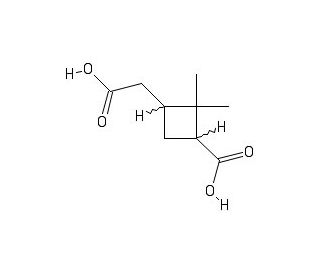

Pinic Acid (CAS 28664-02-0)
See product citations (1)
QUICK LINKS
Pinic acid is an organic compound that is primarily of interest within the field of atmospheric chemistry and environmental research. It is a major oxidation product of α-pinene, a monoterpene that is emitted by coniferous trees and a common constituent of natural forest atmospheres. Studies involving pinic acid focus on its formation, role, and fate in the atmosphere as a secondary organic aerosol (SOA) component. Researchers examine how pinic acid contributes to aerosol optical properties, which can affect climate by influencing the Earth′s radiation balance. Additionally, pinic acid is used in investigations related to the understanding of aerosol particle formation and growth processes, as these particles can have significant effects on both air quality and climate. The compound′s behavior in atmospheric chemical reactions, including its interactions with other pollutants and participation in various atmospheric conditions, is also a subject of research.
Pinic Acid (CAS 28664-02-0) References
- Evaporation rates and vapor pressures of individual aerosol species formed in the atmospheric oxidation of alpha- and beta-pinene. | Bilde, M. and Pandis, SN. 2001. Environ Sci Technol. 35: 3344-9. PMID: 11529575
- Aerosol formation: atmospheric particles from organic vapours. | O'Dowd, CD., et al. 2002. Nature. 416: 497-8. PMID: 11932734
- Determination of organic acids in aerosol particles from a coniferous forest by liquid chromatography-mass spectrometry. | Anttila, P., et al. 2005. J Sep Sci. 28: 337-46. PMID: 15792248
- Contributions of organic peroxides to secondary aerosol formed from reactions of monoterpenes with O3. | Docherty, KS., et al. 2005. Environ Sci Technol. 39: 4049-59. PMID: 15984782
- Hydroxydicarboxylic acids: markers for secondary organic aerosol from the photooxidation of alpha-pinene. | Claeys, M., et al. 2007. Environ Sci Technol. 41: 1628-34. PMID: 17396652
- Multifunctional acid formation from the gas-phase ozonolysis of beta-pinene. | Ma, Y. and Marston, G. 2008. Phys Chem Chem Phys. 10: 6115-26. PMID: 18846301
- Determination of higher carboxylic acids in snow samples using solid-phase extraction and LC/MS-TOF. | Kippenberger, M., et al. 2008. Anal Bioanal Chem. 392: 1459-70. PMID: 18958453
- Roadside, urban, and rural comparison of primary and secondary organic molecular markers in ambient PM2.5. | Yan, B., et al. 2009. Environ Sci Technol. 43: 4287-93. PMID: 19603636
- Application of hollow fiber liquid phase microextraction for pinic acid and pinonic acid analysis from organic aerosols. | Hyder, M., et al. 2012. Anal Chim Acta. 713: 79-85. PMID: 22200311
- Use of denuder/filter apparatus to investigate terpene ozonolysis. | Wells, JR. 2012. J Environ Monit. 14: 1044-54. PMID: 22334151
- Analysis of α-acyloxyhydroperoxy aldehydes with electrospray ionization-tandem mass spectrometry (ESI-MS(n)). | Witkowski, B. and Gierczak, T. 2013. J Mass Spectrom. 48: 79-88. PMID: 23303750
- Analysis of organic aerosols using a micro-orifice volatilization impactor coupled to an atmospheric-pressure chemical ionization mass spectrometer. | Brüggemann, M., et al. 2014. Eur J Mass Spectrom (Chichester). 20: 31-41. PMID: 24881453
- Effect of Bisulfate, Ammonia, and Ammonium on the Clustering of Organic Acids and Sulfuric Acid. | Myllys, N., et al. 2017. J Phys Chem A. 121: 4812-4824. PMID: 28585824
- Effect of relative humidity and the presence of aerosol particles on the α-pinene ozonolysis. | Zhang, G., et al. 2018. J Environ Sci (China). 71: 99-107. PMID: 30195694
- Year-round measurements of size-segregated low molecular weight organic acids in Arctic aerosol. | Feltracco, M., et al. 2021. Sci Total Environ. 763: 142954. PMID: 33498125
Ordering Information
| Product Name | Catalog # | UNIT | Price | Qty | FAVORITES | |
Pinic Acid, 50 mg | sc-477289 | 50 mg | $353.00 | |||
Pinic Acid, 500 mg | sc-477289A | 500 mg | $2567.00 |