
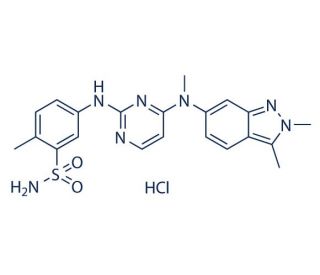

Pazopanib Hydrochloride (CAS 635702-64-6)
See product citations (1)
QUICK LINKS
Pazopanib Hydrochloride is a small molecule inhibitor that functions as a potent and selective multi-targeted receptor tyrosine kinase inhibitor. It exerts its mechanism of action by binding to and inhibiting the activity of several protein kinases involved in tumor cell proliferation and angiogenesis, including vascular endothelial growth factor receptor (VEGFR), platelet-derived growth factor receptor (PDGFR), and stem cell factor receptor (c-KIT). By targeting these key signaling pathways, Pazopanib Hydrochloride disrupts the growth and survival of tumor cells, as well as the formation of new blood vessels that support tumor growth. Pazopanib Hydrochloride′s mechanism of action involves interfering with the intracellular signaling cascades that regulate cell growth, survival, and angiogenesis, ultimately leading to the inhibition of tumor progression and metastasis. Pazopanib Hydrochloride may exhibit anti-tumor and anti-angiogenic effects in preclinical models, making it useful for investigating the molecular mechanisms underlying cancer progression and angiogenesis.
Pazopanib Hydrochloride (CAS 635702-64-6) References
- Analytical control of genotoxic impurities in the pazopanib hydrochloride manufacturing process. | Liu, DQ., et al. 2009. J Pharm Biomed Anal. 50: 144-50. PMID: 19427156
- Analytical control of process impurities in Pazopanib hydrochloride by impurity fate mapping. | Li, Y., et al. 2010. J Pharm Biomed Anal. 52: 493-507. PMID: 20189340
- Pazopanib for the first-line treatment of patients with advanced and/or metastatic renal cell carcinoma: a NICE single technology appraisal. | Kilonzo, M., et al. 2013. Pharmacoeconomics. 31: 15-24. PMID: 23329590
- Characterization of forced degradation products of pazopanib hydrochloride by UHPLC-Q-TOF/MS and in silico toxicity prediction. | Patel, PN., et al. 2015. J Mass Spectrom. 50: 918-28. PMID: 26349647
- Safety and Efficacy of Pazopanib Therapy Prior to Planned Nephrectomy in Metastatic Clear Cell Renal Cancer. | Powles, T., et al. 2016. JAMA Oncol. 2: 1303-1309. PMID: 27254750
- Outcomes of Patients With Metastatic Non-Clear-Cell Renal Cell Carcinoma Treated With Pazopanib. | Matrana, MR., et al. 2017. Clin Genitourin Cancer. 15: e205-e208. PMID: 27568124
- Evaluation of Pazopanib Phase Behavior Following pH-Induced Supersaturation. | Sugihara, H. and Taylor, LS. 2018. Mol Pharm. 15: 1690-1699. PMID: 29502424
- Simultaneous monitoring of pazopanib and its metabolites by UPLC-MS/MS. | Paludetto, MN., et al. 2018. J Pharm Biomed Anal. 154: 373-383. PMID: 29571135
- Use of Physiologically Based Pharmacokinetic Modeling for Predicting Drug-Food Interactions: Recommendations for Improving Predictive Performance of Low Confidence Food Effect Models. | Wagner, C., et al. 2021. AAPS J. 23: 85. PMID: 34142242
- A patent review on efficient strategies for the total synthesis of pazopanib, regorafenib and lenvatinib as novel anti-angiogenesis receptor tyrosine kinase inhibitors for cancer therapy. | Shiri, P., et al. 2022. Mol Divers. 26: 2981-3002. PMID: 35235141
- Atomic Layer Deposition Coating on the Surface of Active Pharmaceutical Ingredients to Reduce Surface Charge Build-Up. | Gupta, S., et al. 2022. ACS Appl Mater Interfaces.. PMID: 35656880
- Preparation and Characterization of Pazopanib Hydrochloride-Loaded Four-Component Self-Nanoemulsifying Drug Delivery Systems Preconcentrate for Enhanced Solubility and Dissolution. | Choi, SA., et al. 2022. Pharmaceutics. 14: PMID: 36145623
- Screening for Differences in Early Exposure in the Fasted State with in Vitro Methodologies can be Challenging: Experience with the BioGIT System. | Kostantini, C., et al. 2023. J Pharm Sci.. PMID: 36918113
- Regioselective methylation of indazoles using methyl 2,2,2-trichloromethylacetimidate | Sudhakar Reddy Baddam a, N. Uday Kumar a, A. Panasa Reddy b, Rakeshwar Bandichhor a. 2013. Tetrahedron Letters. 54: 1661-1663.
- Design, development and evaluation of self-microemulsifying drug delivery system of pazopanib for enhanced dissolution rate and cytotoxic potential | Devender Kumar a, Sushama Talegaonkar b, Simrata Bedi c, Kiran Dubey a. 2023. Journal of Drug Delivery Science and Technology. 80.
Ordering Information
| Product Name | Catalog # | UNIT | Price | Qty | FAVORITES | |
Pazopanib Hydrochloride, 10 mg | sc-364564 | 10 mg | $107.00 | |||
Pazopanib Hydrochloride, 25 mg | sc-364564A | 25 mg | $230.00 |