
Date published: 2025-12-14

1-800-457-3801

SCBT Portrait Logo
Seach Input

ORC1 Antibody (7A7): sc-23887

4.4(5)
Write a reviewAsk a question

Datasheets
  • ORC1 Antibody (7A7) is a rat monoclonal IgG1 ORC1 antibody, cited in 7 publications, provided at 200 µg/ml
  • raised against partially purified His-tagged bacterially expressed fusion protein corresponding to human ORC1
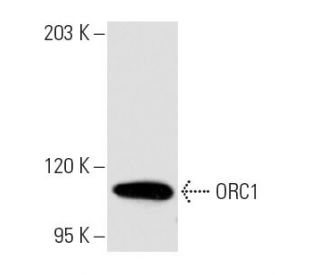
  • ORC1 Antibody (7A7) is recommended for detection of ORC1 of mouse, rat and human origin by WB and IP
  • Anti-ORC1 Antibody (7A7) is available conjugated to agarose for IP; HRP for WB, IHC(P) and ELISA; and to either phycoerythrin or FITC for IF, IHC(P) and FCM
  • also available conjugated to Alexa Fluor® 488, Alexa Fluor® 546, Alexa Fluor® 594 or Alexa Fluor® 647 for WB (RGB), IF, IHC(P) and FCM, and for use with RGB fluorescent imaging systems, such as iBright™ FL1000, FluorChem™, Typhoon, Azure and other comparable systems
  • also available conjugated to Alexa Fluor® 680 or Alexa Fluor® 790 for WB (NIR), IF and FCM; for use with Near-Infrared (NIR) detection systems, such as LI-COR®Odyssey®, iBright™ FL1000, FluorChem™, Typhoon, Azure and other comparable systems
  • TransCruz reagent for Gel Supershift and ChIP applications (sc-23887 X, 200 µg/0.1 ml)
  • At present, we have not yet completed the identification of the preferred secondary detection reagent(s) for ORC1 Antibody (7A7). This work is in progress.

QUICK LINKS

SEE ALSO...

ORC1 Antibody (7A7) is a rat monoclonal IgG1 antibody that detects ORC1 protein of mouse, rat, and human origin by western blotting (WB) and immunoprecipitation (IP). ORC1 (7A7) antibody is available in both non-conjugated and various conjugated forms, including agarose, horseradish peroxidase (HRP), phycoerythrin (PE), fluorescein isothiocyanate (FITC), and multiple Alexa Fluor® conjugates. ORC1 plays a pivotal role in the initiation of DNA replication, which is essential for cell division and the maintenance of genomic integrity. ORC1 is a key component of the origin recognition complex (ORC), which binds to specific DNA sequences at the origins of replication, serving as a scaffold for the assembly of additional initiation factors necessary for the formation of pre-replication complexes. Proper functioning of ORC1 ensures that DNA replication occurs accurately and at the right time during the cell cycle. ORC1 is expressed in the nucleus of proliferating cells, including those in tissues such as the testis, and ORC1′s interaction with other ORC subunits, particularly ORC2, is vital for the stability and functionality of the ORC complex throughout the cell cycle. The dynamic assembly of ORC proteins, including ORC1, ORC2, ORC3, ORC4, ORC5, and ORC6, underscores their importance in regulating the G1-S transition, a critical phase in cell cycle progression.

For Research Use Only. Not Intended for Diagnostic or Therapeutic Use.

Alexa Fluor® is a trademark of Molecular Probes Inc., OR., USA

LI-COR® and Odyssey® are registered trademarks of LI-COR Biosciences

ORC1 Antibody (7A7) References:

  1. Selective instability of Orc1 protein accounts for the absence of functional origin recognition complexes during the M-G(1) transition in mammals.  |  Natale, DA., et al. 2000. EMBO J. 19: 2728-38. PMID: 10835370
  2. Identification and characterization of the human ORC6 homolog.  |  Dhar, SK. and Dutta, A. 2000. J Biol Chem. 275: 34983-8. PMID: 10945994
  3. Subsets of human origin recognition complex (ORC) subunits are expressed in non-proliferating cells and associate with non-ORC proteins.  |  Thome, KC., et al. 2000. J Biol Chem. 275: 35233-41. PMID: 10954718
  4. Chromatin association of human origin recognition complex, cdc6, and minichromosome maintenance proteins during the cell cycle: assembly of prereplication complexes in late mitosis.  |  Méndez, J. and Stillman, B. 2000. Mol Cell Biol. 20: 8602-12. PMID: 11046155
  5. Assembly of the human origin recognition complex.  |  Vashee, S., et al. 2001. J Biol Chem. 276: 26666-73. PMID: 11323433
  6. Architecture of the human origin recognition complex.  |  Dhar, SK., et al. 2001. J Biol Chem. 276: 29067-71. PMID: 11395502
  7. Identification of HsORC4, a member of the human origin of replication recognition complex.  |  Quintana, DG., et al. 1997. J Biol Chem. 272: 28247-51. PMID: 9353276
  8. The human origin recognition complex protein 1 dissociates from chromatin during S phase in HeLa cells.  |  Kreitz, S., et al. 2001. J Biol Chem. 276: 6337-42. PMID: 11102449

Ordering Information

Product NameCatalog #UNITPriceQtyFAVORITES

ORC1 Antibody (7A7)

sc-23887
200 µg/ml
$316.00

ORC1 Antibody (7A7) X

sc-23887 X
200 µg/0.1 ml
$316.00

ORC1 Antibody (7A7) AC

sc-23887 AC
500 µg/ml, 25% agarose
$416.00

ORC1 Antibody (7A7) HRP

sc-23887 HRP
200 µg/ml
$316.00

ORC1 Antibody (7A7) FITC

sc-23887 FITC
200 µg/ml
$330.00

ORC1 Antibody (7A7) PE

sc-23887 PE
200 µg/ml
$343.00

ORC1 Antibody (7A7) Alexa Fluor® 488

sc-23887 AF488
200 µg/ml
$357.00

ORC1 Antibody (7A7) Alexa Fluor® 546

sc-23887 AF546
200 µg/ml
$357.00

ORC1 Antibody (7A7) Alexa Fluor® 594

sc-23887 AF594
200 µg/ml
$357.00

ORC1 Antibody (7A7) Alexa Fluor® 647

sc-23887 AF647
200 µg/ml
$357.00

ORC1 Antibody (7A7) Alexa Fluor® 680

sc-23887 AF680
200 µg/ml
$357.00

ORC1 Antibody (7A7) Alexa Fluor® 790

sc-23887 AF790
200 µg/ml
$357.00

When should the TransCruz reagent sc-23887 X be used instead of the standard form sc-23887?

Asked by: Germaine
Thank you for your question. We recommend using the TransCruz reagent form when performing ChIP or GelShift assays. This form can also be used in other applications such as Western Blot or IHC, but the dilution should be adjusted by a factor of 10 to account for the higher original concentration.
Answered by: Technical Support
Date published: 2017-02-24
  • y_2025, m_12, d_2, h_8CST
  • bvseo_bulk, prod_bvqa, vn_bulk_3.0.42
  • cp_1, bvpage1
  • co_hasquestionsanswers, tq_1
  • loc_en_US, sid_23887, prod, sort_[SortEntry(order=LAST_APPROVED_ANSWER_SUBMISSION_TIME, direction=DESCENDING)]
  • clientName_scbt
  • bvseo_sdk, java_sdk, bvseo-4.0.0
  • CLOUD, getContent, 105ms
  • QUESTIONS, PRODUCT
Rated 4 out of 5 by from Good for westernDetected ORC1 in mouse tissue samples by western (at 1:1,000 dilution)
Date published: 2017-09-29
Rated 5 out of 5 by from Clean blot with single strong band at expectedClean blot with single strong band at expected size using Ramos nuclear extract. -SCBT QC
Date published: 2015-05-18
Rated 4 out of 5 by from Publishable WB and CoIP data with human breastPublishable WB and CoIP data with human breast (MCF10A, MCF10AT, and MCF10AC1a cells) - SCBT Publication Review
Date published: 2015-03-17
Rated 5 out of 5 by from Produced a clear band with HeLa nuclear extractProduced a clear band with HeLa nuclear extract. -SCBT QC
Date published: 2015-02-26
Rated 4 out of 5 by from WB and EMSA publishable data with human HeLaWB and EMSA publishable data with human HeLa, NSF, WI38 and WI38 VA13 2RA - SCBT Publication Review
Date published: 2013-07-14
  • y_2025, m_12, d_2, h_8
  • bvseo_bulk, prod_bvrr, vn_bulk_3.0.42
  • cp_1, bvpage1
  • co_hasreviews, tv_0, tr_5
  • loc_en_US, sid_23887, prod, sort_[SortEntry(order=SUBMISSION_TIME, direction=DESCENDING)]
  • clientName_scbt
  • bvseo_sdk, java_sdk, bvseo-4.0.0
  • CLOUD, getReviews, 15ms
  • REVIEWS, PRODUCT
ORC1 Antibody (7A7) is rated 4.4 out of 5 by 5.
  • y_2025, m_12, d_2, h_8
  • bvseo_bulk, prod_bvrr, vn_bulk_3.0.42
  • cp_1, bvpage1
  • co_hasreviews, tv_0, tr_5
  • loc_en_US, sid_23887, prod, sort_[SortEntry(order=SUBMISSION_TIME, direction=DESCENDING)]
  • clientName_scbt
  • bvseo_sdk, java_sdk, bvseo-4.0.0
  • CLOUD, getAggregateRating, 175ms
  • REVIEWS, PRODUCT
