
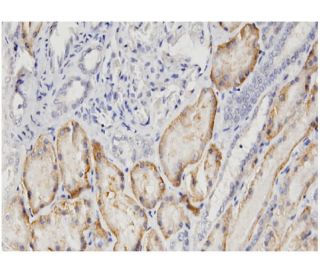


Anticorpo OAT1 (1F2): sc-293323
- OAT1 Antibody 1F2 è un monoclonale di topo IgG1 (kappa light chain) OAT1 antibody fornito in 100 µg/ml
- generato contro gli amminoacidi 451-550 di OAT1 di origine human
- raccomandato per il rilevamento di OAT1 di origine human in WB, IP, IF, IHC(P) e ELISA
- Al momento non abbiamo ancora completato l'identificazione dei reagenti secondari di rilevazione preferiti per OAT1 l'anticorpo (1F2). Questo lavoro è in corso.

LINK RAPIDI
L'anticorpo OAT1 (1F2) è un anticorpo monoclonale di topo IgG1 a catena leggera kappa che rileva la proteina OAT1 di origine umana mediante western blotting (WB), immunoprecipitazione (IP), immunofluorescenza (IF), immunoistochimica e saggio di immunoassorbimento enzimatico (ELISA). L'anticorpo anti-OAT1 (1F2) è disponibile in formato non coniugato. La proteina OAT1, nota anche come trasportatore di anioni organici 1, svolge un ruolo cruciale nell'escrezione renale di vari anioni organici endogeni ed esogeni, che è fondamentale per mantenere l'omeostasi metabolica e disintossicare le sostanze nocive nell'organismo. Questa proteina di 563 aminoacidi è localizzata prevalentemente sulla membrana basolaterale dei tubuli prossimali renali, dove OAT1 facilita il trasporto di anioni organici, come la benzilpenicillina e la cimetidina, contribuendo così all'eliminazione di composti potenzialmente tossici dal flusso sanguigno. OAT1 opera come scambiatore di anioni organici, accoppiando l'assorbimento di un anione organico con l'efflusso di un acido dicarbossilico endogeno, come l'α-chetoglutarato, che è essenziale per mantenere l'equilibrio di questi metaboliti nei reni. L'espressione di OAT1 è regolata attraverso lo splicing alternativo, con conseguente generazione di quattro isoforme distinte, che possono avere proprietà funzionali e meccanismi di regolazione diversi. L'anticorpo anti-OAT1 (1F2) è uno strumento prezioso per i ricercatori che studiano i ruoli fisiologici e patologici di OAT1 nella funzione renale e nel metabolismo dei farmaci.
Alexa Fluor® è un marchio registrato di Molecular Probes Inc., OR., USA
LI-COR® e Odyssey® sono marchi registrati di LI-COR Biosciences
Anticorpo OAT1 (1F2) Riferimenti:
- Clonazione molecolare e caratterizzazione di due nuovi trasportatori renali di anioni organici (hOAT1 e hOAT3). | Race, JE., et al. 1999. Biochem Biophys Res Commun. 255: 508-14. PMID: 10049739
- Struttura genomica ed espressione in vivo del gene Human Organic Anion Transporter 1 (hOAT1). | Bahn, A., et al. 2000. Biochem Biophys Res Commun. 275: 623-30. PMID: 10964714
- Isolamento di una famiglia di trasportatori di anioni organici da fegato e rene umani. | Sun, W., et al. 2001. Biochem Biophys Res Commun. 283: 417-22. PMID: 11327718
- Sovrapposizione delle specificità in vitro e in vivo dei trasportatori di anioni organici OAT1 e OAT3 per i diuretici dell'ansa e tiazidici. | Vallon, V., et al. 2008. Am J Physiol Renal Physiol. 294: F867-73. PMID: 18216144
- Analisi dei polimorfismi regolatori nei geni del trasportatore di ioni organici (SLC22A) nel rene. | Ogasawara, K., et al. 2008. J Hum Genet. 53: 607-614. PMID: 18414781
- Upregolazione dell'espressione dei trasportatori di anioni organici della corticale renale di ratto (OAT1 e OAT3) in risposta al danno da ischemia/riperfusione. | Zhang, R., et al. 2008. Am J Nephrol. 28: 772-83. PMID: 18441523
- Risposte adattive del trasportatore renale di anioni organici 3 (OAT3) durante la colestasi. | Chen, J., et al. 2008. Am J Physiol Renal Physiol. 295: F247-52. PMID: 18480179
- Interazione di imatinib con vettori ionici organici umani. | Hu, S., et al. 2008. Clin Cancer Res. 14: 3141-8. PMID: 18483382
- Clonazione del trasportatore di IPA del rene umano: stretta specificità di substrato e regolazione da parte della proteina chinasi C. | Lu, R., et al. 1999. Am J Physiol. 276: F295-303. PMID: 9950961
Informazioni ordini
| Nome del prodotto | Codice del prodotto | UNITÀ | Prezzo | Quantità | Preferiti | |
OAT1 Anticorpo (1F2) | sc-293323 | 100 µg/ml | $322.00 |