
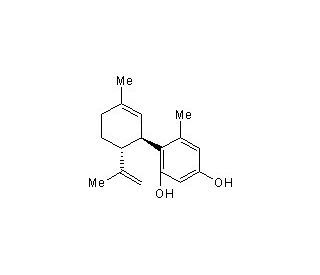

Estructura molecular de O-1602, Número CAS: 317321-41-8
O-1602 (CAS 317321-41-8)
Nombres Alternativos:
5-methyl-4-[(1R, 6R)-3-methyl-6-(1-methylethenyl)-2-cyclohexen-1-yl]-1,3-benzenediol
Solicitud:
O-1602 es un análogo del cannabidiol y activador del receptor GRP55
Número de CAS:
317321-41-8
Peso Molecular:
258.4
Fórmula Molecular:
C17H22O2
Información suplementaria:
Está clasificada como Mercancía peligrosa para el transporte y puede estar sujeta a gastos de envío adicionales.
Para Uso Exclusivo en Investigación. No está diseñado para uso en diagnosis o terapia.
* En el Certificado de Análisis específico de lote, puede encontrar información específica (como el contenido en agua).
ENLACES RÁPIDOS
Información sobre pedidos
Descripción
Información Técnica
Información de Seguridad
SDS & Certificado de Análisis
O-1602 (CAS 317321-41-8) Referencias
- Vasodilatación mesentérica inducida por cannabinoides a través de un sitio endotelial distinto de los receptores CB1 o CB2. | Járai, Z., et al. 1999. Proc Natl Acad Sci U S A. 96: 14136-41. PMID: 10570211
- El nuevo receptor endocannabinoide GPR55 es activado por los cannabinoides atípicos pero no media en sus efectos vasodilatadores. | Johns, DG., et al. 2007. Br J Pharmacol. 152: 825-31. PMID: 17704827
- El análogo anómalo del cannabidiol O-1602 reduce la nocicepción en un modelo de rata de artritis aguda a través del receptor cannabinoide putativo GPR55. | Schuelert, N. and McDougall, JJ. 2011. Neurosci Lett. 500: 72-6. PMID: 21683763
- El cannabinoide atípico O-1602 protege contra la colitis experimental e inhibe el reclutamiento de neutrófilos. | Schicho, R., et al. 2011. Inflamm Bowel Dis. 17: 1651-64. PMID: 21744421
- El cannabinoide atípico O-1602 estimula la ingesta de alimentos y la adiposidad en ratas. | Díaz-Arteaga, A., et al. 2012. Diabetes Obes Metab. 14: 234-43. PMID: 21981246
- El cannabinoide atípico O-1602 aumenta la sensibilización de la pata trasera en el modelo de lesión por constricción crónica del dolor neuropático. | Breen, C., et al. 2012. Neurosci Lett. 508: 119-22. PMID: 22227298
- El cannabinoide atípico O-1602: dianas, acciones y sistema nervioso central. | Ashton, JC. 2012. Cent Nerv Syst Agents Med Chem. 12: 233-9. PMID: 22831390
- Papel antiinflamatorio del cannabidiol y el O-1602 en la pancreatitis aguda inducida por ceruleína en ratones. | Li, K., et al. 2013. Pancreas. 42: 123-9. PMID: 22850623
- Papel del O-1602 y del receptor GPR55 acoplado a proteína G en el control de la motilidad colónica en ratones. | Li, K., et al. 2013. Neuropharmacology. 71: 255-63. PMID: 23603203
- Ligandos cannabinoides atípicos O-1602 y O-1918 administrados crónicamente en la obesidad inducida por dieta. | Simcocks, AC., et al. 2019. Endocr Connect. 8: 203-216. PMID: 30707678
- Actividad Antitumoral del Cannabidiol Anómalo y su Análogo O-1602 en Modelos Preclínicos de Cáncer de Mama Resistentes al Taxol. | Tomko, A., et al. 2019. Front Pharmacol. 10: 1124. PMID: 31611800
- O-1602, un Agonista de los Receptores Cannabinoides Atípicos GPR55, Revierte los Síntomas de Depresión y la Hiperactividad del Detrusor en Ratas Sometidas a Tratamiento con Corticosterona. | Wróbel, A., et al. 2020. Front Pharmacol. 11: 1002. PMID: 32733244
- O-1602 promueve la esteatosis hepática a través de la señalización de GPR55 y PI3 quinasa/Akt/SREBP-1c en ratones. | Kang, S., et al. 2021. Int J Mol Sci. 22: PMID: 33803038
Inhibidor de:
PLC β2.Activador de:
CNR1, GPR18, GPR55, y NAB2.Información sobre pedidos
| Nombre del producto | Número de catálogo | UNIDAD | Precio | CANTIDAD | Favoritos | |
O-1602, 1 mg | sc-202745 | 1 mg | $208.00 | |||
O-1602, 5 mg | sc-202745A | 5 mg | $416.00 |