
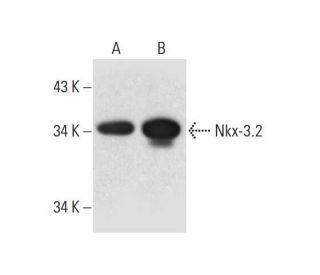
Not CRISPR data: the image illustrates antibody quality for visualizing CRISPR experiment results.
Not CRISPR data: the image illustrates antibody quality for visualizing CRISPR experiment results.
Nkx-3.2 CRISPR/Cas9 KO Plasmid (h): sc-406906
- Target species: human
- 20 µg of transfection-ready, purified plasmid DNA; Suitable for up to 20 transfections
- Nkx-3.2 CRISPR/Cas9 Knockout (KO) Plasmid (h) is a pool of plasmids, each encoding Cas9 nuclease and a target-specific 20 nt guide RNA (gRNA) designed for maximum knockout efficiency using sequences derived from the GeCKO v2 library
- gRNA sequences direct Cas9 to induce site-specific double-strand breaks (DSBs) in the Nkx-3.2 genomic locus, resulting in gene knockout through non-homologous end joining (NHEJ)
- The puromycin resistance and RFP genes are flanked by LoxP sites, enabling removal of selection markers via Cre recombinase (Cre Vector: sc-418923) after establishing stable knockout cell lines
- Following transfection, gene knockout efficiency can be assayed by WB, IF or IHC using antibody: Nkx-3.2 Antibody (H-4): sc-514166

Ordering Information
| Product Name | Catalog # | UNIT | Price | Qty | FAVORITES | |
Nkx-3.2 CRISPR/Cas9 KO Plasmid (h) | sc-406906 | 20 µg | $397.00 |
Overview
NKX3-2 encodes the homeobox transcription factor Nkx-3.2, a nuclear DNA-binding protein that regulates developmental gene expression programs, particularly those controlling chondrogenesis and axial skeletal patterning. Nkx-3.2 modulates lineage specification and differentiation by coordinating transcriptional networks downstream of morphogen signaling, including pathways linked to BMP and TGF-β family cues. Altered NKX3-2 activity has been associated with defects in cartilage and skeletal development and is frequently studied in the context of congenital skeletal dysplasias and craniofacial patterning mechanisms. In cell-based systems, NKX3-2 provides a tractable node for dissecting transcriptional control of mesenchymal differentiation and extracellular matrix gene regulation.
Nkx-3.2 CRISPR/Cas9 KO Plasmid (h) is a pool of plasmids designed for targeted disruption of the NKX3-2 gene in human cell lines. Each plasmid co-expresses a unique single guide RNA (sgRNA) targeting a distinct site within the NKX3-2 together with the Streptococcus pyogenes Cas9 nuclease. The plasmids also encode GFP, allowing fluorescent identification and enrichment of successfully transfected cells by fluorescence microscopy or flow cytometry.
The multi-guide design increases the likelihood of generating insertions or deletions (indels) that disrupt the NKX3-2 open reading frame following Cas9-mediated double-strand break formation. DNA breaks introduced by the CRISPR/Cas9 system are repaired through endogenous non-homologous end joining (NHEJ) pathways, frequently resulting in frameshift mutations that abolish Nkx-3.2 protein expression.
This CRISPR knockout system enables efficient generation of NKX3-2-deficient cell models for investigation of Nkx-3.2 signaling, functional genomics studies, cancer biology research, and evaluation of therapeutic responses in human cell lines.
Key Features
- sgRNAs targeting NKX3-2 exon(s) critical for Nkx-3.2 function
- Co-expression of SpCas9 and sgRNA from a single plasmid for simplified delivery
- GFP reporter for identification of transfected cells
- Pool of plasmids targeting multiple NKX3-2 genomic sites to improve knockout efficiency
- Compatible with delivery by transfection
Design Variants
CRISPRs +/- HDRs
- gRNAs encoded by Nkx-3.2 CRISPR/Cas9 KO Plasmid (h) and Nkx-3.2 CRISPR/Cas9 KO Plasmid (h2) target distinct sites within the NKX3-2 locus. One or both targeting designs may be available. See Related Products for availability.
- HDR donor constructs encoded by Nkx-3.2 HDR Plasmid (h) and Nkx-3.2 HDR Plasmid (h2) contain a puromycin resistance cassette and an RFP reporter flanked by NKX3-2 homology arms to support homology-directed repair at defined NKX3-2 target sites corresponding to the CRISPR/Cas9 KO designs. HDR donor availability may vary. See Related Products for availability.
For Research Use Only. Not Intended for Diagnostic or Therapeutic Use.