
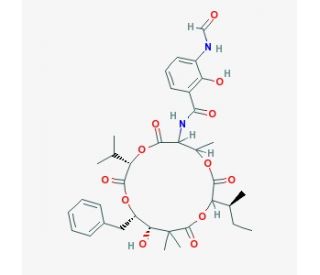

Neoantimycin (CAS 22862-63-1)
QUICK LINKS
Neoantimycin, identified by the CAS number 22862-63-1, is a member of the antimycin class of compounds, which are distinguished by their potent activity as inhibitors of mitochondrial complex III (ubiquinol-cytochrome c oxidoreductase) in the electron transport chain. This complex is critical for the mitochondrial process of oxidative phosphorylation, which is the primary pathway for ATP generation in eukaryotic cells. Neoantimycin exerts its effects by binding to the Qi site of cytochrome b, which is part of complex III. This binding interferes with the normal electron transfer from ubiquinol to cytochrome c, leading to a disruption in the proton gradient across the mitochondrial membrane and, consequently, a decrease in ATP synthesis. The inhibition also results in increased production of reactive oxygen species (ROS) as byproducts, which can induce oxidative stress in cells. In research, neoantimycin has been extensively used to study the biochemical and cellular effects of mitochondrial dysfunction. This includes investigations into how cells respond to decreased mitochondrial function and the role of ROS as signaling molecules. Additionally, neoantimycin serves as a tool in the study of apoptosis and other cell death pathways that are influenced by changes in cellular energy levels and oxidative stress, providing insights into disease mechanisms related to mitochondrial impairments.
Neoantimycin (CAS 22862-63-1) References
- Prunustatin A, a novel GRP78 molecular chaperone down-regulator isolated from Streptomyces violaceoniger. | Umeda, Y., et al. 2005. J Antibiot (Tokyo). 58: 206-9. PMID: 15895530
- Absolute structure of prunustatin A, a novel GRP78 molecular chaperone down-regulator. | Umeda, Y., et al. 2007. Org Lett. 9: 4239-42. PMID: 17887691
- Rare Streptomyces N-formyl amino-salicylamides inhibit oncogenic K-Ras. | Salim, AA., et al. 2014. Org Lett. 16: 5036-9. PMID: 25238489
- Biosynthesis of the 15-Membered Ring Depsipeptide Neoantimycin. | Skyrud, W., et al. 2018. ACS Chem Biol. 13: 1398-1406. PMID: 29693372
- Directed Accumulation of Anticancer Depsipeptides by Characterization of Neoantimycins Biosynthetic Pathway and an NADPH-Dependent Reductase. | Zhou, Y., et al. 2018. ACS Chem Biol. 13: 2153-2160. PMID: 29979567
- Reprogramming of the antimycin NRPS-PKS assembly lines inspired by gene evolution. | Awakawa, T., et al. 2018. Nat Commun. 9: 3534. PMID: 30166552
- A chromatogram-simplified Streptomyces albus host for heterologous production of natural products. | Fazal, A., et al. 2020. Antonie Van Leeuwenhoek. 113: 511-520. PMID: 31781915
- Biosynthesis of depsipeptides with a 3-hydroxybenzoate moiety and selective anticancer activities involves a chorismatase. | Shen, Y., et al. 2020. J Biol Chem. 295: 5509-5518. PMID: 32165500
- Biosynthesis of the 3,4-dihydroxy-2,2-dimethyl-5-phenylvaleric acid residue of neoantimycin. | Caglioti, L., et al. 1972. J Chem Soc Perkin 1. 9: 1235-7. PMID: 5064382
- The structure of neoantimycin. | Caglioti, L., et al. 1969. Tetrahedron. 25: 2193-221. PMID: 5788395
Ordering Information
| Product Name | Catalog # | UNIT | Price | Qty | FAVORITES | |
Neoantimycin, 500 µg | sc-202240 | 500 µg | $359.00 |