
Date published: 2026-4-20

1-800-457-3801

SCBT Portrait Logo
Seach Input

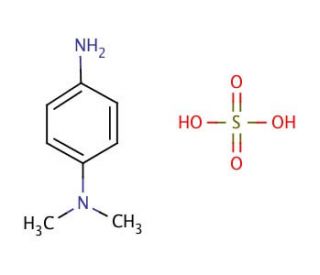
N,N-Dimethyl-p-phenylenediamine sulfate salt (CAS 536-47-0)

0.0(0)
Write a reviewAsk a question

Alternate Names:
4-Amino-N,N-dimethylaniline sulfate
CAS Number:
536-47-0
Purity:
≥98%
Molecular Weight:
234.27
Molecular Formula:
C8H12N2•H2SO4
Supplemental Information:
This is as a Dangerous Good for transport and may be subject to additional shipping charges.
For Research Use Only. Not Intended for Diagnostic or Therapeutic Use.
* Refer to Certificate of Analysis for lot specific data.

QUICK LINKS

N,N-Dimethyl-p-phenylenediamine sulfate salt (DMPD) holds a significant position as a widely utilized reagent in the realm of scientific research. This white crystalline powder serves as a sulfonating agent, finding extensive application across various laboratory experiments. N,N-Dimethyl-p-phenylenediamine sulfate salt′s versatility allows it to fulfill a wide range of roles, including synthesis, analysis, and biological experimentation. In the realm of scientific research, N,N-Dimethyl-p-phenylenediamine sulfate salt plays a vital role. Its application as a sulfonating agent enables the synthesis of diverse compounds, such as dyes and polymers. Furthermore, it finds utility in compound analysis, serving as a reliable detector of sulfonic acid groups. Within biological experimentation, N,N-Dimethyl-p-phenylenediamine sulfate salt proves invaluable in identifying specific enzymes and proteins. The key function of N,N-Dimethyl-p-phenylenediamine sulfate salt lies in its sulfonating properties, allowing it to react with other compounds and generate sulfonic acid groups. This reaction holds immense significance in synthesizing various compounds, as the sulfonic acid group can serve as a catalyst for subsequent reactions. Moreover, N,N-Dimethyl-p-phenylenediamine sulfate salt enables the detection of sulfonic acid groups within other compounds, further expanding its analytical capabilities.


N,N-Dimethyl-p-phenylenediamine sulfate salt (CAS 536-47-0) References

  1. Eukaryotic and prokaryotic contributions to colonic hydrogen sulfide synthesis.  |  Flannigan, KL., et al. 2011. Am J Physiol Gastrointest Liver Physiol. 301: G188-93. PMID: 21474649
  2. Hydrogen sulfide and resolution of acute inflammation: A comparative study utilizing a novel fluorescent probe.  |  Dufton, N., et al. 2012. Sci Rep. 2: 499. PMID: 22787557
  3. Beneficial effects of diminished production of hydrogen sulfide or carbon monoxide on hypertension and renal injury induced by NO withdrawal.  |  Wesseling, S., et al. 2015. Br J Pharmacol. 172: 1607-19. PMID: 24597655
  4. Geochemical production of reactive oxygen species from biogeochemically reduced Fe.  |  Murphy, SA., et al. 2014. Environ Sci Technol. 48: 3815-21. PMID: 24597860
  5. Fermentation couples Chloroflexi and sulfate-reducing bacteria to Cyanobacteria in hypersaline microbial mats.  |  Lee, JZ., et al. 2014. Front Microbiol. 5: 61. PMID: 24616716
  6. Estimation of bacterial hydrogen sulfide production in vitro.  |  Basic, A., et al. 2015. J Oral Microbiol. 7: 28166. PMID: 26130377
  7. Reduced Glutathione Mediates Resistance to H2S Toxicity in Oral Streptococci.  |  Ooi, XJ. and Tan, KS. 2016. Appl Environ Microbiol. 82: 2078-2085. PMID: 26801579
  8. New approaches to achieve high level enzyme production in Streptomyces lividans.  |  Sevillano, L., et al. 2016. Microb Cell Fact. 15: 28. PMID: 26846788
  9. Effects of Dietary Selenium on Inflammation and Hydrogen Sulfide in the Gastrointestinal Tract in Chickens.  |  Wu, C., et al. 2016. Biol Trace Elem Res. 174: 428-435. PMID: 27178167
  10. Expression and activity of hydrogen sulfide generating enzymes in murine macrophages stimulated with lipopolysaccharide and interferon-γ.  |  Bronowicka-Adamska, P., et al. 2019. Mol Biol Rep. 46: 2791-2798. PMID: 30859447
  11. Novel Applications of Lead Acetate and Flow Cytometry Methods for Detection of Sulfur-Containing Molecules.  |  Anishchenko, E., et al. 2019. Methods Protoc. 2: PMID: 31164595
  12. Hydrogen sulfide formation in experimental model of acute pancreatitis.  |  Bronowicka-Adamska, P., et al. 2019. Acta Biochim Pol. 66: 611-618. PMID: 31893496
  13. Nanoparticle-Enabled Combination Therapy Showed Superior Activity against Multi-Drug Resistant Bacterial Pathogens in Comparison to Free Drugs.  |  Brar, A., et al. 2022. Nanomaterials (Basel). 12: PMID: 35808015

Ordering Information

Product NameCatalog #UNITPriceQtyFAVORITES

N,N-Dimethyl-p-phenylenediamine sulfate salt, 25 g

sc-250513
25 g
$54.00
US: (Out of Stock: Availability January 20, 2026)