
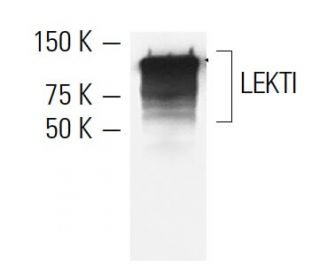


LEKTI Antibody (1C11G6): sc-32330
- LEKTI Antibody (1C11G6) is a mouse monoclonal IgG1, cited in 1 publications, provided at 200 µg/ml
- raised against recombinant LEKTI of human origin
- recommended for detection of precursor and mature LEKTI (specifically domains 1-6, 6-9, 9-12 and weakly with domains 13-15) of human origin by WB, IP and IF
- At present, we have not yet completed the identification of the preferred secondary detection reagent(s) for LEKTI Antibody (1C11G6). This work is in progress.

QUICK LINKS
SEE ALSO...
LEKTI Antibody (1C11G6) is a mouse monoclonal IgG1 antibody that detects Lympho-epithelial Kazal-type inhibitor (LEKTI) in human samples through applications such as western blotting (WB), immunoprecipitation (IP), and immunofluorescence (IF). LEKTI plays a crucial role as a serine protease inhibitor, providing essential protection to mucous epithelia against microbial invasion and inflammation, thereby maintaining the integrity of epithelial barriers. LEKTI is predominantly located in the granular and uppermost spinous layers of the epidermis, as well as in the differentiated layers of stratified epithelia, highlighting LEKTI′s importance in epithelial differentiation and function. LEKTI expression is vital for the proper functioning of the skin and mucosal surfaces, as LEKTI helps to regulate proteolytic activity and prevent tissue damage from pathogens. Notably, mutations in the SPINK5 gene, which encodes LEKTI, are linked to Netherton syndrome, a severe autosomal recessive disorder that manifests with symptoms such as atopic dermatitis and hay fever, underscoring LEKTI′s significance in human health. Anti-LEKTI antibody (1C11G6) is an invaluable tool for researchers studying epithelial biology and related disorders, providing insights into the mechanisms of protease inhibition and epithelial protection.
Alexa Fluor® is a trademark of Molecular Probes Inc., OR., USA
LI-COR® and Odyssey® are registered trademarks of LI-COR Biosciences
LEKTI Antibody (1C11G6) References:
- Biochemical features, molecular biology and clinical relevance of the human 15-domain serine proteinase inhibitor LEKTI. | Walden, M., et al. 2002. Biol Chem. 383: 1139-41. PMID: 12437098
- LEKTI proteolytic processing in human primary keratinocytes, tissue distribution and defective expression in Netherton syndrome. | Bitoun, E., et al. 2003. Hum Mol Genet. 12: 2417-30. PMID: 12915442
- LEKTI is localized in lamellar granules, separated from KLK5 and KLK7, and is secreted in the extracellular spaces of the superficial stratum granulosum. | Ishida-Yamamoto, A., et al. 2005. J Invest Dermatol. 124: 360-6. PMID: 15675955
- LEKTI domain 15 is a functional Kazal-type proteinase inhibitor. | Vitzithum, K., et al. 2008. Protein Expr Purif. 57: 45-56. PMID: 17936012
- LEKTI-1 in sickness and in health. | Roelandt, T., et al. 2009. Int J Cosmet Sci. 31: 247-54. PMID: 19467033
- rAAV2-mediated restoration of LEKTI in LEKTI-deficient cells from Netherton patients. | Roedl, D., et al. 2011. J Dermatol Sci. 61: 194-8. PMID: 21251800
- Proteolytic activation cascade of the Netherton syndrome-defective protein, LEKTI, in the epidermis: implications for skin homeostasis. | Fortugno, P., et al. 2011. J Invest Dermatol. 131: 2223-32. PMID: 21697885
- Netherton syndrome and its multifaceted defective protein LEKTI. | D'Alessio, M., et al. 2013. G Ital Dermatol Venereol. 148: 37-51. PMID: 23407075
- LEKTI domains D6, D7 and D8+9 serve as substrates for transglutaminase 1: implications for targeted therapy of Netherton syndrome. | Wiegmann, H., et al. 2019. Br J Dermatol. 181: 999-1008. PMID: 30801672
- LEKTI domain 6 displays anti-inflammatory action in vitro and in a murine atopic dermatitis model. | Canbolat, P., et al. 2024. J Dermatol Sci. 115: 13-20. PMID: 38849289
Ordering Information
| Product Name | Catalog # | UNIT | Price | Qty | FAVORITES | |
LEKTI Antibody (1C11G6) | sc-32330 | 200 µg/ml | $322.00 |