
Date published: 2026-2-17

1-800-457-3801

SCBT Portrait Logo
Seach Input

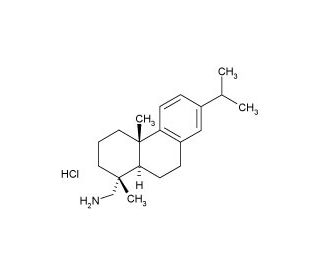
Leelamine HCl (CAS 1446-61-3)

0.0(0)
Write a reviewAsk a question

Alternate Names:
Dehydroabietylamine
Application:
Leelamine HCl is a weak CB1 receptor agonist and PDK inhibitor
CAS Number:
1446-61-3
Purity:
≥98%
Molecular Weight:
321.9
Molecular Formula:
C20H31N•HCl
Supplemental Information:
This is classified as a Dangerous Good for transport and may be subject to additional shipping charges.
For Research Use Only. Not Intended for Diagnostic or Therapeutic Use.
* Refer to Certificate of Analysis for lot specific data.

QUICK LINKS

Leelamine hydrochloride (HCl) is a synthetic derivative of leelamine, a naturally occurring compound found in the bark of pine trees. This chemical has garnered attention in the scientific community, primarily for its role in modulating various biochemical pathways in research settings. The primary mechanism of action of Leelamine HCl involves the disruption of cellular lipid metabolism. It specifically targets the homeostasis of cholesterol and other critical lipids, influencing their distribution and synthesis within cellular compartments. This unique mechanism has been leveraged in studies aimed at understanding lipid dynamics, particularly how cells regulate lipid stores and respond to disruptions in lipid metabolism. Furthermore, Leelamine HCl has been used in research to explore the signaling pathways that are influenced by changes in lipid metabolism. By altering lipid dynamics, Leelamine HCl can impact various signaling pathways, providing insights into the interconnected nature of metabolic and signaling networks. These studies are crucial for understanding the broader implications of lipid metabolism on cellular functions.


Leelamine HCl (CAS 1446-61-3) References

  1. Triterpene and diterpene inhibitors of pyruvate dehydrogenase kinase (PDK).  |  Aicher, TD., et al. 1999. Bioorg Med Chem Lett. 9: 2223-8. PMID: 10465550
  2. Presynaptic modulation by endocannabinoids.  |  Lovinger, DM. 2008. Handb Exp Pharmacol. 435-77. PMID: 18064422
  3. Pyruvate dehydrogenase kinase 4: regulation by thiazolidinediones and implication in glyceroneogenesis in adipose tissue.  |  Cadoudal, T., et al. 2008. Diabetes. 57: 2272-9. PMID: 18519799
  4. The green approaches for the synthesis of N-dehydroabietic alpha-aminophosphonates.  |  Rao, X., et al. 2008. Nat Prod Res. 22: 890-5. PMID: 18626824
  5. Tyrosine kinase inhibitory activity of dehydroabietylamine derivatives tested by homogeneous time-resolved fluorescence based high throughput screening model.  |  Zhou, TT., et al. 2013. Chin J Nat Med. 11: 506-13. PMID: 24359775
  6. Abietane-Type Diterpenoid Amides with Highly Potent and Selective Activity against Leishmania donovani and Trypanosoma cruzi.  |  Pirttimaa, M., et al. 2016. J Nat Prod. 79: 362-8. PMID: 26849852
  7. High anticancer potency on tumor cells of dehydroabietylamine Schiff-base derivatives and a copper(II) complex.  |  Zhao, F., et al. 2018. Eur J Med Chem. 146: 451-459. PMID: 29407970
  8. Synthesis and potential antineoplastic activity of dehydroabietylamine imidazole derivatives.  |  Zhao, F., et al. 2018. Medchemcomm. 9: 2091-2099. PMID: 30746067
  9. Dehydroabietylamine, A Diterpene from Carthamus tinctorious L. Showing Antibacterial and Anthelmintic Effects with Computational Evidence.  |  Sj, AR., et al. 2020. Curr Comput Aided Drug Des. 16: 231-237. PMID: 30827256
  10. Synthesis of novel, DNA binding heterocyclic dehydroabietylamine derivatives as potential antiproliferative and apoptosis-inducing agents.  |  Zhao, F., et al. 2020. Drug Deliv. 27: 216-227. PMID: 31984809
  11. Cytotoxic Dehydroabietylamine Derived Compounds.  |  Wiemann, J., et al. 2020. Anticancer Agents Med Chem. 20: 1756-1767. PMID: 32183684
  12. Synthesis and high antiproliferative activity of dehydroabietylamine pyridine derivatives in vitro and in vivo.  |  Zhao, F., et al. 2020. Biochem J. 477: 2383-2399. PMID: 32497169
  13. Exploration of multifunctional wood coating based on an interpenetrating network system of rosin-CO2-based polyurethane and mussel bionic rosin-based benzoxazine.  |  Piao, X., et al. 2022. J Mater Chem B. 10: 6939-6945. PMID: 36040715

Ordering Information

Product NameCatalog #UNITPriceQtyFAVORITES

Leelamine HCl, 10 mg

sc-200375
10 mg
$126.00

Leelamine HCl, 50 mg

sc-200375A
50 mg
$541.00