
Date published: 2026-3-17

1-800-457-3801

SCBT Portrait Logo
Seach Input

KLHDC4 Antibody (H-9): sc-398467

5.0(2)
Write a reviewAsk a question

Datasheets
  • KLHDC4 Antibody (H-9) is a mouse monoclonal IgG1 λ KLHDC4 antibody provided at 200 µg/ml
  • raised against amino acids 11-60 mapping near the N-terminus of KLHDC4 of mouse origin
  • KLHDC4 Antibody (H-9) is recommended for detection of KLHDC4 of mouse, rat and human origin by WB, IP, IF and ELISA
  • Anti-KLHDC4 Antibody (H-9) is available conjugated to agarose for IP; HRP for WB, IHC(P) and ELISA; and to either phycoerythrin or FITC for IF, IHC(P) and FCM
  • also available conjugated to Alexa Fluor® 488, Alexa Fluor® 546, Alexa Fluor® 594 or Alexa Fluor® 647 for WB (RGB), IF, IHC(P) and FCM, and for use with RGB fluorescent imaging systems, such as iBright™ FL1000, FluorChem™, Typhoon, Azure and other comparable systems
  • also available conjugated to Alexa Fluor® 680 or Alexa Fluor® 790 for WB (NIR), IF and FCM; for use with Near-Infrared (NIR) detection systems, such as LI-COR®Odyssey®, iBright™ FL1000, FluorChem™, Typhoon, Azure and other comparable systems
  • m-IgGλ BP-HRP (mouse IgGλ binding protein-HRP) is the preferred secondary detection reagent for KLHDC4 Antibody (H-9) for WB applications. This reagent is now offered in a bundle with KLHDC4 Antibody (H-9) (see ordering information below). For additional m-IgGλ BP conjugates see our complete list of Mouse IgG Binding Proteins.
    Crispr Promo Banner

    QUICK LINKS

    SEE ALSO...

    KLHDC4 Antibody (H-9) is a mouse monoclonal IgG1 antibody that detects KLHDC4 protein of mouse, rat, and human origin by western blotting (WB), immunoprecipitation (IP), immunofluorescence (IF), and enzyme-linked immunosorbent assay (ELISA). KLHDC4 (H-9) antibody is available in both non-conjugated and various conjugated forms, including agarose, horseradish peroxidase (HRP), phycoerythrin (PE), fluorescein isothiocyanate (FITC), and multiple Alexa Fluor® conjugates. KLHDC4, also known as kelch domain-containing protein 4, is a 520 amino acid protein characterized by six kelch repeats, which are crucial for protein-protein interactions and play a significant role in various cellular processes. KLHDC4 is primarily located in the cytoplasm, where KLHDC4 is involved in regulating cellular signaling pathways and maintaining cytoskeletal integrity. This cytoplasmic localization enables KLHDC4 to interact with other proteins, influencing cellular responses to stress and contributing to overall cell homeostasis. The gene encoding KLHDC4 is situated on human chromosome 16q24.2 and mouse chromosome 8 E1, a region associated with numerous genetic disorders, including those affecting the nervous system and immune response. Understanding KLHDC4 function and localization is essential for elucidating KLHDC4′s role in health and disease, making anti-KLHDC4 antibody (H-9) a valuable research tool.

    For Research Use Only. Not Intended for Diagnostic or Therapeutic Use.

    Alexa Fluor® is a trademark of Molecular Probes Inc., OR., USA

    LI-COR® and Odyssey® are registered trademarks of LI-COR Biosciences

    KLHDC4 Antibody (H-9) References:

    1. The kelch repeat superfamily of proteins: propellers of cell function.  |  Adams, J., et al. 2000. Trends Cell Biol. 10: 17-24. PMID: 10603472
    2. The gene encoding gigaxonin, a new member of the cytoskeletal BTB/kelch repeat family, is mutated in giant axonal neuropathy.  |  Bomont, P., et al. 2000. Nat Genet. 26: 370-4. PMID: 11062483
    3. Giant axonal neuropathy (GAN): case report and two novel mutations in the gigaxonin gene.  |  Kuhlenbäumer, G., et al. 2002. Neurology. 58: 1273-6. PMID: 11971098
    4. Genetics of inflammatory bowel disease: progress and prospects.  |  Mathew, CG. and Lewis, CM. 2004. Hum Mol Genet. 13 Spec No 1: R161-8. PMID: 14764625
    5. Advances in the genetics of inflammatory bowel disease.  |  Cho, JH. 2004. Curr Gastroenterol Rep. 6: 467-73. PMID: 15527676
    6. Combining protein-based IMAC, peptide-based IMAC, and MudPIT for efficient phosphoproteomic analysis.  |  Cantin, GT., et al. 2008. J Proteome Res. 7: 1346-51. PMID: 18220336
    7. The Rubinstein-Taybi syndrome: occurrence in two sets of identical twins.  |  Baraitser, M. and Preece, MA. 1983. Clin Genet. 23: 318-20. PMID: 6682729
    8. Rubinstein-Taybi syndrome caused by submicroscopic deletions within 16p13.3.  |  Breuning, MH., et al. 1993. Am J Hum Genet. 52: 249-54. PMID: 8430691

    Ordering Information

    Product NameCatalog #UNITPriceQtyFAVORITES

    KLHDC4 Antibody (H-9)

    sc-398467
    200 µg/ml
    $322.00

    KLHDC4 Antibody (H-9): m-IgGλ BP-HRP Bundle

    sc-524355
    200 µg Ab, 40 µg BP
    $361.00

    KLHDC4 Antibody (H-9) AC

    sc-398467 AC
    500 µg/ml, 25% agarose
    $424.00

    KLHDC4 Antibody (H-9) HRP

    sc-398467 HRP
    200 µg/ml
    $322.00

    KLHDC4 Antibody (H-9) FITC

    sc-398467 FITC
    200 µg/ml
    $336.00

    KLHDC4 Antibody (H-9) PE

    sc-398467 PE
    200 µg/ml
    $349.00

    KLHDC4 Antibody (H-9) Alexa Fluor® 488

    sc-398467 AF488
    200 µg/ml
    $364.00

    KLHDC4 Antibody (H-9) Alexa Fluor® 546

    sc-398467 AF546
    200 µg/ml
    $364.00

    KLHDC4 Antibody (H-9) Alexa Fluor® 594

    sc-398467 AF594
    200 µg/ml
    $364.00

    KLHDC4 Antibody (H-9) Alexa Fluor® 647

    sc-398467 AF647
    200 µg/ml
    $364.00

    KLHDC4 Antibody (H-9) Alexa Fluor® 680

    sc-398467 AF680
    200 µg/ml
    $364.00

    KLHDC4 Antibody (H-9) Alexa Fluor® 790

    sc-398467 AF790
    200 µg/ml
    $364.00

    I am using the LiCor/Odyssey system. Which secondary antibody do you recommend using with KLHDC4 (H-9): sc-398467 monoclonal antibody?

    Asked by: Germaine
    We recommend using one of our our exclusive Mouse IgG Binding Proteins (m-IgGλ) conjugated to CFL 680 or CFL 790. They are suitable for use with Near-Infrared (NIR) detection systems, such as LI-COR/Odyssey and other comparable systems. A complete list of available binding proteins is available on our website here: https://www.scbt.com/scbt/browse/support-products-mouse-igg-binding-proteins/_/N-ecrety
    Answered by: Technical Support
    Date published: 2017-02-27
    • y_2026, m_3, d_17, h_7CST
    • bvseo_bulk, prod_bvqa, vn_bulk_3.0.42
    • cp_1, bvpage1
    • co_hasquestionsanswers, tq_1
    • loc_en_US, sid_398467, prod, sort_[SortEntry(order=LAST_APPROVED_ANSWER_SUBMISSION_TIME, direction=DESCENDING)]
    • clientName_scbt
    • bvseo_sdk, java_sdk, bvseo-4.0.0
    • CLOUD, getContent, 100ms
    • QUESTIONS, PRODUCT
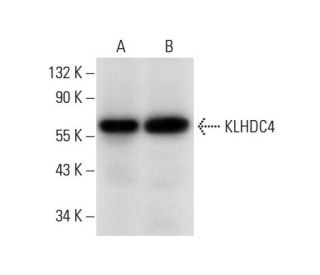
    Rated 5 out of 5 by from Good Western Blot data of KLHDC4 expression in nonGood Western Blot data of KLHDC4 expression in non-transfected and human KLHDC4 transfected 293T whole cell lysates. -SCBT QC
    Date published: 2015-01-21
    Rated 5 out of 5 by from Nice Western Blot data of KLHDC4 expressionNice Western Blot data of KLHDC4 expression in Jurkat and HeLa whole cell lysates. -SCBT QC
    Date published: 2014-10-31
    • y_2026, m_3, d_17, h_7
    • bvseo_bulk, prod_bvrr, vn_bulk_3.0.42
    • cp_1, bvpage1
    • co_hasreviews, tv_0, tr_2
    • loc_en_US, sid_398467, prod, sort_[SortEntry(order=SUBMISSION_TIME, direction=DESCENDING)]
    • clientName_scbt
    • bvseo_sdk, java_sdk, bvseo-4.0.0
    • CLOUD, getReviews, 18ms
    • REVIEWS, PRODUCT
    KLHDC4 Antibody (H-9) is rated 5.0 out of 5 by 2.
    • y_2026, m_3, d_17, h_7
    • bvseo_bulk, prod_bvrr, vn_bulk_3.0.42
    • cp_1, bvpage1
    • co_hasreviews, tv_0, tr_2
    • loc_en_US, sid_398467, prod, sort_[SortEntry(order=SUBMISSION_TIME, direction=DESCENDING)]
    • clientName_scbt
    • bvseo_sdk, java_sdk, bvseo-4.0.0
    • CLOUD, getAggregateRating, 108ms
    • REVIEWS, PRODUCT
