
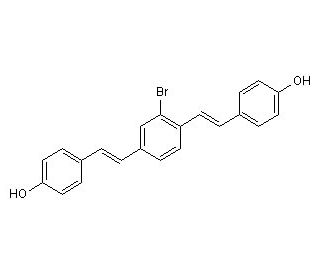

Molecular structure of K 114, CAS Number: 872201-12-2
K 114 (CAS 872201-12-2)
See product citations (1)
Alternate Names:
(trans,trans)-1-Bromo-2,5-bis-(4-hydroxy)styrylbenzene; K114
Application:
K 114 is a potent amyloid fibril-specific fluorescent dye
CAS Number:
872201-12-2
Purity:
≥98%
Molecular Weight:
393.27
Molecular Formula:
C22H17BrO2
For Research Use Only. Not Intended for Diagnostic or Therapeutic Use.
* Refer to Certificate of Analysis for lot specific data.
QUICK LINKS
Ordering Information
Product Citations
Description
Technical Information
Safety Information
SDS & Certificate of Analysis
A potent amyloid fibril-specific fluorescent dye (EC50 = 20 - 30 nM). Displays minimal fluorescence in aqueous buffers and fluoresces brightly in the presence of Aβ, α-synuclein and tau in situ. (Optimum wavelength = 550 nM).
K 114 (CAS 872201-12-2) References
- Effects of oxidative and nitrative challenges on alpha-synuclein fibrillogenesis involve distinct mechanisms of protein modifications. | Norris, EH., et al. 2003. J Biol Chem. 278: 27230-40. PMID: 12857790
- Role of alpha-synuclein carboxy-terminus on fibril formation in vitro. | Murray, IV., et al. 2003. Biochemistry. 42: 8530-40. PMID: 12859200
- A comparison of amyloid fibrillogenesis using the novel fluorescent compound K114. | Crystal, AS., et al. 2003. J Neurochem. 86: 1359-68. PMID: 12950445
- Mechanism of A beta(1-40) fibril-induced fluorescence of (trans,trans)-1-bromo-2,5-bis(4-hydroxystyryl)benzene (K114). | LeVine, H. 2005. Biochemistry. 44: 15937-43. PMID: 16313197
- A FRET sensor for non-invasive imaging of amyloid formation in vivo. | Kaminski Schierle, GS., et al. 2011. Chemphyschem. 12: 673-680. PMID: 21308945
- K114 inhibits A-beta aggregation and inflammation in vitro and in vivo in AD/Tg mice. | Zhang, YH., et al. 2014. Curr Alzheimer Res. 11: 299-308. PMID: 24552157
- K114 (trans, trans)-bromo-2,5-bis(4-hydroxystyryl)benzene is an efficient detector of cationic amyloid fibrils. | Selmani, V., et al. 2015. Protein Sci. 24: 420-5. PMID: 25524064
- Definition of a molecular pathway mediating α-synuclein neurotoxicity. | Burré, J., et al. 2015. J Neurosci. 35: 5221-32. PMID: 25834048
- A Non-imaging High Throughput Approach to Chemical Library Screening at the Unmodified Adenosine-A3 Receptor in Living Cells. | Arruda, MA., et al. 2017. Front Pharmacol. 8: 908. PMID: 29321740
- Identification of an ERK Inhibitor as a Therapeutic Drug Against Tau Aggregation in a New Cell-Based Assay. | Siano, G., et al. 2019. Front Cell Neurosci. 13: 386. PMID: 31496937
- Development of a Rapid in vivo Assay to Evaluate the Efficacy of IRE1-specific Inhibitors of the Unfolded Protein Response Using Medaka Fish. | Jin, B., et al. 2020. Cell Struct Funct. 45: 23-31. PMID: 31875595
- The Q336H MAPT Mutation Linked to Pick's Disease Leads to Increased Binding of Tau to the Microtubule Network via Altered Conformational and Phosphorylation Effects. | Siano, G., et al. 2020. Front Mol Neurosci. 13: 569395. PMID: 33343296
- Spectral photokinetic conversion of the fluorescent probes BSB and K114 for improved detection of amyloid assemblies. | Stepanchuk, AA., et al. 2021. J Biophotonics. 14: e202100203. PMID: 34499422
- Use of a stable and solvent-soluble variant of Amylo-Glo, Amylo-Glo+, for the high-contrast and resolution fluorescent localization of amyloid plaques in murine and human brain tissue sections. | Schmued, L. 2022. J Neurosci Methods. 365: 109381. PMID: 34662590
- Quantitative detection of grey and white matter amyloid pathology using a combination of K114 and CRANAD-3 fluorescence. | Stepanchuk, AA., et al. 2021. Neurobiol Dis. 161: 105540. PMID: 34751140
Substrate of:
α-synuclein, and Tau.Ordering Information
| Product Name | Catalog # | UNIT | Price | Qty | FAVORITES | |
K 114, 10 mg | sc-204027 | 10 mg | $157.00 | |||
K 114, 50 mg | sc-204027A | 50 mg | $630.00 |