
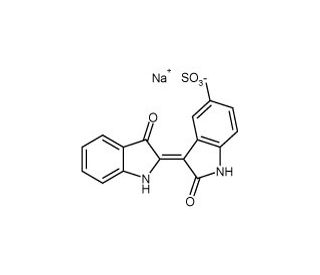

Indirubin-5-sulfonic acid sodium salt
QUICK LINKS
Indirubin-5-sulfonic acid sodium salt is a chemically synthesized derivative of indirubin, a natural compound that is part of the indigo dye family. This particular salt form enhances solubility in aqueous solutions, making it especially useful in various types of biochemical research. Indirubin derivatives have been extensively studied for their role as inhibitors of cyclin-dependent kinases (CDKs), which are critical regulators of cell cycle progression. By selectively modulating these enzymes, indirubin-5-sulfonic acid sodium salt serves as a valuable tool in the study of cellular processes related to cell division and growth. The mechanism of action of indirubin-5-sulfonic acid sodium salt involves the inhibition of CDK activity, which can induce a cell cycle arrest at the G1/S or G2/M transition phase. This property is leveraged in research focusing on the fundamental aspects of cell cycle regulation and its implications in cell physiology. Moreover, the compound′s impact on other kinases such as glycogen synthase kinase 3 (GSK-3) has also been explored, broadening its application in the study of signaling pathways that influence cellular metabolism, development, and apoptosis.
Indirubin-5-sulfonic acid sodium salt References
- Indirubin, the active constituent of a Chinese antileukaemia medicine, inhibits cyclin-dependent kinases. | Hoessel, R., et al. 1999. Nat Cell Biol. 1: 60-7. PMID: 10559866
- Indirubins inhibit glycogen synthase kinase-3 beta and CDK5/p25, two protein kinases involved in abnormal tau phosphorylation in Alzheimer's disease. A property common to most cyclin-dependent kinase inhibitors? | Leclerc, S., et al. 2001. J Biol Chem. 276: 251-60. PMID: 11013232
- Inhibition of cyclin-dependent kinase 1 (CDK1) by indirubin derivatives in human tumour cells. | Marko, D., et al. 2001. Br J Cancer. 84: 283-9. PMID: 11161389
- Inhibitor binding to active and inactive CDK2: the crystal structure of CDK2-cyclin A/indirubin-5-sulphonate. | Davies, TG., et al. 2001. Structure. 9: 389-97. PMID: 11377199
- From the insoluble dye indirubin towards highly active, soluble CDK2-inhibitors. | Jautelat, R., et al. 2005. Chembiochem. 6: 531-40. PMID: 15742375
- Inhibition of Toxoplasma gondii by indirubin and tryptanthrin analogs. | Krivogorsky, B., et al. 2008. Antimicrob Agents Chemother. 52: 4466-9. PMID: 18824607
- Identifying tumor cell growth inhibitors by combinatorial chemistry and zebrafish assays. | Xiang, J., et al. 2009. PLoS One. 4: e4361. PMID: 19194508
- Indirubin and Indirubin Derivatives for Counteracting Proliferative Diseases. | Blažević, T., et al. 2015. Evid Based Complement Alternat Med. 2015: 654098. PMID: 26457112
- Theoretical characterization and biological activity investigation of indirubins, cyclin dependent kinases inhibitors. | Adjir, K., et al. 2023. J Biomol Struct Dyn. 1-10. PMID: 38100566
- Portraying the selectivity of GSK-3 inhibitors towards CDK-2 by 3D similarity and molecular docking | Pacureanu, L., et al. 2019. Structural Chemistry. 30(3): 911-923.
Ordering Information
| Product Name | Catalog # | UNIT | Price | Qty | FAVORITES | |
Indirubin-5-sulfonic acid sodium salt, 1 mg | sc-221755 | 1 mg | $57.00 | |||
Indirubin-5-sulfonic acid sodium salt, 5 mg | sc-221755A | 5 mg | $324.00 |