
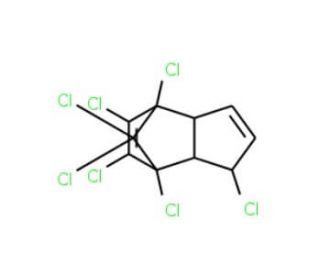

Heptachlor (CAS 76-44-8)
QUICK LINKS
Heptachlor is a chlorinated hydrocarbon that is used as a pesticide, herbicide, and insecticide in agricultural and industrial settings. It is a persistent organic pollutant (POP) and is considered to be a major environmental hazard. Heptachlor is employed in scientific research for a variety of purposes. It has been used to study the effects of chemicals on aquatic ecosystems, the effects of insecticides on insects, and the effects of herbicides on plants. It has also been used to study the metabolism and toxicology of chemicals, as well as to investigate the effects of chemicals on the nervous system. Heptachlor works by inhibiting the activity of an enzyme called acetylcholinesterase. This enzyme is responsible for breaking down acetylcholine, a neurotransmitter that is involved in the transmission of nerve impulses. When Heptachlor binds to the enzyme, the enzyme is unable to break down acetylcholine, leading to an accumulation of the neurotransmitter. This accumulation of acetylcholine leads to a variety of symptoms, including muscle twitching, seizures, and paralysis. Heptachlor has been linked to an increased risk of cancer, as well as reproductive and developmental problems. It can also cause damage to the liver, kidneys, and nervous system.
Heptachlor (CAS 76-44-8) References
- Perinatal heptachlor exposure increases expression of presynaptic dopaminergic markers in mouse striatum. | Caudle, WM., et al. 2005. Neurotoxicology. 26: 721-728. PMID: 16112329
- Genotoxicity of heptachlor and heptachlor epoxide in human TK6 lymphoblastoid cells. | Prado, G., et al. 2009. Mutat Res. 673: 87-91. PMID: 19146984
- Application of biological data in cancer risk estimations of chlordane and heptachlor. | Adeshina, F. and Todd, EL. 1991. Regul Toxicol Pharmacol. 14: 59-77. PMID: 1947246
- Metabolism of organochlorine pesticide heptachlor and its metabolite heptachlor epoxide by white rot fungi, belonging to genus Phlebia. | Xiao, P., et al. 2011. FEMS Microbiol Lett. 314: 140-6. PMID: 21087297
- Chlordane and heptachlor are metabolized enantioselectively by rat liver microsomes. | Kania-Korwel, I. and Lehmler, HJ. 2013. Environ Sci Technol. 47: 8913-22. PMID: 23799267
- Heptachlor induced mitochondria-mediated cell death via impairing electron transport chain complex III. | Hong, S., et al. 2013. Biochem Biophys Res Commun. 437: 632-6. PMID: 23867817
- Ecological toxicology and human health effects of heptachlor. | Fendick, EA., et al. 1990. Rev Environ Contam Toxicol. 111: 61-142. PMID: 2403688
- A method developed for determination of heptachlor and its metabolites from pork. | Zuo, HG., et al. 2014. Environ Monit Assess. 186: 2399-412. PMID: 24337977
- Heptachlor induced nigral dopaminergic neuronal loss and Parkinsonism-like movement deficits in mice. | Hong, S., et al. 2014. Exp Mol Med. 46: e80. PMID: 24577234
- Biodegradation of heptachlor and heptachlor epoxide-contaminated soils by white-rot fungal inocula. | Purnomo, AS., et al. 2014. Environ Sci Pollut Res Int. 21: 11305-12. PMID: 24840358
- Heptachlor degradation characteristics of a novel strain and its application. | Qiu, L., et al. 2018. Water Sci Technol. 77: 2113-2122. PMID: 29722697
- Heptachlor-induced epithelial to mesenchymal transition in HK-2 cells mediated via TGF-β1/Smad signalling. | Singh, N., et al. 2019. Hum Exp Toxicol. 38: 567-577. PMID: 30719927
- Carcinogenicity of heptachlor and heptachlor epoxide. | Reuber, MD. 1987. J Environ Pathol Toxicol Oncol. 7: 85-114. PMID: 3550042
- Heptachlor epoxide in marine mammals. | Kerkhoff, M., et al. 1981. Sci Total Environ. 19: 41-50. PMID: 6791283
- Inhibition of gap junctional intercellular communication in heptachlor- and heptachlor epoxide-treated normal human breast epithelial cells. | Nomata, K., et al. 1996. Cell Biol Toxicol. 12: 69-78. PMID: 8738476
Ordering Information
| Product Name | Catalog # | UNIT | Price | Qty | FAVORITES | |
Heptachlor, 100 mg | sc-338741 | 100 mg | $408.00 |