
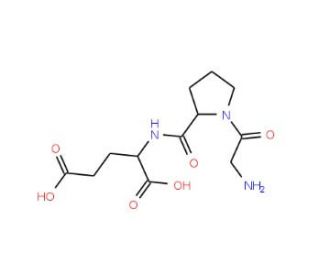

Gly-Pro-Glu (CAS 32302-76-4)
QUICK LINKS
Gly-Pro-Glu is a tripeptide that functions as a substrate for enzymes involved in the breakdown of proteins. It plays a role in the regulation of cellular processes by serving as a precursor for the synthesis of other bioactive peptides. Within the experimental context, Gly-Pro-Glu interacts with specific enzymes to modulate their activity, thereby influencing the degradation of proteins and the subsequent release of peptides. At the molecular level, this tripeptide binds to active sites on enzymes, altering their conformation and affecting their catalytic function. This interaction ultimately impacts the overall proteolytic activity within the cellular environment. By participating in these enzymatic processes, Gly-Pro-Glu contributes to the network of biochemical reactions that regulate protein turnover and cellular homeostasis. Its mechanism of action involves specific molecular interactions that influence the activity of key enzymes involved in protein degradation pathways.
Gly-Pro-Glu (CAS 32302-76-4) References
- Neuroprotective effects of Gly-Pro-Glu, the N-terminal tripeptide of IGF-1, in the hippocampus in vitro. | Saura, J., et al. 1999. Neuroreport. 10: 161-4. PMID: 10094155
- A three amino acid peptide, Gly-Pro-Arg, protects and rescues cell death induced by amyloid beta-peptide. | Ioudina, M. and Uemura, E. 2003. Exp Neurol. 184: 923-9. PMID: 14769384
- Gly-Pro-Glu protects beta-amyloid-induced somatostatin depletion in the rat cortex. | Aguado-Llera, D., et al. 2004. Neuroreport. 15: 1979-82. PMID: 15305149
- Analogues of the neuroprotective tripeptide Gly-Pro-Glu (GPE): synthesis and structure-activity relationships. | Alonso De Diego, SA., et al. 2005. Bioorg Med Chem Lett. 15: 2279-83. PMID: 15837309
- New Gly-Pro-Glu (GPE) analogues: expedite solid-phase synthesis and biological activity. | Alonso De Diego, SA., et al. 2006. Bioorg Med Chem Lett. 16: 1392-6. PMID: 16321525
- NNZ-2566: a Gly-Pro-Glu analogue with neuroprotective efficacy in a rat model of acute focal stroke. | Bickerdike, MJ., et al. 2009. J Neurol Sci. 278: 85-90. PMID: 19157421
- Molecular mechanism underlying the cerebral effect of Gly-Pro-Glu tripeptide bound to L-dopa in a Parkinson's animal model. | Minelli, A., et al. 2012. Amino Acids. 43: 1359-67. PMID: 22218995
- A comparison of the biological activity of the recombinant intact and truncated insulin-like growth factor 1 (IGF-1). | Carlsson-Skwirut, C., et al. 1989. Biochim Biophys Acta. 1011: 192-7. PMID: 2469478
- The IGF-derived tripeptide Gly-Pro-Glu is a weak NMDA receptor agonist. | Vaaga, CE., et al. 2014. J Neurophysiol. 112: 1241-5. PMID: 24944213
- Identification of Gly-Pro-Glu (GPE), the aminoterminal tripeptide of insulin-like growth factor 1 which is truncated in brain, as a novel neuroactive peptide. | Sara, VR., et al. 1989. Biochem Biophys Res Commun. 165: 766-71. PMID: 2574573
- GPE Promotes the Proliferation and Migration of Mouse Embryonic Neural Stem Cells and Their Progeny In Vitro. | Almengló, C., et al. 2017. Int J Mol Sci. 18: PMID: 28621713
- Effects of a Tripeptide on Mitogen-Activated Protein Kinase and Glycogen Synthase Kinase Activation in a Cell Line Derived from the Foetal Hippocampus of a Trisomy 16 Mouse: an Animal Model of Down Syndrome. | Arora, T., et al. 2020. Neurotox Res. 37: 714-723. PMID: 31802378
- Effects of IGF-1, truncated IGF-1 and the tripeptide Gly-Pro-Glu on acetylcholine release from parietal cortex of rat brain. | Nilsson-Håkansson, L., et al. 1993. Neuroreport. 4: 1111-4. PMID: 8219036
Ordering Information
| Product Name | Catalog # | UNIT | Price | Qty | FAVORITES | |
Gly-Pro-Glu, 10 mg | sc-252859 | 10 mg | $92.00 |