
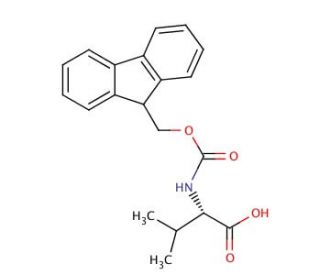

Fmoc-Val-OH 的分子结构, CAS编号: 68858-20-8
Fmoc-Val-OH (CAS 68858-20-8)
备用名:
Fmoc-L-valine
应用:
Fmoc-Val-OH 是一种受 Fmoc 保护的缬氨酸衍生物
CAS号码:
68858-20-8
分子量:
339.39
分子式:
C20H21NO4
仅供科研使用。不可用于诊断或治疗。
* 参考分析证明 大量特定数据 (包括水 含量).
快捷链接
订购信息
描述
技术信息
安全信息
安全技术说明书和分析证明书
Fmoc-Val-OH 是一种在肽合成中用作保护基的化合物。它用于阻断氨基酸的活性官能团,使肽链中的特定位点发生选择性反应。这种化合物附着在缬氨酸残基的氨基上,防止在肽组装过程中发生不必要的副反应。作为保护罩,Fmoc-Val-OH 能够精确控制合成肽的序列和结构。它的作用模式包括与氨基酸形成稳定的共价键,在脱保护步骤之前有效地掩盖氨基酸的反应性。这样就可以逐步延长肽链,确保达到所需的序列,而不受其他反应基团的干扰。
Fmoc-Val-OH (CAS 68858-20-8) 参考文献
- 基于 4-Aminoproline 的新型小分子环肽亚胺作为 α4β1 Integrin 的潜在调节剂。 | Sartori, A., et al. 2021. Molecules. 26: PMID: 34641610
- 通过自动固相掺入对 Cathepsin B 敏感的二肽连接体来设计可酶解的寡核苷酸。 | Jin, C., et al. 2022. Angew Chem Int Ed Engl. 61: e202114016. PMID: 34953094
- 优化组胺 H1 受体的多肽连接体荧光配体。 | Kok, ZY., et al. 2022. J Med Chem. 65: 8258-8288. PMID: 35734860
- 碳二亚胺介导的 Oxyma-B 贝克曼重排作为多肽合成中的副反应。 | Orlandin, A., et al. 2022. Molecules. 27: PMID: 35807480
- 针对丝氨酸蛋白酶的新型抑制剂和基于活性的探针。 | Ferguson, TEG., et al. 2022. Front Chem. 10: 1006618. PMID: 36247662
- 抗结核氨基脂肽 Trichoderin A 对葡萄糖饥饿条件下培养的人胰腺导管腺癌细胞具有选择性毒性。 | Kasim, JK., et al. 2023. Pharmaceutics. 15: PMID: 36678914
- 二丙胺用于 9-芴甲氧羰基 (Fmoc) 脱保护,减少固相肽合成中天冬酰亚胺的形成。 | Personne, H., et al. 2023. ACS Omega. 8: 5050-5056. PMID: 36777595
- 含有 GYK/MVK 可裂解连接体的 PSMA 靶向衍生物的合成与放射性标记。 | Murce, E., et al. 2023. R Soc Open Sci. 10: 220950. PMID: 36908985
- 含有 l-阿拉伯糖基化羟脯氨酸和硫酸化酪氨酸的糖肽的化学合成。 | van de Sande, JW. and Albada, B. 2023. Org Lett. 25: 1907-1911. PMID: 36917069
- 用交联透明质酸及其与 BMP 片段的共轭物涂覆碳纤维无纺布的方法。 | Magdziarz, S., et al. 2023. Polymers (Basel). 15: PMID: 36987331
- 含有疏水性氨基酸衍生物的 Rimonabant 类化合物作为大麻素受体亚型 1 配体。 | Dvorácskó, S., et al. 2023. ACS Med Chem Lett. 14: 479-486. PMID: 37077391
- 二丙二醇二甲醚--固相肽合成的新型绿色溶剂:提高治疗肽开发可持续性的进一步挑战。 | Vivenzio, G., et al. 2023. Pharmaceutics. 15: PMID: 37376220
- 通过单流三组分耦合方法实现快速, 无柱色谱的肽链延长。 | Sugisawa, N., et al. 2023. Chem Sci. 14: 6986-6991. PMID: 37389269
订购信息
| 产品名称 | 产品编号 | 规格 | 价格 | 数量 | 收藏夹 | |
Fmoc-Val-OH, 50 g | sc-235209 | 50 g | $104.00 |