
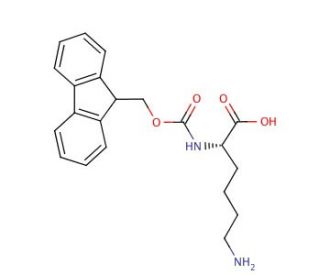

Fmoc-Lys-OH hydrochloride (CAS 139262-23-0)
ENLACES RÁPIDOS
Fmoc-Lys-OH hydrochloride es un reactivo altamente versátil y ampliamente utilizado en el ámbito de la síntesis orgánica. Este compuesto se deriva del aminoácido L-lisina, en el cual se encuentra unido un grupo fluorenilmetiloxicarbonilo (Fmoc) al grupo amino. Dentro del ámbito de la investigación científica, el Fmoc-Lys-OH hydrochloride encuentra una amplia utilización, especialmente en la síntesis de péptidos y proteínas. Su incorporación permite la modificación de las propiedades de péptidos y proteínas, facilitando la síntesis de moléculas complejas. Además, el Fmoc-Lys-OH hydrochloride desempeña un papel fundamental en la síntesis de diversos compuestos como moléculas pequeñas, polímeros y complejos metálicos. Como derivado de un aminoácido, Fmoc-Lys-OH hydrochloride opera en base a su capacidad para reaccionar con otras moléculas. Participa en la formación de enlaces peptídicos al reaccionar con otras moléculas y también puede participar en reacciones con grupos funcionales, como grupos carboxilo, lo que lleva a la creación de ésteres.
Fmoc-Lys-OH hydrochloride (CAS 139262-23-0) Referencias
- Grupo N-metil-fenaciloxicarbamidometilo (Pocam): un nuevo grupo protector tiol para la síntesis de péptidos en fase sólida y las reacciones de condensación peptídica. | Katayama, H., et al. 2011. Org Biomol Chem. 9: 4653-61. PMID: 21537511
- Marcaje sitio-específico de péptido sintético mediante la reacción quimioselectiva entre el N-metoxiaminoácido y el isotiocianato. | Hara, T., et al. 2015. J Pept Sci. 21: 765-9. PMID: 26358741
- La instalación específica de un análogo de succinil lisina en las histonas revela el efecto de la succinilación de H2BK34 sobre la dinámica de los nucleosomas. | Jing, Y., et al. 2018. Cell Chem Biol. 25: 166-174.e7. PMID: 29249693
- Nuevos Nanorods de Oro Dirigidos para el Tratamiento del Glioblastoma mediante Terapia Fotodinámica. | Youssef, Z., et al. 2019. J Clin Med. 8: PMID: 31847227
- Enlaces Cruzados ADN-Proteína Formados por Reacción de Lisina con Sitios Apurínicos/Apirimidínicos en ADN y Células Humanas: Análisis cuantitativo mediante cromatografía líquida-espectrometría de masas en tándem acoplada a dilución de isótopos estables. | Chan, W. and Jin, L. 2022. Anal Chem. 94: 803-810. PMID: 34971314
- Diseño de una Plataforma Dirigida e Independiente del Oxígeno para Mejorar la Terapia Fotodinámica: Una Prueba de Concepto. | Larue, L., et al. 2021. ACS Appl Bio Mater. 4: 1330-1339. PMID: 35014484
Información sobre pedidos
| Nombre del producto | Número de catálogo | UNIDAD | Precio | CANTIDAD | Favoritos | |
Fmoc-Lys-OH hydrochloride, 5 g | sc-228191 | 5 g | $138.00 |